Unit 4
Sorting and grouping
Sort things by a rule, then by two rules, and work out the rule someone else used.
Read
Which box does it go in?
Noor has a big pile of washing. Socks, shirts, towels, all mixed up. "Help me put it away!" says Amma.
Noor makes three piles: socks, shirts, towels. Now the washing is easy to put away, and easy to find.
Noor has just done something computers do all day. She sorted.
Sort, group and rule
To sort things is to put them into groups. Each group holds things that are alike in some way. The way you decide which group a thing goes in is the rule.
Rule: the idea you use to decide which group each thing goes in.
Noor's rule was "what kind of clothes is it?". A good rule is one that anyone can check. If two people use the same rule, they put every thing in the same group.
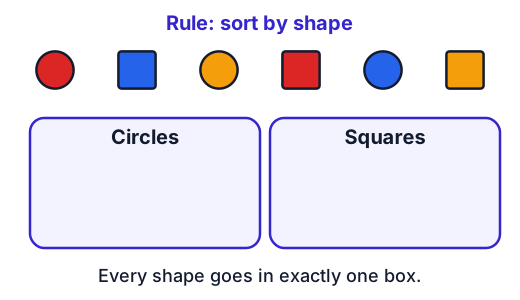
Notice: the shapes are different colours, but the rule was shape, so colour did not matter. Each shape goes in exactly one box.
The same pile, a different rule
You can sort the same pile in more than one way. Here is a pile of red and blue shapes:
- Rule colour: a red box and a blue box.
- Rule shape: a circle box and a square box.
Neither way is wrong. But start with one rule at a time. If you mix two rules in the same boxes ("red things" and "circles") some shapes fit two boxes and you get stuck! (The next part shows how to use two rules properly.)
Two rules at once
Sometimes one rule is not enough. If you want to find "the red circle" quickly, you can sort with two rules: first by colour, then by shape. That makes more boxes.
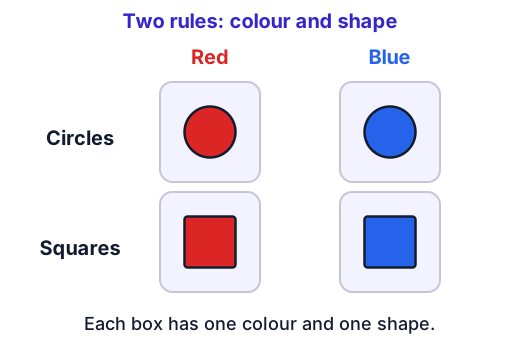
Example. Sort a small blue square.
- Rule one is colour. It is blue, so go to the blue column.
- Rule two is shape. It is a square, so go to the square row.
- It goes in the box where blue and square meet.
Two colours and two shapes make boxes. Three colours and two shapes would make 6 boxes.
Guess the rule
Here is a game. Look at what is in each group and work out the rule.
Group A: ant, bee, beetle. Group B: cat, dog, cow.
What is the rule? Ant, bee and beetle each have six legs. Cat, dog and cow each have four. The rule is number of legs.
Use these tips to guess:
- Look at everything in one group. What is the same?
- Check the other group. Is it different in that way?
- Test it with a new thing. Does the rule tell you which group it goes in?
Two things people get wrong
A rule must be something anyone can check. "Nice things" and "not nice things" is not a good rule, because people will not agree. "Has stripes" and "has no stripes" is a good rule.
Look at all of a group. Two things can match in a way that is not the rule. If a red circle and a red square are in the same group, the rule might be colour, not shape. Check every item.
Try it: Use Sorting machine. Sort by one rule, then two rules, then guess the rules.
Why computers sort
Computers sort all the time: your phone sorts your contacts by name, a shop's website sorts things by price, and a library sorts books by shelf. Sorting is how computers keep a lot of information in order so it is quick to find.
For the grown-up helping
Use real objects first: socks, spoons, buttons, leaves. Ask "How did you decide?" and "Could we sort it another way?" To practise guessing the rule, make two groups in secret and let your child look, then predict where a new item goes. Good rules at this age are colour, size, shape and number of legs or wheels. If your child says "I like these ones", help them find a rule someone else could check.
Lab
Sorting machine
Pick up a shape, then tap the box it belongs in. Sort by one rule, then by two rules. In the last missions the rule is a secret, so look at the groups and guess it.
Your goals
- Sort shapes by one rule (shape, then colour).
- Sort shapes by two rules at once, using four boxes.
- Work out a secret sorting rule from the examples in two groups, then use it on new shapes.
The interactive lab opens once you register. Register to do this.
Activity
Sort the sock drawer
Your child sorts a pile of everyday things by one rule, then by two rules, and then guesses your secret rule. About 20 minutes.
You'll need
- A pile of about 12 safe household things, such as clean socks, spoons, plastic bottle caps, large buttons or wooden blocks
- Paper plates or a few bowls to use as groups
- Paper and a pencil
Steps
- Tip the pile out. Ask your child to sort it into groups and say what the rule is. Write the rule on a paper label for each plate.
- Mix the pile and sort it a second way, using a different rule. Ask "Which things moved? Why?"
- Now sort by two rules at once, for example colour and size, using four plates. Write both rules on each plate.
- Swap. Secretly make two groups with your own rule and hide the rule. Your child looks and guesses the rule.
- Test the guess with a new thing from the pile. Does it go in the group the rule says?
- Ask "Can you think of a rule that would not work? Why not?" (For example, "things I like best".)
Safety
- Use only large, safe things. Nothing small enough to swallow if a younger child is nearby (bottle caps, buttons and coins are choking hazards for under-threes).
- No sharp things, no medicines or cleaning products, no glass.
Keeping a log of the activity is for registered learners. Register to do this.
Quick check
Sorting check
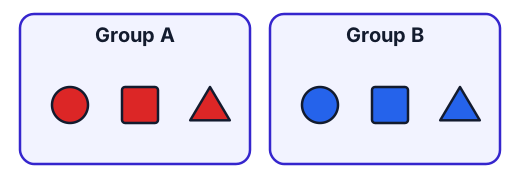
Seven questions about sorting by a rule. Look at the pictures carefully.
1.What is the sorting rule?
- Shape
- Colour
- Size
Choose one
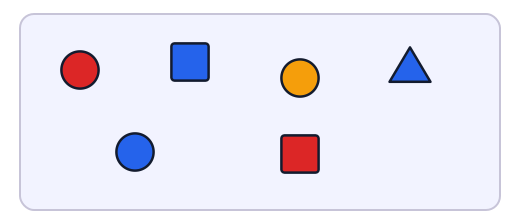
2.You sort these shapes by shape. How many shapes go in the circles group?
Answer with a number
3.How many of the shapes are both big and blue?
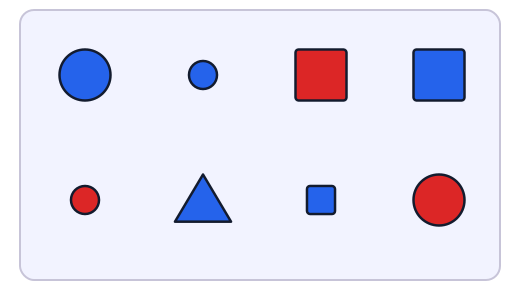
Answer with a number
4.What is the sorting rule this time?
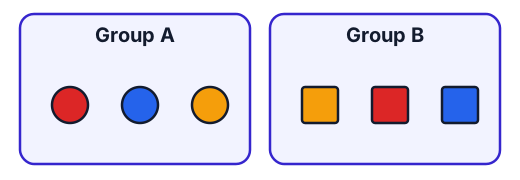
- Colour
- Size
- Shape
Choose one
5.You sort shapes by two rules, colour and then shape. The pile has a blue circle, a red square, a red circle and another blue circle. Which box ends up with two shapes in it?
- Red circles
- Red squares
- Blue circles
- Blue squares
Choose one
6.Which of these are good sorting rules for a pile of socks? Pick all that work. A good rule is one that anyone can check and get the same answer.
- Colour
- Nicest and not nice
- Has stripes or has no stripes
- Has a picture on it or has no picture
Choose all that apply
7.Sort these numbers from smallest to largest.
- 4
- 7
- 9
- 2
Put these in order
Answering and checking are for registered learners. Register to do this.
Quick check
New puzzles
Sorting in new places. Think about the rule.
1.Ravi has 10 pencils. 4 are red, 3 are blue and 3 are yellow. He sorts them by colour. How many pencils are in the groups that are not red?
Answer with a number
2.Group 1: ant, bee, beetle. Group 2: cat, dog, cow. What rule was used?
- The colour of the animal
- How many legs the animal has
- Where the animal lives
Choose one
3.Sana sorts buttons by two rules. Rule one is colour (red, blue or green). Rule two is the number of holes (2 holes or 4 holes). How many boxes does she need?
Answer with a number
4.Sort these animals from smallest to largest.
- Mouse
- Elephant
- Ant
- Cat
Put these in order
5.A computer sorts names in alphabetical order, A first. Mira, Arun, Zoya and Kofi are in the list. Which name comes first?
- Mira
- Arun
- Zoya
- Kofi
Choose one
Answering and checking are for registered learners. Register to do this.
Activity
Tell it back
Your child explains, in their own words, what a sorting rule is and why computers sort. Three minutes.
Steps
- Put a few mixed things in front of your child (for example a spoon, a fork, a red cup, a blue cup). Ask "How could we sort these? What is your rule?"
- Ask "What does a good rule look like?" and "Can you sort the same things another way?" Let your child answer without hints.
- Ask "Why do computers sort things?" Write down what your child says in their own words.
Keeping a log of the activity is for registered learners. Register to do this.
Like what you see?
Register for free to answer the quick checks, do the activities and save your work. Your work is saved on your device and syncs to your account.