Unit 1
Listening and retelling
Listen to a story, find who it is about, and tell it back in order.
Read
A story, from beginning to end
Grown-up: read this aloud slowly. Stop at the questions and let your child answer.
Close your eyes and get ready to listen. Here is a short story.
Tara and the mango seed
Tara was eating a sweet mango under the big tree behind her house. When she finished, she found a large, flat seed in her hand.
"What can I do with this?" she asked her grandmother.
"Plant it," said Grandmother. "Then wait."
So Tara dug a small hole in a pot. She pushed the seed in and covered it with soil. Every morning she gave it a little water. Every morning she looked. Nothing happened. Not on Monday. Not on Tuesday. Not for many days.
Tara sighed. But she kept watering.
Then one morning, something green was poking out of the soil. It was a tiny shoot, no bigger than her finger.
"Look, Grandmother!" Tara shouted. "It's growing!"
Tara smiled all day long.
Who is it about?
Every story is about someone. The someone is the character. In this story the main character is Tara. Her grandmother is a character too, but a smaller one. Things happen to Tara, and she does things too.
Try it: Who is the story about? Who else is in it?
What happened, in order?
A story is things happening in an order. If you mix up the order, it stops making sense. Imagine "a shoot came up" before "Tara planted the seed". That would be odd!
Every story has three parts.
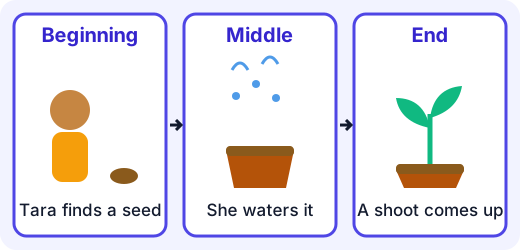
Part What it does In Tara's story Beginning Meets the character and starts the story Tara finds a seed Middle Something happens, often a problem or a wait She plants it and waters it, but nothing grows yet End How it turns out A green shoot comes up and Tara smiles 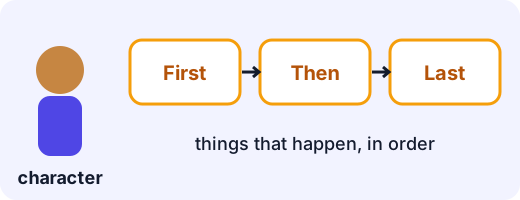
Retelling
To retell a story is to tell it again in your own words. You do not need the same words. You need the same things, in the same order.
Special little words help you keep the order: first, then, next, and last.
Example. Here is a retelling of Tara's story:
First, Tara found a seed. Then she planted it and watered it every day. Last, a green shoot came up.
It is short, it has the character, and it goes in order. That is a good retelling.
Try it: Tell Tara's story to a grown-up using first, then and last.
A common mix-up
Some children begin with the ending, because it is the exciting part: "A shoot came up!" That is fine for a happy shout, but a retelling starts at the beginning. Ask yourself: "What happened first?"
For the grown-up helping
Read with expression and pause so your child can picture it. Ask "who" and "what happened first?" rather than quizzing with many questions. If your child gets stuck while retelling, offer only the little word ("first...") or hold up one finger for each part. Mixing the order up or leaving out a part is normal at this age; practise with books and with the day just gone. Short and in order is better than long and tangled.
Activity
Story fingers
Read a short story aloud, then your child retells it with three pieces of paper for beginning, middle and end. About 15 minutes.
You'll need
- A short picture book or story you know (a Panchatantra tale, a Jataka tale or any bedtime story)
- Three pieces of paper or three small objects such as stones or spoons
Steps
- Read the story aloud once, slowly. Your child listens; no questions yet.
- Ask "Who is the story about?" and let your child answer.
- Lay out three pieces of paper in a row. Say "This is the beginning, this is the middle, this is the end."
- Ask your child to tell you what happened in each part. Point to each piece of paper as they tell it. Help only with "first", "then", "last".
- Swap roles. You retell the story but put the middle first. Does your child notice? Ask "Is that right? What should come first?"
- Try a second story, or retell something real, like how you got ready for the day.
Keeping a log of the activity is for registered learners. Register to do this.
Quick check
Ravi's kite
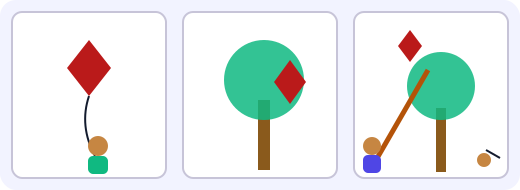
Listen to this story. A grown-up can read it aloud. Ravi had a red kite. First, the wind carried the kite up high and Ravi laughed. Then the string got caught in a tree and the kite would not come down. Ravi felt worried. Last, a neighbour reached it down with a long stick. Ravi ran home happy. Now answer the questions.
1.Who is the story about?
- Ravi
- The wind
- The tree
Choose one
2.Put these in the order they happened.
- The wind carried the kite up high
- A neighbour reached the kite down
- The kite got caught in a tree
Put these in order
3.Match each part of the story to what happens.
- Beginning
- Middle
- End
Match each to: The kite comes down and Ravi is happy · The kite gets stuck · Ravi's kite flies up
4.How did Ravi feel when the kite was stuck in the tree?
- Worried
- Sleepy
- Hungry
Choose one
5.Which retelling is in the right order?
- First the kite flew up. Then it got stuck in a tree. Last, a neighbour got it down.
- First a neighbour got the kite down. Then it flew up. Last, it got stuck.
- First the kite got stuck. Then Ravi was happy. Last, the kite flew up.
Choose one
6.Which little words help you tell a story in order?
- first
- red
- then
- last
Choose all that apply
Answering and checking are for registered learners. Register to do this.
Quick check
New puzzles
Stories are everywhere, even in your day. Can you use what you know?
1.Dev is retelling the story of the fox and the grapes. Three things happened. The fox saw sweet grapes high up. The fox jumped and jumped but could not reach them. The fox walked away. Which should Dev say first?
- The fox saw sweet grapes high up
- The fox walked away
- The fox jumped and jumped
Choose one
2.A story is about a bear who finds a beehive and is chased away by the bees. Who are the characters?
- The bear
- The bees
- The honey
- The tree branch
Choose all that apply
3.Tell the story of a day. Put these in order.
- I wake up
- I eat dinner
- I eat lunch
- I go to sleep
Put these in order
4.Every story is about someone. What do we call that someone? (It starts with c.)
Answer with a word or phrase
5.Mira tells a story. She says: Last, the boat reached the shore. First, the boat left the shore. What is wrong with it?
- The things are not told in the order they happened
- Stories cannot have boats
- Nothing is wrong
Choose one
Answering and checking are for registered learners. Register to do this.
Activity
Tell it back
Your child explains, in their own words, what makes a story a story. Two or three minutes.
Steps
- After a story or a cartoon your child enjoyed, ask "Who was it about?" and "What happened first? Then? Last?"
- Then ask "If I told it with the end first, would that be a good story? Why not?"
- Write down what your child says, in their words. Do not correct; ask "What else?" instead.
Keeping a log of the activity is for registered learners. Register to do this.
Like what you see?
Register for free to answer the quick checks, do the activities and save your work. Your work is saved on your device and syncs to your account.