Unit 2
Hearing the sounds in words
Listen inside words, split them into sounds, blend sounds back into words, and find rhymes.
Read
Listen inside the word
Grown-up: this unit is about listening, not letters. Say the sounds out loud together. Sounds are written between slashes, like /k/. Say the sound itself ("k"), not the letter name ("kay").
Let's play a game. I say a word very, very slowly.
"Mmmmmaaaap."
Did you hear it? Inside the word map are three little sounds: /m/, /a/ and /p/. You say them so fast that they squash together into one word. But they are all in there.
Words are made of sounds
A sound is a small piece of a word that you can hear. Words are built from sounds, a bit like a bead necklace is built from beads.
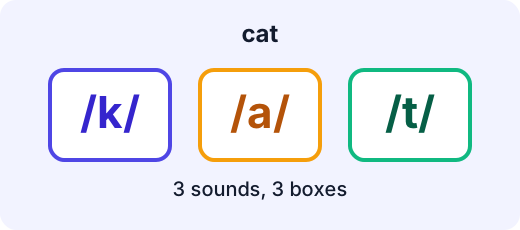
Look at the word cat. Say it slowly: /k/ ... /a/ ... /t/. That is three sounds. We can put one sound in each box.
Try it: Hold up a finger for each sound as you say dog slowly. How many fingers? (Three: /d/ /o/ /g/.)
Some words have two sounds, like bee: /b/ /ee/. Some have four, like stop: /s/ /t/ /o/ /p/.
Example. How many sounds in sun?
- Say it slowly: /s/ ... /u/ ... /n/.
- Count the sounds: 1, 2, 3.
- So sun has three sounds.
Counting sounds is not counting letters
This is the most important thing to know. We listen for sounds, not letters. The word ship has four letters, s-h-i-p. But it has three sounds: /sh/ /i/ /p/. The letters s and h work together to make one sound.
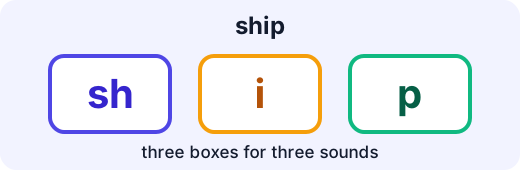
Later you will learn which letters make which sounds. For now, just use your ears.
Blending: putting sounds together
Blending is the opposite of splitting. I say the sounds, and you say the word.
I say: /s/ ... /u/ ... /n/. You say: sun!
Say the sounds slowly, then slide them closer, until they join up into a word. If you can blend sounds, you can read new words one day. That is why this is so important.
Rhymes
Two words rhyme when they sound the same at the end. Hat, cat and mat all end with the sound -at. They rhyme. Hot ends with -ot, so it does not rhyme with hat.
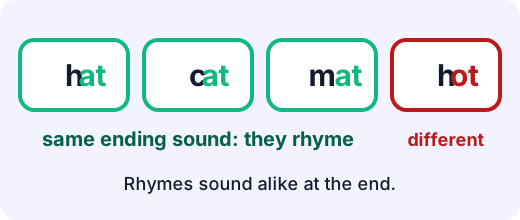
Rhyming is about how words sound, not how they are spelled. Me and knee rhyme, even though they look different.
Try it: Think of a word that rhymes with pin. Can you think of three? (win, fin, tin, bin, sin...) It is fine to say silly words like zin. Rhyming words do not have to be real words.
A common mix-up
"Is it four sounds in ship, because I counted four letters?" Count with your ears, not your eyes. Say the word slowly and notice how many times your mouth changes.
For the grown-up helping
Do these games in the car, at mealtimes and at bedtime, with no paper at all. Keep the sounds "clean": say /m/ not "muh", /s/ not "suh". Tap a finger, a clap or a step for each sound. Children often count letters, or hear only the first sound; that is normal and improves with play. Songs and rhyming books (nursery rhymes, "Chanda mama door ke") give lots of practice. If your child struggles to hear rhymes after a few weeks of play, mention it to their teacher.
Lab
Sound boxes
Play six word games. Split words into sound boxes, blend sounds into words, and find rhymes. A grown-up can read the words aloud.
Your goals
- Split two words by putting one box for each sound.
- Blend sounds into two words.
- Find the rhyme in two rounds.
The interactive lab opens once you register. Register to do this.
Activity
Sound games
Four short listening games with no paper needed (tap the sounds, robot talk, rhyme chain and odd one out). About 10 to 15 minutes.
You'll need
- Five small objects such as coins, stones or buttons
- Three household objects with short names (cup, pen, bag, spoon, ball, key)
Steps
- Tap the sounds. Say a short word, like "sun". Say it slowly together and push one coin forward for each sound (s, u, n). Count the coins: three. Do cat, dog, bus, and one longer one such as "stop" (four).
- Robot talk. Pick up an object, say its sounds like a robot with a tiny pause in between ("c-u-p"), and ask your child to say the word. Then swap: your child robot-talks a word and you guess it.
- Rhyme chain. Say a word, like "hat". Take turns saying words that rhyme (cat, mat, sat, bat). Silly made-up words are allowed. The chain ends when nobody can think of another.
- Odd one out. Say three words, such as "bed, red, car". Ask "Which one does not rhyme?" Try three more sets.
- Ask "Which game did you like best? Why?" and listen.
Keeping a log of the activity is for registered learners. Register to do this.
Quick check
Sounds check
Seven questions. Say each word slowly to yourself, or ask a grown-up to read it. Count sounds, not letters.
1.How many sounds are in the word "sun"?
Answer with a number
2.How many sounds are in the word "ship"?
Answer with a number
3.How many sounds are in the word "stop"?
Answer with a number
4.Blend these sounds into a word: /m/ /a/ /p/.
- map
- mop
- men
Choose one
5.Which word rhymes with "hat"?
- cat
- hot
- hen
Choose one
6.Which words rhyme with "pin"? Pick all that do.
- win
- fin
- pan
- pig
Choose all that apply
7.Put the sounds of "dig" in the order you say them.
- /g/
- /d/
- /i/
Put these in order
Answering and checking are for registered learners. Register to do this.
Quick check
New puzzles
These are tricky word games. Listen carefully.
1.Say "bat". Now say it again without the first sound, /b/. What is left? (Write the word.)
Answer with a word or phrase
2.Three of these words rhyme. Which one does not?
- bell
- well
- bed
- shell
Choose one
3.How many sounds are in the word "frog"?
Answer with a number
4.Do "knee" and "me" rhyme?
- Yes, they sound the same at the end
- No, they are spelled differently
Choose one
5.How many sounds are in the word "bee"?
Answer with a number
Answering and checking are for registered learners. Register to do this.
Activity
Tell it back
Your child shows and explains how words are made of sounds. Three minutes.
Steps
- Say "Pick any word you like and show me what is inside it." Let your child choose and say it slowly, tapping or counting the sounds.
- Ask "How many sounds? How do you know?" Then ask "Can you tell me a word that rhymes with it?"
- Ask "What is a sound? What are words made of?" Write down what your child says, in their words.
Keeping a log of the activity is for registered learners. Register to do this.
Like what you see?
Register for free to answer the quick checks, do the activities and save your work. Your work is saved on your device and syncs to your account.