Unit 10
Writing sentences
Write two or three sentences about something that happened, each with a capital letter and an end mark.
Read
One thought at a time
Grown-up: read this together. Your child can tell you ideas out loud first; writing comes after.
Maya went to the market on Sunday. When she got home she wrote about it. This is what she wrote:
went to the market bought mangoes saw a parrot
Can you read it? You can, but it is hard. There is no capital letter and no full stop, and you cannot tell where one idea stops and the next one starts. Here is the same news, written so it is easy to read:
I went to the market. I bought mangoes. I saw a parrot.
Now it is three clear sentences.
What is a sentence?
A sentence is one complete thought. It tells you who or what and what happens.
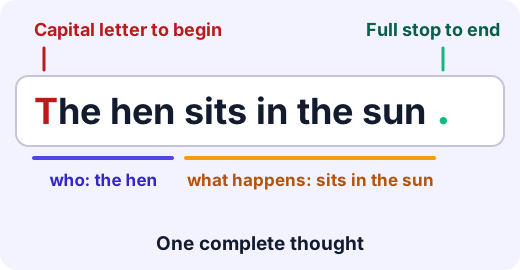
Every sentence has three signs:
- It starts with a capital letter.
- It makes sense by itself: it says who or what and what happens.
- It ends with a full stop (.), or with a question mark (?) if it asks something, or an exclamation mark (!) if it is excited.
Also leave a small finger space between words so they do not run together.
Is it a whole thought?
Read these. Which are whole thoughts?
Words A sentence? Why The dog barked. Yes It says who (the dog) and what happened (barked). The big brown dog No It says who, but nothing happens. ran to the shop No It says what happened, but not who. Aman ran to the shop. Yes Who and what happened. Example. Make "ran to the shop" into a sentence.
- What is missing? It does not say who.
- Add a who: "Aman".
- Start with a capital and end with a full stop: "Aman ran to the shop."
Names and the word I always use a capital letter, anywhere in a sentence.
Write about something that happened, in order
At this stage you often write about an event: something that happened. Tell it in the order it happened. Time words help.

- First, Rani put a seed in the soil.
- Next, she gave it water.
- Last, a green shoot came up.
Each line is its own sentence, with a capital letter at the start and a full stop at the end. Two or three sentences in the right order make a tiny story.
Plan, write, check
- Think. What happened? Say it out loud.
- Say your first sentence in your head. Hold it while you write.
- Write it. Capital letter, spaces between words, full stop at the end.
- Read it back. Does it make sense? Is anything missing?
- Do the same for the next thing, and then the last.
Try it: Tell a grown-up one thing that happened to you today. Count on your fingers: First... Next... Last... Then write three sentences. Check each one: capital, whole thought, full stop.
Common mix-ups
Running on. Do not write "I went to the park I played on the swing I had fun" with no stops. Stop after each whole thought.
Capital letters in the middle. Only names, the word I, and the first letter of a sentence get a capital letter. "I saw A parrot" is wrong.
Out of order. "I ate lunch. I went to the park. I woke up." That mixes up the order. Think about what happened first.
For the grown-up helping
Let your child say the sentence out loud before writing it, and say it again as they write. Do not correct every spelling mistake; focus on the three signs: a capital letter, a whole thought, and a full stop. Use the "tell it first, then write it" routine. If your child gets tired, they can tell you the next sentence and you write it. Praise what is right ("I can see your capital letter!").
Lab
Sentence workshop
Build sentences from word tiles, fix sentences with a missing capital letter or end mark, and put three sentences in the order they happened. A grown-up can read the words with you.
Your goals
- Build three sentences from word tiles.
- Fix three sentences by adding a capital letter and an end mark.
- Put three sentences of a story in the right order.
The interactive lab opens once you register. Register to do this.
Activity
Three sentences about my day
Your child tells you about something that happened, then writes two or three sentences about it in order. About 20 minutes.
You'll need
- Paper with lines
- A pencil and an eraser
- A coloured pencil or crayon
Steps
- Choose one thing that happened today or this week, such as a walk, a meal, a visit or a game. Your child tells it to you out loud.
- Ask 'What happened first? What happened next? What happened last?' Count the answers on your fingers.
- Your child says the first sentence aloud, then writes it. Remind them: capital letter at the start, a small finger space between words, and a full stop at the end.
- Do the same for the next sentence, then for the last one if there is time. Start each sentence on a new line or leave a gap.
- Read it back together. Ask 'Does each sentence make sense by itself? Is the order right?' Fix anything that does not.
- With a coloured pencil, your child circles every capital letter at the start of a sentence and every full stop.
- Draw a picture to go with the sentences.
Safety
- Use pencils only and keep the eraser out of small mouths.
- If writing is tiring, your child can tell the third sentence and you write it down for them.
Keeping a log of the activity is for registered learners. Register to do this.
Quick check
Writing sentences check
Seven questions. Read each sentence carefully, then choose.
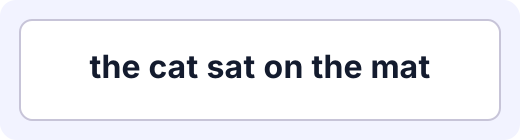
1.What does this sentence need?
- Nothing, it is perfect
- A capital letter at the start and a full stop at the end
- A question mark at the end only
Choose one
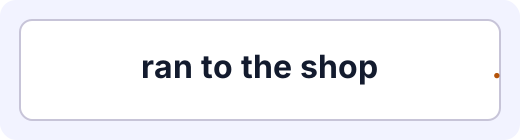
2.Is this a whole sentence?
- Yes
- No, it does not say who ran
- No, it has no full stop
Choose one
3.Which one is a sentence?
- The dog barked.
- The big dog
- In the garden
Choose one
4.Put the words in order to make a sentence.
- Asha
- a
- rides
- bike.
- red
Put these in order
5.Put these sentences in the order they happened.
- First, Dev got out of bed.
- Last, he walked to school.
- Next, he brushed his teeth.
Put these in order
6.Which sentences are written correctly?
- Dev has a kite.
- dev has a kite.
- Dev has a kite
- We ran home.
Choose all that apply
7.Which mark ends this sentence?
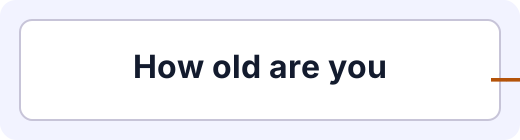
- A full stop
- A question mark
- A comma
Choose one
Answering and checking are for registered learners. Register to do this.
Quick check
New puzzles
Use what you know about sentences on new writing.
1.Which one is written correctly?
- Toby has a sore foot he cannot play.
- Toby has a sore foot. He cannot play.
- toby has a sore foot. he cannot play.
Choose one
2.How many sentences are there? "Pia woke up. She ate rice. Then she ran to school."
Answer with a number
3.Put these sentences in the order they happened.
- Last, she cooked the roti.
- First, Gita mixed the dough.
- Next, she rolled it flat.
Put these in order
4.Which mark ends this sentence? What is your name
- A full stop
- A question mark
- An exclamation mark
Choose one
5.Which one is NOT a whole thought?
- Meera has a pet cat.
- Under the table.
- We ate rice.
Choose one
Answering and checking are for registered learners. Register to do this.
Activity
Tell it back
Your child explains what a sentence is and how to know if they have written one. Three minutes.
Steps
- Write 'the big red kite' and 'Dev flew the kite.' Ask 'Which one is a whole sentence? How do you know?'
- Ask 'What three things should a sentence have?' Give a hint if needed: how it starts, how it ends, what it says.
- Ask 'What would you add to the first one to make it a sentence?' Write down what your child says, in their words.
Keeping a log of the activity is for registered learners. Register to do this.
Like what you see?
Register for free to answer the quick checks, do the activities and save your work. Your work is saved on your device and syncs to your account.