Unit 2
Reading fluently
Read a passage aloud so it sounds like talking, and fix your own mistakes as you go.
Read
Reading that sounds like talking
Listen to two children read the same sentence.
Child one: "The. Dog. Ran. To. The. Gate." Each word comes out alone, like beads on a string with no string.
Child two: "The dog ran to the gate." The words flow, the way you would say it to a friend.
Both children read every word correctly. But only the second one is fluent. Fluent reading sounds like talking.
Three parts of fluent reading
1. Accurate. You read the words that are really on the page, not words you guessed. If the page says shed and you read shop, the story changes.
2. A good pace. Pace is how fast you read. A good pace is the speed you would talk at when you are telling someone something: not slow and stuck, and not a race. Racing is not fluent. If you rush, you miss words and nobody can follow you.
3. Expression. Your voice goes up, goes down, rests and gets excited at the right places.
Read in phrases
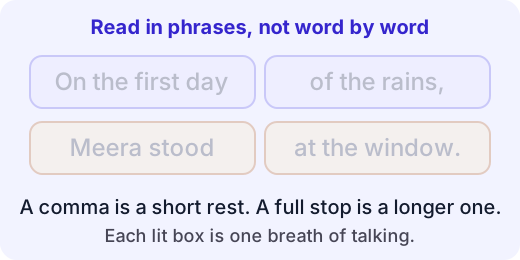
When you talk, you do not say one word at a time. You say little groups of words in one breath. These groups are called phrases.
On the first day | of the rains, | Meera stood | at the window.
Your eyes can look ahead to the next phrase while your mouth says the one you are on. That is the secret of smooth reading.
Let the marks tell your voice
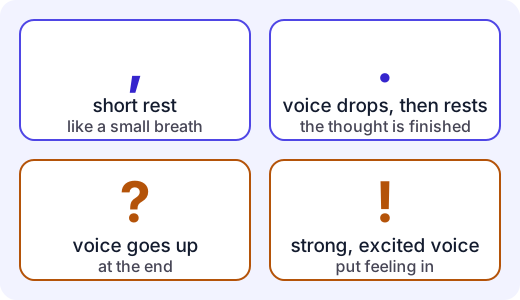
Writers put marks on the page to show you how the voice should go.
Example. Read this with the marks:
"Can we go out?" she asked. "Yes! Take your umbrella, and mind the puddles."
- "Can we go out?" The voice goes up at the question mark.
- "Yes!" The voice is bright and strong.
- "Take your umbrella," a tiny rest at the comma.
- "and mind the puddles." The voice comes down and rests at the full stop.
A mistake? Catch it!
Every reader makes mistakes, even grown-ups. A good reader notices and fixes it. This is called self-correcting.
Suppose the page says: The cat sat on the mat. You read: "The cat sat on the map..." Then you stop. That doesn't make sense! You go back: "...the mat." And you carry on.
Here is how:
- Notice. Something sounds wrong, or does not make sense, or does not match the letters.
- Go back a few words (not all the way to the start).
- Look closely at the word. Use your parts and your letter sounds.
- Read it again and carry on.
Self-correcting is a sign of a strong reader. It means you are listening to yourself.
How to get smoother
- Read it again. The second time, and the third time, are smoother, because you know the words. Re-reading is how every musician practises.
- Read to someone: a grandparent, a sister, a pet or a soft toy.
- Read in phrases. Put a pencil slash between phrases, then read it with a slash in your mind.
- Match the marks. Look at the commas, full stops and question marks before you start.
Be careful!
- Fast is not the same as fluent. If you skip words, you are not accurate.
- Slow is fine at first. A careful reader who gets every word right is on the way. Smoothness comes with practice.
- Reading in a flat voice is not wrong, but it is not yet talking. Try putting a little feeling in.
Try it: Read this passage aloud. Then read it again, smoother.
On the first day of the rains, Meera stood at the window. Drops tapped the roof. Tap, tap, tap. Soon the tapping grew louder, and the whole street sounded like a drum.
For the grown-up helping
Listen more than you correct. If your child makes a mistake, wait a few seconds: they may fix it themselves, and that is the best result. If they do not, point to the word and ask "Does that look right?". Praise self-correcting out loud ("You noticed that!"). Read the same short passage two or three days in a row. Taking turns, you read a page and then your child reads a page, so they hear what smooth sounds like.
Activity
Read it three times
Your child practises one short passage three times, and you record the last reading. About 15 minutes. Use a phone, tablet or voice recorder if you have one.
You'll need
- The passage below, written or printed large, or any page of a story book your child can read with a few stumbles
- A pencil
- A phone or recorder (optional)
Steps
- Use this passage, or a similar one from a favourite book: 'On the first day of the rains, Meera stood at the window. Drops tapped the roof. Tap, tap, tap. Soon the tapping grew louder, and the whole street sounded like a drum. Can we go out? she asked her grandmother. Take your umbrella, said Nani, smiling. And mind the puddles!'
- First reading: your child reads it aloud at their own pace. Do not interrupt. If they get stuck, wait. If a word stays stuck after a few seconds, say it quietly and move on. Make a tiny pencil dot under any word that was hard.
- Look at the dotted words together. Split any long ones into parts. Look at the commas, the full stops, the question mark and the exclamation mark. Ask 'How will your voice sound here?'
- Second reading: your child reads it again. Ask them to read it like they are telling the story to a friend. Take turns if they like: you read one sentence, they read the next.
- Third reading: record it if you can. Your child reads the whole passage as smoothly as they can. Afterwards ask 'Where did you notice a mistake and fix it?' and 'What part sounded most like talking?'
- Listen to the recording together. Praise one thing that was good, for example a self-correction, a voice that went up at the question, or a smooth phrase.
Safety
- Keep the recording private and only keep it if your child is happy to. Delete it whenever they ask.
Keeping a log of the activity is for registered learners. Register to do this.
Quick check
Fluent reading check
Six questions about reading so that it sounds like talking.
1.The page says: The cat sat on the mat. Sana reads: The cat sat on the map. She stops, says mat, and goes on. What did Sana do?
- She noticed a mistake and fixed it
- She skipped a word
- She gave up
Choose one
2.Which reader sounds most like talking?
- One who says each word alone, with a stop after every word
- One who reads in phrases and rests at full stops
- One who reads as fast as possible without stopping
Choose one
3.Match each mark to what your voice does.
- comma ,
- full stop .
- question mark ?
Match each to: voice drops and rests · voice goes up · a short rest
4.Which things help you read more smoothly?
- Read the same passage again
- Read aloud to a friend or a pet
- Race through it to see how fast you can go
- Read in phrases
Choose all that apply
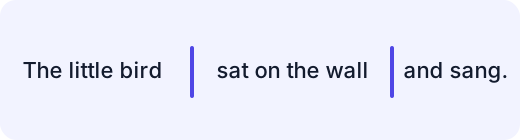
5.The bars show where the phrases end. How many phrases are in this sentence?
Answer with a number
6.Dev reads very fast, but he skips the small words and changes some of the big ones. Is Dev reading fluently?
- Yes, because he is fast
- No, because fluent reading needs to be accurate too
Choose one
Answering and checking are for registered learners. Register to do this.
Quick check
New puzzles
Use what you know about fluent reading in new places.
1.You read this question aloud: Is this my shoe? What does your voice do at the end?
- It goes up
- It drops down and rests
- It stays the same
Choose one
2.Which way of reading this sentence is the most like talking?
- After school | we played | in the park.
- After | school we | played in the | park.
- After | school | we | played | in | the | park.
Choose one
3.The page says: The bird flew into the tree. Anil reads: The bird flew into the nest. He stops, frowns, goes back to The bird and reads it again. Why did he stop?
- He noticed the word did not match the letters on the page
- He was bored
- He had finished the page
Choose one
4.Layla reads a passage three times. The third time is the smoothest. Why?
- She knows the words better, so she can read in phrases
- It is luck
- The passage got shorter
Choose one
5.A character shouts: We won the match! How should your voice sound?
- Strong and excited
- Quiet and sleepy
- Slow and sad
Choose one
Answering and checking are for registered learners. Register to do this.
Activity
Tell it back
Your child explains what makes reading sound like talking. Three minutes.
Steps
- Ask your child to read one sentence in a flat, word-by-word voice, and then in a talking voice. Ask 'What is different?'
- Ask 'What do you do when you read a word wrong and notice?' Let them answer in their own words.
- Ask 'What would you tell a friend who reads very fast and misses words?' Write down what your child says.
Keeping a log of the activity is for registered learners. Register to do this.
Like what you see?
Register for free to answer the quick checks, do the activities and save your work. Your work is saved on your device and syncs to your account.