Unit 3
Working out new words
Use the sentence around a new word and the pictures to guess what it means, then check your guess in a picture dictionary.
Read
Be a word detective
Priya is reading a story in bed. She comes to this sentence.
The kitten was timid. It hid under the bed whenever the door banged.
She stops. Timid? She has never seen that word before.
Priya could put down the book. Or she could be a word detective. A detective does not give up when something is missing. A detective looks for clues.
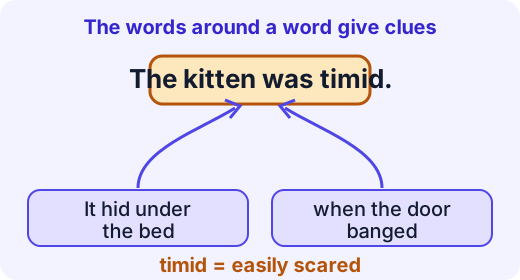
What are the clues? The kitten hid under the bed. It did that when the door banged. Who hides when there is a loud noise? Someone who is easily scared. So timid must mean easily scared.
That is the big idea: the words around a word give clues.
Where to look for clues
- The same sentence. "We were famished. We ate three rotis each." Eating three rotis is a clue: famished means very hungry.
- The sentence before or after. The clue might be next door, like the sentence about the door above.
- The picture. A picture shows what the word is about.
- "Not" and "but" words. "Ravi is not shy. He is sociable: he talks to everyone." Not shy, talks to everyone, so sociable means friendly and likes being with people.
- A small explanation. Sometimes the writer tells you: "The brook was a small stream, so we jumped across."
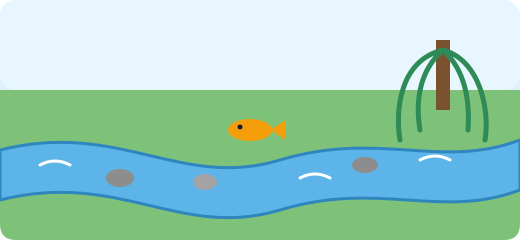
A picture of a stream next to the word brook would be a big clue, too.
Five steps for a new word
- Read the whole sentence, and the one next to it.
- Look for clues: other words, the picture, "not" and "but" words.
- Guess what the word means.
- Try it. Put your guess in place of the word. Does the sentence still make sense?
- Check in a picture dictionary.
Example. "It was a gloomy day. Dark clouds hid the sun, and everyone felt sad."
- Read: the whole sentence, plus what comes next.
- Clues: "dark clouds hid the sun", "everyone felt sad".
- Guess: gloomy means dark and sad.
- Try it: "It was a dark and sad day." That makes sense!
- Check: the picture dictionary says gloomy: dark and sad, with little hope or cheer. Matches!
The picture dictionary
A picture dictionary lists words in ABC order. For each word you get a small picture, what it means and an example sentence.
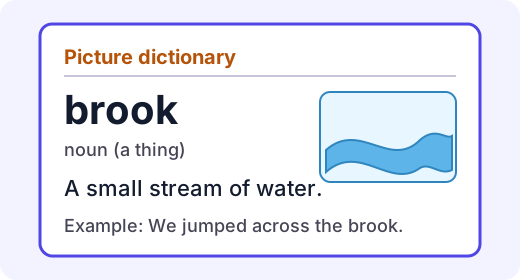
Use it to check your guess. If your guess was close, good. If it was wrong, that is fine too. A detective changes the idea when the evidence is different.
Be careful!
- Your first guess can be wrong. Always try it in the sentence and check.
- Sometimes there are no clues. If the sentence gives you nothing, look at the next sentence and the picture. Then use the dictionary or ask someone. That's what detectives do.
- A word may look like another word. The look of a word is not a clue. The meaning clues are.
- Look at the whole sentence. One clue is not always enough. Gather two or three.
Try it: The sentence says: Gita was drowsy. Her eyes kept closing, and she yawned. What does drowsy mean? Which words helped you? (Answer: sleepy. The clues are "eyes kept closing" and "yawned".)
For the grown-up helping
When your child asks "What does this word mean?", try "What do you think? What words help you?" before giving the answer. Pointing to the clue works better than telling the meaning. Praise a sensible guess even if it is not exactly right. Keep a small picture dictionary at hand and use it together for words that stay unclear.
Lab
The word detective
Solve six word cases. Read each sentence, find the clues around the underlined word, pick its meaning, then check the picture dictionary card.
Your goals
- Work out the meaning of six new words from the words around them.
- Open the dictionary card for each word to check your guess.
The interactive lab opens once you register. Register to do this.
Activity
Make a picture dictionary
Your child finds new words in a book, guesses their meaning from clues, then checks and draws them in their own picture dictionary. About 20 minutes.
You'll need
- A story book or picture book with a few words your child doesn't know
- Paper folded into a small booklet, or a notebook
- Pencils or crayons
- A real children's dictionary (optional, to check)
Steps
- Read a page together. When your child finds a word they don't know, mark it with a small scrap of paper. Find two or three such words.
- For each word, ask 'What do you think it means? Which words and pictures gave you a clue?' Let your child point at the clue words.
- Try the guess in the sentence: read the sentence aloud with the guessed meaning in place of the word. Does it make sense?
- Check the meaning in a children's dictionary, or ask a grown-up, or look it up together.
- In the booklet, give each word its own page. Write the word, draw a small picture of what it means, and write the meaning in your child's own words in one short line. Add one sentence that uses the word.
- Put the pages in ABC order if your child can (it is fine to ask for help). Read the booklet together tomorrow.
Safety
- If you look words up online, a grown-up should stay with the child.
Keeping a log of the activity is for registered learners. Register to do this.
Quick check
New words check
Seven questions about working out new words.
1.The sun was scorching. The road was so hot that we could not walk on it without shoes. What does scorching mean?
- very hot
- very wet
- very dark
Choose one
2.The willow trailed its long branches in the water. Look at the picture. What is a willow?
- a tree with long drooping branches
- a kind of fish
- a stone in the stream
Choose one
3.Unlike his quiet sister, Arjun is boisterous. He shouts and laughs loudly. What does boisterous mean?
- noisy and full of energy
- shy and silent
- sleepy
Choose one
4.Where can you find clues about a new word?
- Other words in the same sentence
- The picture beside the text
- The sentences before and after
- The number of the page
Choose all that apply
5.You guess what a word means, but when you put your guess in the sentence it makes no sense. What should you do?
- Look at the clues again and make a new guess
- Keep your guess anyway
- Stop reading the book
Choose one
6.Put the steps for a new word in order.
- Make a guess
- Try your guess in the sentence
- Look for clues
- Check in a picture dictionary
- Read the whole sentence
Put these in order
7.A book that lists words in ABC order, with a picture and a meaning for each, is a picture ____.
Answer with a word or phrase
Answering and checking are for registered learners. Register to do this.
Quick check
New puzzles
New words, new sentences. Be a detective.
1.It was pouring. Mina put on her galoshes and splashed through the puddles with dry feet. What are galoshes?
- waterproof boots worn over shoes
- a woolly hat
- a kind of kite
Choose one
2.Which sentence gives a better clue to what ravenous means?
- I saw a ravenous dog.
- The dog was ravenous. It gobbled the whole bowl of food in a second.
Choose one
3.Sana was elated when she won the race. She jumped up and down and laughed with joy. What does elated mean?
- very happy
- very tired
- very cross
Choose one
4.A sentence says: Tomorrow we will see the zibbo. There is no picture and no other clue. What is the best next step?
- Ask a grown-up or look in a dictionary
- Pretend you know and go on
- Make a wild guess and never check
Choose one
5.Gita was drowsy. Her eyes kept closing, and she yawned. Which parts are clues that drowsy means sleepy?
- Her eyes kept closing
- She yawned
- Gita
Choose all that apply
Answering and checking are for registered learners. Register to do this.
Activity
Tell it back
Your child explains how they work out a word they don't know. Three minutes.
Steps
- Read your child a sentence with a word they probably haven't met, for example: 'The old man was frail. He walked slowly with a stick and had to sit down after every few steps.' Ask 'What do you think frail means? What helped you?'
- Let your child answer in their own words. If they guess a meaning, ask them to try it in the sentence.
- Ask 'What would you tell a friend who finds a word they don't know?' Write down what your child says.
Keeping a log of the activity is for registered learners. Register to do this.
Like what you see?
Register for free to answer the quick checks, do the activities and save your work. Your work is saved on your device and syncs to your account.