Unit 11
Speaking to a group
Plan a short talk, speak so everyone can hear and follow, and answer a listener's question.
Read
Talking so your listeners follow
Neha was excited. She wanted to tell her class about her grandmother's tortoise. She stood up, looked at the floor and spoke very fast and very quietly. She started with how the tortoise eats, then jumped to its name, then back to its age. After one minute, nobody in the class knew what her talk was about.
Neha knew a lot. What went wrong? She forgot about her audience.
Your audience
Your audience is the people who are listening to you. When you talk with a friend, you can see their face and fix things at once. If they look puzzled, you say it again. In front of a group, you must do that thinking before you talk.
Ask yourself three questions:
- Who are my listeners? The class? My family? A little cousin?
- Can they all hear me? Even the person at the back?
- Can they follow me? Are my ideas in an order that makes sense?
Speaking clearly
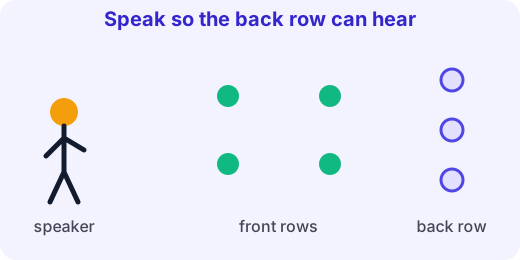
Think of your voice as a ripple that must reach the back row.
- Volume. Loud enough for the back row, but you do not need to shout. Stand up straight and breathe in before you start.
- Pace. That means how fast you speak. Nerves make us speed up. Slow down a little, more than feels natural.
- Say every word. Open your mouth and finish the ends of words.
- Pause. A short stop between ideas gives listeners time to think.
- Look up. Look at different people in the room, not at the floor or the wall.
The order of your ideas
Listeners cannot go back and re-read. They hear your ideas once, so your talk needs a shape that is easy to follow.
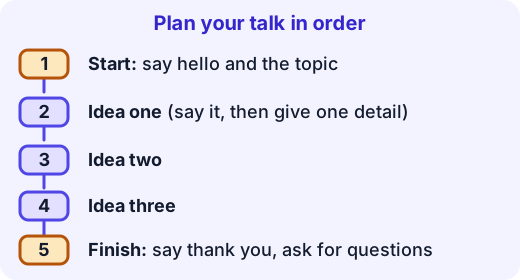
- Start. Say hello and tell the audience what your talk is about.
- Three ideas. Give one idea at a time, in an order that makes sense. For each, say the idea and give one detail.
- Finish. Say the main thing again in a few words, say thank you, and ask "Does anyone have a question?"
A good plan fits on three small cards, with a few words on each. Do not write everything out. Cards remind you; they are not for reading aloud.
Example. Here is Neha's talk, replanned.
Start: "Hello, everyone. My talk is about my grandmother's tortoise, Moti."
Idea 1, what Moti eats: "Moti eats leaves and vegetables, like spinach."
Idea 2, how Moti moves: "Moti walks very slowly. She takes ten minutes to cross the garden."
Idea 3, how long Moti lives: "Tortoises can live a very long time. Moti is thirty years old."
Finish: "So Moti is a slow, leaf-eating old friend. Thank you. Does anyone have a question?"
Now every listener knows what the talk is about, hears three clear ideas, and knows when it ends.
Answering a question
When someone asks a question, do these things:
- Listen to the whole question. Do not answer too early.
- Pause for a moment to think.
- Answer the question that was asked, in a sentence or two.
- If you do not know, say so. "I don't know, but I can find out." That is a good answer.
- If you did not hear or understand, ask politely: "Could you say that again, please?"
Be careful!
- Do not rush. A fast talk is a lost talk.
- Do not read every word from a page. You will look down and nobody will hear you. Use cards.
- Do not make something up when you do not know the answer. It is fine to say "I don't know."
- Do not talk too long. Three clear ideas beat ten muddled ones.
- Think about the audience. Talking to a four-year-old needs short sentences and simple words. Talking to your class can use more detail.
Try it: Pick something you learned this week. Say what your talk is about in one sentence, then name three ideas in an order that makes sense. (For example: "My talk is about how a seed grows. First it drinks water. Next it sends a root down. Then it sends a shoot up.")
For the grown-up helping
Be a friendly audience. Let your child practise on you two or three times. Ask them to tell you the plan before the talk, and stand at the other side of the room so they have to project their voice. Praise one thing they did well (loud enough, clear order, eye contact) and suggest one thing to try again. Do not interrupt the talk to correct. After it, ask a real question so they can practise answering.
Lab
The talk studio
Plan a talk about how a bean seed grows, tune your voice for three different audiences, and choose good answers to listeners' questions.
Your goals
- Put the parts of a talk in order, from the opening to the closing and questions.
- Set your volume and pace so each of three audiences can hear and follow you.
- Choose a helpful answer for three listener questions.
The interactive lab opens once you register. Register to do this.
Activity
Plan and give a short talk
Your child chooses something they have learned, plans a talk on three cards, practises, and gives it to family members, then answers a question. About 30 minutes.
You'll need
- Five small pieces of paper or index cards
- A pencil
- Two or three family members as the audience (a soft toy audience is fine too)
Steps
- Choose something your child has learned about, such as an animal, a game, a festival or how to make something. Your child says in one sentence what the talk is about.
- Your child writes one card for the start (hello and the topic), three cards for the three ideas (a few words each, not full sentences), and one card for the finish (thank you and 'Any questions?').
- Practise twice. The first time, the audience sits close. The second time, they sit across the room, so your child must speak up for the back row.
- Gather the audience and let your child give the talk using only the cards. The audience listens without interrupting.
- At the end, each listener asks one question. Your child listens to the whole question, pauses and answers. If they do not know, they say 'I don't know, but I can find out.'
- Together, say one thing that went well and one thing to try next time.
Safety
- Your child stands on the floor, not on a chair or table.
- Keep walkways clear so nobody trips while the audience gathers.
Keeping a log of the activity is for registered learners. Register to do this.
Quick check
Speaking to a group check
Seven questions about planning and giving a talk.
1.What does the word audience mean?
- The people who are listening to you
- The person who is speaking
- The thing your talk is about
Choose one
2.A girl in the back row cups her hand to her ear. What should the speaker do?
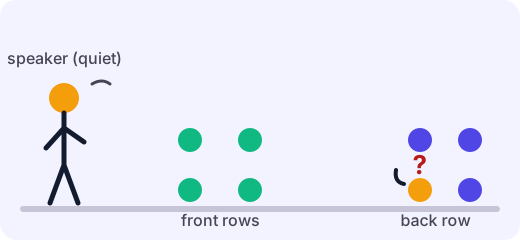
- Speak a little louder and slow down
- Talk faster so the talk is over sooner
- Turn around and talk to the board
Choose one
3.Put the parts of this talk in the best order.
- Hello. My talk is about how a butterfly grows.
- Then it makes a hard case called a chrysalis.
- Next, a caterpillar comes out and eats leaves.
- First, a butterfly lays an egg on a leaf.
- Finally, a butterfly comes out. Does anyone have a question?
Put these in order
4.Which things help your listeners understand you?
- Looking at the people in your audience
- Speaking so the back row can hear
- Talking as fast as you can
- Pausing between your ideas
- Looking only at your shoes
Choose all that apply
5.A listener asks a question and you do not know the answer. What is the best thing to say?
- "I don't know, but I can find out."
- Make up an answer that sounds good
- Say nothing and sit down
Choose one
6.You are telling your four-year-old cousin about a thunderstorm. What should you change?
- Use short sentences and simple words
- Use long science words so she learns them
- Whisper so she has to come close
Choose one
7.Match each speaking word to what it means.
- volume
- pace
- pause
Match each to: a short stop between ideas · how fast you speak · how loud your voice is
Answering and checking are for registered learners. Register to do this.
Quick check
New puzzles
New listeners and new talks to think about.
1.Ishaan will tell his grandmother, who is a little hard of hearing, about his cricket match. She sits across the room. What is the best plan?
- Face her, speak clearly and a little slower and louder, but do not shout
- Whisper so she has to come close
- Talk very fast so she hears everything
Choose one
2.Put the parts of this talk about sea turtles in the best order.
- Hello! I will tell you how a sea turtle is born.
- That is how new sea turtles begin their lives. Any questions?
- Weeks later, the babies hatch and crawl toward the sea.
- A mother turtle digs a nest in the sand and lays her eggs.
Put these in order
3.Dev's talk has ten ideas, and his listeners are fidgeting. Which change thinks most about his listeners?
- Keep the three most interesting ideas and make each one short and clear
- Speak even faster to fit all ten ideas in
- Add more ideas so there is something for everyone
Choose one
4.A listener asks a question, but you did not understand it. What is the best thing to say?
- "Could you say that another way, please?"
- Guess an answer and hope it is right
- "That is a silly question."
Choose one
Answering and checking are for registered learners. Register to do this.
Activity
Tell it back
Your child explains, in their own words, how they thought about their listeners when they gave a talk. Three minutes.
Steps
- Ask 'Who was listening to your talk? What did you do to help them hear and follow you?'
- Ask 'Why do you think the order of your ideas matters?'
- Ask 'If your listeners were four years old instead of adults, what would you change?'
- Write down what your child says, in their words.
Keeping a log of the activity is for registered learners. Register to do this.
Like what you see?
Register for free to answer the quick checks, do the activities and save your work. Your work is saved on your device and syncs to your account.