Unit 10
Alphabetical order and dictionaries
Put words in ABC order, even when they start with the same letters, and use guide words to find any word in a dictionary fast.
Read
A system for finding things fast
Imagine a library with 10,000 books. The books are on the shelves in no order at all. You want one book, The Tiger Who Came to Tea. How long would it take? Maybe all day!
Now imagine the books are lined up by the first letter of the title. You walk straight to the T shelf. It takes a minute. A dictionary works the same way. It holds thousands of words, and alphabetical order (also called ABC order) lets you find any one of them quickly.
The alphabet
The English alphabet has 26 letters, always in the same order:
a b c d e f g h i j k l m n o p q r s t u v w x y z
It helps to know that m is about the middle. Letters a to m are the first half and n to z are the second half. Hindi, Tamil and many other languages have their own letter orders. This unit is about English ABC order.
Step 1: Look at the first letter
To put words in ABC order, compare their first letters.
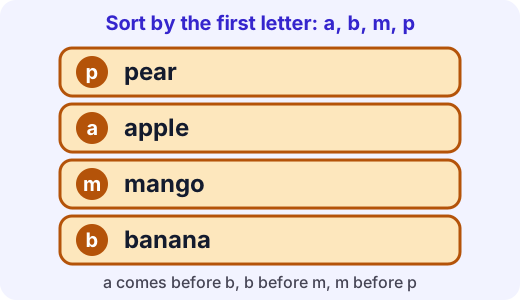
Example. Put pear, apple, mango, banana in order.
- First letters: p, a, m, b.
- In the alphabet: a, b, m, p.
- So: apple, banana, mango, pear.
Step 2: Same first letter? Look at the next one.
What about cow, cat, cup? All three start with c. Look at the second letter: o, a, u. In the alphabet a comes before o, and o comes before u. So: cat, cow, cup.
If the second letters are the same too, look at the third letter, and so on.
Example. Put bus, bat, bun, bag in order.
- All start with b. Second letters: u, a, u, a. The a words come first: bat, bag, then the u words: bus, bun.
- Compare bag and bat. Third letters: g and t. g comes before t, so bag, bat.
- Compare bus and bun. Third letters: s and n. n comes before s, so bun, bus.
Answer: bag, bat, bun, bus.
If one word is just the start of another, the shorter word comes first: sun, sunny, sunset.
Using a dictionary
A dictionary lists words in ABC order and gives the meaning of each one. At the top of every page are two guide words. The left one is the first word on the page. The right one is the last. Every word on the page comes between them.
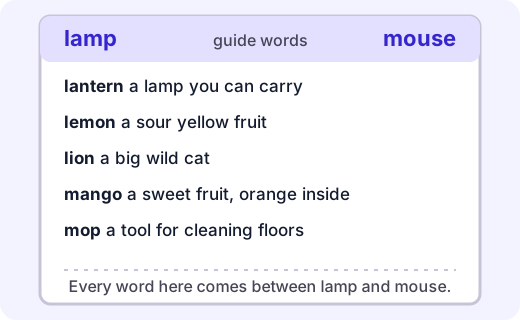
Example. Find mango. Does it belong on the page with guide words lamp and mouse?
- Is mango after lamp? m comes after l. Yes.
- Is mango before mouse? Both start with m, so look at the second letters: a comes before o. Yes.
So mango is on this page. It is listed right there, with its meaning.
To find a word fast, open the dictionary near where its first letter should be. For zebra, go near the back. For mango, go near the middle. Then look at the guide words and flip forward or backward.
Be careful!
- Do not stop at the first letter when two words start the same. Look at the next one.
- A shorter word comes first when it is the start of a longer word: car before card.
- Do not mix up b and d, or p and q. Say the alphabet to yourself if you are not sure.
- Guide words are not the only words on a page. They are the first and the last. Many words fit in between.
Try it: Put these in ABC order: sofa, sand, seal, sun. Then say whether seed belongs on a page with guide words sand and sofa. (sand, seal, sofa, sun. Yes: seed comes after sand because e comes after a, and before sofa because e comes before o.)
For the grown-up helping
Practise on real things: names in the family, groceries, library books. Sing or say the alphabet slowly and point to each letter. When two words start with the same letter, ask "What is the next letter?" and keep going together. Let your child use a real children's dictionary. They will enjoy being the one who finds the word first.
Lab
The dictionary detective
First put three sets of words in ABC order. Then use guide words to choose the dictionary page where each word lives.
Your goals
- Put three sets of five words in alphabetical order, including words that start with the same letters.
- Use guide words to pick the right dictionary page for four words.
The interactive lab opens once you register. Register to do this.
Activity
Sort and find with a real dictionary
Your child sorts real names into ABC order, then uses a children's dictionary to find five words. About 30 minutes.
You'll need
- Paper, cut or torn into 10 small slips (a grown-up cuts or tears them)
- A pencil
- A children's dictionary (a picture dictionary is fine)
Steps
- Write ten names on the slips, one per slip: family members, friends, or pets. Include at least two names that start with the same letter.
- Shuffle the slips. Your child puts them in alphabetical order on the table. Say the alphabet together if your child needs it. For names with the same first letter, ask 'What is the second letter?'
- Your child copies the names in order on a sheet of paper.
- Write five words on paper that your child does not know well (for example: anchor, lantern, meadow, rudder, tunnel). Your child finds each one in the dictionary.
- For each word, your child first opens the dictionary near where the first letter should be, then reads the guide words and says 'Is my word before, after or between them?'
- Your child writes the two guide words and a short meaning in their own words next to each word.
Safety
- A grown-up does any cutting; tearing paper is fine. Keep scissors away from young children.
Keeping a log of the activity is for registered learners. Register to do this.
Quick check
Alphabetical order check
Seven questions about ABC order and dictionaries.
1.Put these words in alphabetical order.
- grape
- orange
- plum
- apple
Put these in order
2.Which word comes first in ABC order?
- door
- ball
- fish
- cat
Choose one
3.These words all start with b. Put them in alphabetical order.
- bun
- bat
- bag
- bus
Put these in order
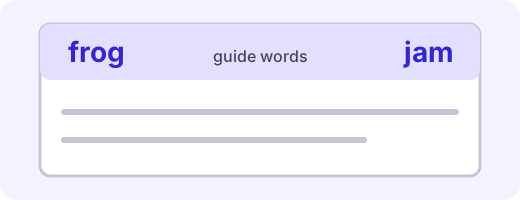
4.Which word is on this dictionary page?
- fish
- kite
- hen
- ant
Choose one
5.How many letters are in the English alphabet?
Answer with a number
6.What do the guide words at the top of a dictionary page tell you?
- The first word and the last word on the page
- What every word on the page means
- Who wrote the dictionary
Choose one
7.Which letter comes just after m in the alphabet? Type the letter.
Answer with a word or phrase
Answering and checking are for registered learners. Register to do this.
Quick check
New puzzles
New lists to sort and new pages to search.
1.A teacher puts the class names in ABC order. What is the order?
- Sia
- Sofia
- Sana
- Samir
Put these in order
2.Which list is in the right ABC order?
- sun, sunny, sunset
- sunny, sun, sunset
- sunset, sunny, sun
Choose one
3.A dictionary page has the guide words mist and moon. Which word is NOT on this page?
- mix
- mold
- money
- mouse
Choose one
4.You want to find the word zebra in a big dictionary. Where is the best place to start looking?
- Near the front
- Near the middle
- Near the back
Choose one
Answering and checking are for registered learners. Register to do this.
Activity
Tell it back
Your child explains, in their own words, why alphabetical order helps and how to use it. Three minutes.
Steps
- Ask 'Imagine a dictionary where the words were in no order. What would happen when you wanted to find one word?'
- Ask 'How does ABC order help? How do you find the word cat in a dictionary?'
- Say two words that start the same, such as 'bat' and 'bag', and ask 'Which comes first? How do you know?'
- Write down what your child says, in their words.
Keeping a log of the activity is for registered learners. Register to do this.
Like what you see?
Register for free to answer the quick checks, do the activities and save your work. Your work is saved on your device and syncs to your account.