Unit 6
Writing paragraphs
Build paragraphs around one clear topic sentence, backed by supporting details that stick to the point.
Read
One idea, one paragraph
Imagine opening a toy box where someone has dumped cricket bats, watercolours, mango peels, jigsaw pieces, and dirty socks all into one enormous tangled heap. You would have no idea where to look or what to do!
Writing can look like that messy toy box when an author jams fifty thoughts into one endless wall of words. The reader's eyes grow tired, their mind wanders, and the main point gets lost.
The secret to clean, powerful writing is the paragraph.
What is a paragraph?
A paragraph is a collection of sentences that work together to develop one single idea.
When a reader sees a paragraph break (a fresh indented line or a small space), their brain takes a mini-breath and prepares for the next thought. If a sentence does not belong to that central idea, it does not belong in the paragraph.
The golden rule of writing is simple and unforgettable: One paragraph, one idea.
The paragraph burger
Think of a paragraph as a delicious sandwich or burger with three main layers.
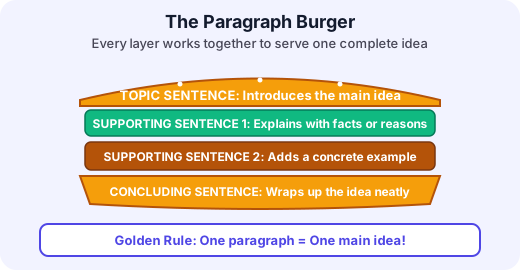
1. The Top Bun: Topic Sentence
The topic sentence is usually the very first sentence. It is the boss of the paragraph. It clearly announces what the entire paragraph will be about. If someone reads only your topic sentence, they should immediately know your main message.
2. The Fillings: Supporting Sentences
Inside the burger are the tasty fillings: the patty, crisp lettuce, cheese, and tomatoes. In your writing, these are your supporting sentences. You usually need two to four supporting sentences. They give facts, explain reasons, describe sensory details, or share examples that prove your topic sentence.
3. The Bottom Bun: Concluding Sentence
The concluding sentence wraps up the paragraph neatly without starting a brand-new topic. It holds the fillings in place and leaves the reader satisfied.
Keeping under the umbrella
Every single supporting sentence must fit underneath the paragraph's one-idea umbrella.
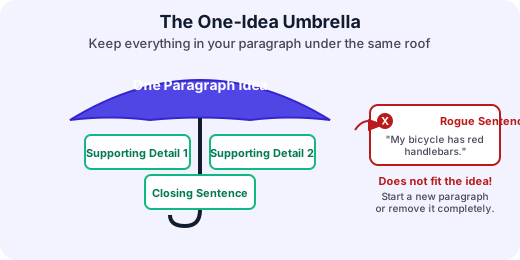
If a sentence wanders away from the main idea, we call it a rogue sentence or an off-topic sentence. Even if a rogue sentence is true and interesting, it ruins the paragraph because it breaks the reader's focus.
Step-by-step: dissecting a paragraph
Example. Read this short paragraph about the desert camel. Notice how every sentence serves the topic.
Camels have remarkable physical adaptations that allow them to survive in scorching deserts. Their broad, leathery foot pads keep them from sinking into soft burning sand. Long double eyelashes and nostrils that seal shut protect them from swirling dust storms. In addition, their humps store nutrient-rich fat that can be converted into energy when food is scarce. These clever body features make the camel perfectly suited for life in harsh arid lands.
Let's look at each layer:
- Topic Sentence: "Camels have remarkable physical adaptations that allow them to survive in scorching deserts." (Names the animal and the big idea: survival adaptations).
- Supporting Detail 1: Wide foot pads for walking on hot sand.
- Supporting Detail 2: Eyelashes and nostrils that keep out sandstorms.
- Supporting Detail 3: Humps that store fat for energy.
- Concluding Sentence: "These clever body features make the camel perfectly suited for life in harsh arid lands." (Summarizes the adaptations).
Now, what if someone slipped in this sentence: "My uncle rode a camel at the beach in Mumbai last December."?
That sentence might be completely true! But it is off-topic. It is about an uncle's vacation, not about how a camel's body survives the desert. It must be thrown out of the paragraph.
When should you start a new paragraph?
You start a new paragraph whenever:
- You move to a new idea or different topic.
- You change the time (for example, moving from "that morning" to "three days later").
- You change the place (moving from the classroom to the playground).
- A new person speaks in a story.
Mistakes to avoid
- "A paragraph is just five sentences in a row." A list of unrelated sentences is not a paragraph! Five sentences about shoes, space, and sandwiches do not make a paragraph. They must all share one idea.
- "Writing one giant paragraph for a two-page report." Readers need paragraph breaks to process thoughts. If your paragraph covers more than one topic, split it.
- "Starting a new paragraph for every single sentence." Sentences that work together on the same thought should stay together.
- "Leaving out the topic sentence." If you jump straight into details without a topic sentence, the reader has to guess what your point is.
Try it: Think of your favourite game. Write a three-sentence mini-paragraph: a topic sentence naming the game, two supporting details explaining why you enjoy it, and a closing sentence. Check that every sentence stays under the same umbrella!
Lab
The Paragraph Workshop
Build solid paragraphs by identifying topic sentences, arranging supporting details, and weeding out rogue off-topic sentences into the Recycle Bin.
Your goals
- Place topic sentences, supporting details and concluding sentences in proper structure.
- Weed out off-topic sentences from three different paragraphs.
The interactive lab opens once you register. Register to do this.
Quick check
Writing paragraphs quick check
Eight questions on topic sentences, supporting details, concluding sentences, and paragraph unity.
1.What is the primary job of a topic sentence in a paragraph?
- To tell the reader the central idea of the paragraph
- To make the paragraph rhyme like a poem
- To fill up empty space on the paper
Choose one
2.Read these details: (1) Slice sweet mangoes into a blender, (2) Add thick curd and honey, (3) Blend until creamy. Which is the best topic sentence?
- Making a fresh mango lassi at home is quick and simple.
- You can purchase packaged juices at the supermarket.
- Mango trees produce fruit during the summer season.
Choose one
3.Match each paragraph component to its job.
- Topic sentence
- Supporting sentence
- Concluding sentence
Match each to: Announces the main idea at or near the start · Rounds off the idea and leaves the reader with a clear closing thought · Provides facts, details, or examples that back up the main idea
4.A writer's topic sentence is: 'Elephants use their trunks for many daily tasks.' Which TWO sentences belong under this topic umbrella?
- They suck up gallons of water with their trunk and spray it into their mouth.
- An elephant can grasp and lift heavy tree branches using its strong trunk.
- Elephant tusks are actually elongated incisor teeth.
- Lions sometimes rest in the shade of acacia trees.
Choose all that apply
5.Which sentence does NOT belong in a paragraph about caring for a pet rabbit?
- Goldfish swim in freshwater tanks and eat dried flake food.
- Provide fresh Timothy hay and clean water in its hutch every morning.
- Gently brush its soft fur to prevent tangled hairballs.
Choose one
6.Put these three sentences in the best logical order for a paragraph.
- With regular practice, you soon gain balance and pedal smoothly on your own.
- Learning to ride a bicycle takes balance, patience, and practice.
- At first, you might wobble and need someone holding the saddle.
Put these in order
7.The golden rule of paragraph writing is: 'One paragraph, one ____.'
Answer with a word or phrase
8.When should an author begin a brand new paragraph?
- When moving to a new topic, time, or setting
- Every time they write exactly ten words
- After every single full stop
Choose one
Answering and checking are for registered learners. Register to do this.
Quick check
New puzzles
Apply what you know about topic sentences and paragraph focus to solve these editorial puzzles.
1.Read this draft: '(1) The deep ocean is pitch-black and freezing cold. (2) Anglerfish use glowing lures to hunt in the dark. (3) Tube worms survive near volcanic vents on the seafloor. (4) My cousin had an ice cream at the beach yesterday.' Which sentence should be removed to keep the paragraph focused?
- Sentence 4
- Sentence 2
- Sentence 1
Choose one
2.If the author still wants to share their memory about eating ice cream at the beach, what is the correct way to handle it?
- Start a brand-new, separate paragraph about the beach trip
- Squeeze it into the middle of the deep sea paragraph
- Put it in tiny letters at the bottom of the trench paragraph
Choose one
3.A writer has these supporting details: (1) Thick blubber stores warmth, (2) Dense hollow fur traps body heat, (3) Wide paws act like snowshoes on ice. Which is the best topic sentence?
- A polar bear's body is specially adapted to survive freezing Arctic cold.
- Polar bears hunt seals along the edge of sea ice.
- Melting sea ice creates difficulties for northern wildlife.
Choose one
4.A school story moves across three distinct parts of the day: (1) The morning assembly, (2) The afternoon art workshop, and (3) The evening football match. At minimum, how many paragraphs should this composition have?
Answer with a number
Answering and checking are for registered learners. Register to do this.
Your turn
Master the paragraph
Show that you understand how a paragraph is built and why writers keep to one idea.
Write your response in these four parts:
- Write a paragraph. Write an original paragraph (4 to 5 sentences) about ONE of these topics:
- Planting and caring for a garden flower or vegetable
- Why your favourite sport or game is fun to play
- How your family celebrates a special festival or rainy day Clearly label:
Topic Sentence:Supporting Sentence 1:Supporting Sentence 2:Concluding Sentence:
- Prove your unity. Explain in two sentences how each of your supporting sentences connects directly to your topic sentence.
- The rogue sentence test. Write one example of a sentence that mentions the general subject of your paragraph but is actually OFF-TOPIC. Explain why it does not belong under your paragraph umbrella.
- Advice to a beginner. Explain the rule "One paragraph, one idea" to a younger student who writes their entire story as one giant unbroken page of text. Give them a helpful picture or comparison (like a burger or toy box) to help them remember.
How it's judged
- Writes a structured paragraph
- Demonstrates paragraph unity
- Creates and critiques a rogue sentence
- Explains the one-idea rule to a beginner
Writing and submitting your answer is for registered learners. Register to do this.
- Write a paragraph. Write an original paragraph (4 to 5 sentences) about ONE of these topics:
Like what you see?
Register for free to answer the quick checks, do the activities and save your work. Your work is saved on your device and syncs to your account.