Unit 5
Finding information
Use contents pages, indexes, glossaries and keywords to hunt down facts without reading the whole book.
Read
How to hunt down facts
Kabir slammed his library book onto the desk. It had 240 thick pages and was titled Wild Animals of the Himalayas.
"The science quiz is tomorrow morning," Kabir groaned. "I need to find out what snow leopards eat in winter. If I read this whole book page by page, I'll still be reading at midnight!"
His teacher, Ms Sharma, walked over and turned the book around.
"Kabir," she asked, "when you look up your friend's phone number, do you read the entire phone directory from page one?"
"No," said Kabir. "I jump straight to their name."
"A non-fiction book works the exact same way," smiled Ms Sharma. "You don't read an information book like a story. You navigate it like a map."
The toolkit of a researcher
When an author writes an informational book, they build special signposts called text features. These features help you find facts in seconds without reading every single sentence.
A good researcher always knows which signpost to check first.
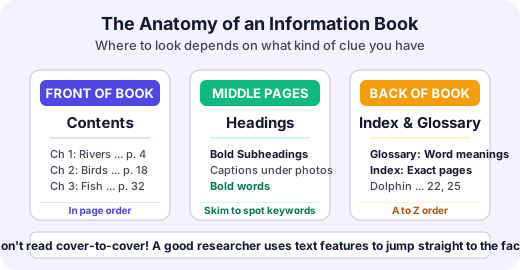
Here are the four key tools every researcher carries:
1. The Table of Contents (Front of the book)
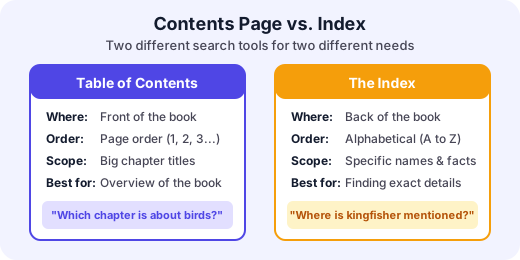
The Table of Contents sits right after the title page. It lists the book's big chapters or sections in page order (from page 1 to the end).
- When to use it: When you want a broad overview, or when you want to know which chapter covers a big topic (such as Chapter 4: Mountain Cats, page 82).
2. The Index (Back of the book)
The Index is at the very back of the book. It is a long, detailed list of every person, animal, place, and specific idea mentioned in the book, arranged in alphabetical order (A to Z). Next to each word, it gives the exact page numbers where that word appears.
- When to use it: When you have a specific name or keyword in mind (such as Snow leopard, 84, 91–93).
3. The Glossary (Near the back)
A glossary is a mini-dictionary just for that book. When the author uses a difficult or technical word in the text, they usually print it in bold. In the glossary, you can look up that bold word in alphabetical order to read its definition.
- When to use it: When you see an unfamiliar technical word like carnivore, camouflage, or territory and want to know what it means.
4. Keywords: The secret search words
Before you open the index or search an online page, you must pick your keywords. A keyword is the most important noun or concept in your research question.
- If your question is: "What do snow leopards eat in winter?"
- Weak keywords: what, do, eat (these words appear thousands of times everywhere).
- Strong keywords: snow leopard, diet, prey.
Step-by-step: tracking down a fact
Example. Kabir wants to know what snow leopards hunt in the rocky cliffs. Here is how he uses his tools step by step:
- Pick the keyword. The most specific word is snow leopard.
- Flip to the Index at the back. Run down to the letter S.
- Read the index entry:
Snow leopard, 82, 85–87
camouflage, 86
diet and hunting, 87 - Jump straight to page 87. Kabir turns directly to page 87. Under the bold heading Diet in the Crags, he reads: "Snow leopards prey primarily on blue sheep (bharal), ibex, and mountain hares."
- Note where the fact came from. A fact is only as good as its source! Kabir writes in his notebook:
"Snow leopards eat blue sheep and ibex."
Source: Wild Animals of the Himalayas by Dr. P. Negi, page 87.
Because Kabir recorded the book title and page number, his teacher and classmates can check his fact and confirm it is true.
Mistakes to avoid
- "Starting on page one for every research question." Stories are read from beginning to end; reference books are explored using the index and contents page.
- "Searching the Table of Contents for tiny details." The Table of Contents only shows big chapters. If you want a specific animal or river, check the Index at the back!
- "Searching for common question words." Words like how, why, can, and animal are too broad. Always pick specific nouns as keywords.
- "Forgetting to write down the source page." If you find an amazing fact but forget which page it was on, you cannot prove where it came from if someone asks.
Try it: Pick any non-fiction book from your shelf. Find the Index at the back. Pick a keyword starting with the first letter of your name. Flip straight to the page listed and share one fact with someone nearby!
Lab
Fact Detective: The Book Explorer
Use the interactive Table of Contents, Index, and Glossary of an informational book to hunt down facts and verify page sources.
Your goals
- Navigate an information book using the Table of Contents, Index, and Glossary.
- Solve three research missions by locating facts and verifying technical terms.
The interactive lab opens once you register. Register to do this.
Quick check
Finding information quick check
Eight questions on using the Table of Contents, Index, Glossary and keywords to find and record facts.
1.Where in a book is the Table of Contents usually located, and how are its chapters ordered?
- At the front of the book, in page order
- At the back of the book, in alphabetical order
- In the middle of the book, ordered by chapter size
Choose one
2.You want to find the exact page that describes an emperor penguin's feathers. Which text feature is fastest to use?
- The Index at the back of the book
- The book's front cover title
- The Table of Contents
Choose one
3.Match each text feature to its primary purpose.
- Table of Contents
- Index
- Glossary
Match each to: Defines bold or difficult vocabulary words used in the text · Lists specific keywords alphabetically with exact page numbers · Shows big chapter titles and starting pages in book order
4.Ravi wants to research what food monarch caterpillars eat. Which TWO are the strongest, most specific keywords to search?
- monarch caterpillar
- what
- milkweed
- eating
Choose all that apply
5.While reading a book about reptiles, Priya spots the bold word *ectothermic*. Where should she turn to read its definition?
- The Glossary
- The back cover summary
- The publisher's barcode
Choose one
6.Put these four animal index entries into alphabetical order as they would appear in an Index.
- Camel
- Bat
- Elephant
- Dolphin
Put these in order
7.When you note down where a fact came from, you should record the book title, author, and the exact ____ number.
Answer with a word or phrase
8.Why does a good researcher always record the source and page number of a fact?
- So others can check the evidence and confirm it is true
- To make the report longer and take up more lines
- Because every book must be returned within three days
Choose one
Answering and checking are for registered learners. Register to do this.
Quick check
New puzzles
Read this snippet from the Index of an astronomy book, then solve the puzzles. * Asteroids, 14, 22–24 * Black holes, 88–92 * Comets, 31, 35 * Gravity, 10, 89 * Mars, 44–48 * ice caps, 47 * moons, 46
1.According to the index snippet, which page contains information about BOTH black holes and gravity?
- Page 89
- Page 10
- Page 88
Choose one
2.Under the index heading 'Mars', which page should a researcher turn to in order to read about its moons?
- Page 46
- Page 44
- Page 47
Choose one
3.How many different pages in this book discuss comets according to the index?
Answer with a number
4.On page 47, Zoya sees the bold word *permafrost*. Which section of the book is designed to provide definitions for bold technical terms?
- The Glossary
- The Table of Contents
- The front cover
Choose one
Answering and checking are for registered learners. Register to do this.
Your turn
The researcher's guide
Your classmate Fatima has just been assigned her first major school project: "How Honeybees Build Hives and Make Honey." She is holding a 180-page library book and looks completely overwhelmed.
Write a step-by-step guide to teach Fatima how to research efficiently. Answer these four parts:
- Contents vs. Index. Explain to Fatima the difference between the Table of Contents and the Index. Tell her exactly when she should use each one.
- Keyword mastery. Fatima wants to find out what temperature bees keep their honeycomb inside the hive.
- Name two strong, specific keywords she should look up.
- Name two weak keywords she should avoid, and explain why they are weak.
- The Glossary. Explain what a glossary is, how it is organized, and how it helps when Fatima comes across a technical word like nectar or propolis.
- Recording the source. Imagine Fatima finds the answer on page 64 of The Secret Life of Bees by Dr. Tariq Khan.
- Write down the exact citation note Fatima should record in her notebook.
- In two sentences, explain why recording where a fact came from is essential for any true researcher.
How it's judged
- Distinguishes Contents from Index
- Selects and justifies keywords
- Explains the Glossary
- Writes citation and explains purpose
Writing and submitting your answer is for registered learners. Register to do this.
Like what you see?
Register for free to answer the quick checks, do the activities and save your work. Your work is saved on your device and syncs to your account.