Unit 1
Reading longer books
Read a whole chapter book one sitting at a time, and keep the plot straight with a "story so far" note.
Read
One chapter at a time
Zara's uncle hands her a book with 96 pages and twelve chapters. She stares at it. "That's huge. I'll never finish."
Her uncle smiles. "How do you eat a whole watermelon?"
"One slice at a time."
"Then read it the same way."
Chapters are the slices
A chapter book is a long story cut into numbered pieces called chapters. Each chapter usually does one job: it shows a new place, adds a problem, gives a clue, or brings a surprise. Most have a title that hints at what is coming.
The plot is the list of things that happen in the story, in order, and how each one leads to the next. When you keep track of the plot, you always know where you are in the story and why.
Sittings and stamina
A sitting is one stretch of reading in one go, say twenty minutes in the evening. A chapter book is read over many sittings, often over days or weeks.
Reading for a long time is like running. Nobody runs a long race on their first day. You start with a short distance and add a little each week. That is reading stamina, and it grows with practice.
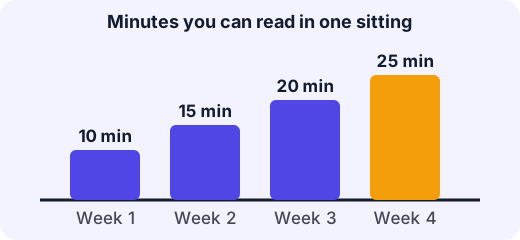
Here is one way a reader's weeks might go. Your own numbers can be different.
Week One sitting lasts How it feels 1 10 minutes Easy, but I want to stop 2 15 minutes I forget less between sittings 3 20 minutes I finish a whole chapter 4 25 minutes I want just one more page Keeping the thread
The tricky part of a long book is the gaps. You close the book on Tuesday and open it on Thursday. What happened last time?
The fix is a story so far note. After each sitting, write one or two lines: who wants what, what happened, and what problem is still open. Before the next sitting, read your note first.
Let's practise with a small book in three short chapters.
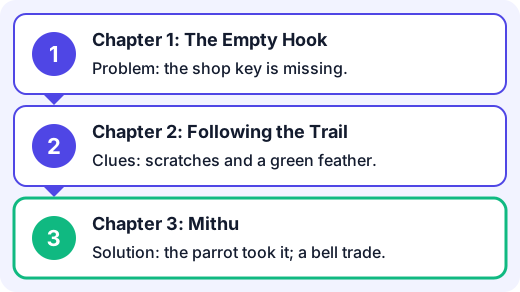
Chapter 1: The Empty Hook. Every morning, Ishaan's grandmother hung the shop key on a hook by the door. Today the hook was empty. "The fair opens at nine," said Dida, "and the lamps are locked inside." Ishaan promised to find the key before the temple bell rang eight.
Chapter 2: Following the Trail. He looked under the mat, in the tea tin and in Dida's shawl pockets. Nothing. Then he noticed tiny scratches on the windowsill and a bright green feather on the floor. Mrs Rao from next door called over, "I heard a clatter at dawn."
Chapter 3: Mithu. The feather belonged to Mithu, the Raos' parrot, who loved shiny things. Ishaan climbed to the roof and found Mithu on the water tank with the key hanging from his claw. "Trade you," said Ishaan, holding up a little brass bell. Mithu dropped the key. The shop opened at nine.
Example. Here are good "story so far" notes after each chapter.
After chapter Story so far 1 The shop key is missing and Ishaan has until eight to find it. 2 He found scratches and a green feather, and a neighbour heard a clatter. 3 A parrot took the key. Ishaan traded a bell for it and the shop opened. Notice what the notes leave out. Ishaan's search under the mat and in the tea tin does not matter later. A good note is short and keeps only what the next chapter will need.
A note can be too short ("Ishaan looks for a key") or too long (a retelling of every sentence). Aim for one or two lines.
Habits that build stamina
- Pick a book you want to read. Wanting to know what happens is the best fuel.
- Read at the same time each day. A habit is easier than a decision.
- Read your last note first. It takes ten seconds and brings the story back.
- Guess what comes next. Predictions keep your mind in the story. It does not matter if you guess wrong.
- Stop where a chapter ends if you can, so the next sitting starts fresh.
- Re-read when you get lost. Going back a page is what good readers do.
Mistakes to avoid
- "I must finish in one go." No. Splitting a book into sittings is how long books are meant to be read.
- "Fast readers are better readers." No. Following the plot matters more than speed.
- "I forgot what happened, so the book is too hard." Forgetting between sittings is normal. Notes fix it.
- "If I skip the chapter I don't understand, I'll be fine." Chapters build on each other, so skipping makes the plot harder to follow.
Try it: Choose a chapter book of 40 to 100 pages. Count the chapters. Decide how many sittings you will need and when each one will happen. Then start, and write your first "story so far" line.
Quick check
Longer books check
Eight questions about reading a long book one sitting at a time.
1.What is a "sitting" in reading?
- One stretch of time when you read, before you stop for something else
- The chair you read in
- The title of a chapter
Choose one
2.Which sentence describes the plot of a story?
- The place where the story happens
- The events in the order they happen, and how each one leads to the next
- How the author feels about the characters
Choose one
3.Put the steps of a good reading sitting in order.
- Read your chapter
- Write one line about what happened
- Read your last 'story so far' note
Put these in order
4.Chapter 4 says: Lina's bicycle had a flat tyre, and the race started at ten. She ran to Mr Joseph's cycle shop, but it was closed. Then she remembered the pump in her father's shed. By half past nine her tyre was hard again. Which is the best 'story so far' line?
- Lina's flat tyre is pumped up with a pump from her father's shed, so she can get to the race.
- Lina has a bicycle.
- Lina ran to a shop that was closed.
Choose one
5.Which habits help you keep track of the plot across many sittings? Pick all that apply.
- Write a short 'story so far' note after each sitting
- Read your last note before you start the next sitting
- Guess what might happen next
- Skip any chapter that is hard to follow
- Never go back to re-read a page
Choose all that apply
6.How does reading stamina grow?
- By reading a little longer on most days
- By reading the thickest book you can find in a single day
- It cannot grow; you either have it or you do not
Choose one
7.What do we call each numbered part that a long book is divided into?
Answer with a word or phrase
8.Match each word to its meaning.
- chapter
- plot
- sitting
- story so far
Match each to: What happens in a story, in order · One stretch of reading time · A short note that recaps the plot to this point · A numbered part of a long book
Answering and checking are for registered learners. Register to do this.
Activity
Read a chapter book over a week
Read a short chapter book (40 to 100 pages) over at least four sittings, and keep a "story so far" note after each one. About 20 minutes a day for a week.
You'll need
- A short chapter book from home, school or the library
- A notebook or sheets of paper for notes
- A bookmark (a strip of paper is fine)
- A pencil
Steps
- Choose a book you want to read. Count the chapters and the pages. Write the title and the number of pages and chapters at the top of your notebook page.
- Plan your sittings. Write down the days and the time of day you will read, and how many pages or chapters you hope to read each time.
- Sitting 1: read for 10 to 20 minutes. Put your bookmark in. Write one or two lines under 'Story so far': who wants what, what happened, and what is still unsolved.
- Before each later sitting, read your last note first. Then read. Then write a new note. Also write down how many minutes you read.
- After each sitting, write one guess about what will happen next. At the next sitting, check whether you were right.
- Read at least four sittings. If you can, make one sitting a few minutes longer than the one before.
- When you finish the book (or reach the end of your plan), read your notes from first to last. Underline the line that shows the biggest turning point in the plot.
Safety
- Read in good light, and sit comfortably with your back supported.
- Rest your eyes now and then. Look at something far away for a minute.
- Do not read while walking along a road or crossing a street.
- Stop in time to get enough sleep.
- Ask a grown-up before borrowing a book or taking one out of the house.
Keeping a log of the activity is for registered learners. Register to do this.
Quick check
New puzzles
Use what you know about sittings, plots and notes in some new situations.
1.Dev's book has 90 pages. He reads 15 pages in each sitting. How many sittings will he need to finish it?
Answer with a number
2.Rhea wants to finish a 120-page book in 10 days, reading the same number of pages every day. How many pages must she read each day?
Answer with a number
3.Which sentence tells a plot event (something that happens) rather than describing a place or a feeling?
- The old house had a crooked red door.
- Maya pushed the door open and heard footsteps upstairs.
- The house felt cold and lonely.
Choose one
4.Ali put down his book four days ago and cannot remember what happened in Chapter 5. What should he do first?
- Start Chapter 6 and hope it comes back
- Read his own 'story so far' notes, then glance at the end of Chapter 5
- Give up because the book is too hard
Choose one
5.Put these events from a chapter book in the order they happen.
- She searches the bus and the playground
- Sana returns the book and says thank you
- A friend finds the book under a bench
- Sana loses her library book
Put these in order
Answering and checking are for registered learners. Register to do this.
Your turn
Teach a friend to read a long book
A friend in your class says, "Chapter books are too long. I always give up halfway."
Write them a short letter (6 to 10 sentences) that explains how to read a long book over many sittings and still follow the plot. Use the words chapter, plot, sitting and story so far in your letter.
Use an example from a chapter book you have read, or from Ishaan's story in the reading, to show what a good "story so far" note looks like. Write the note out in your letter.
How it's judged
- Explains how to keep track of the plot
- Gives a good example note
- Explains how stamina grows
Writing and submitting your answer is for registered learners. Register to do this.
Like what you see?
Register for free to answer the quick checks, do the activities and save your work. Your work is saved on your device and syncs to your account.