Unit 2
Main idea and details
Find what a passage is mostly about, and test which details really hold that idea up.
Read
What is it mostly about?
"What's your library book about?" asks Arjun.
"Bees," says Neha.
"Yes, but what about bees?"
Neha thinks. "It's about how a bee that finds flowers can tell the other bees where they are." That is a much better answer. It is the main idea of the book.
A topic is small; a main idea says something
The topic is what a passage is about, in a word or a short phrase. The main idea is the most important thing the author says about that topic, and it needs a whole sentence.
Topic Main idea Camels A camel's body is built for life in the desert. Banyan trees A banyan tree spreads by growing new roots down from its branches. The monsoon The monsoon winds bring most of India's yearly rain. If you can answer "So what?" or "What about it?" after your sentence, it is probably only a topic.
Details are the legs of the table
Supporting details are the facts, examples, reasons and numbers that explain or prove the main idea. Think of a table. The main idea is the table top. The details are the legs. Take the legs away and the top falls down.
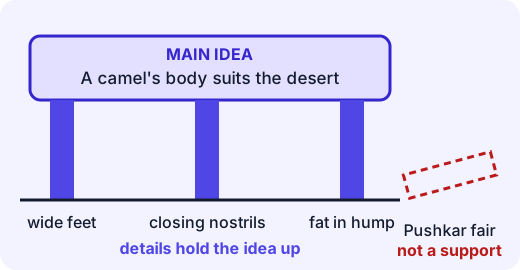
A detail may be interesting and still not belong. That is the second job of details: you can test them. Ask of every sentence, "Does this help prove the main idea?" If yes, it is a leg. If no, it is something else.
Worked example 1: one paragraph
A camel's body is built for desert life. Its wide, padded feet spread out so it does not sink into soft sand. Long eyelashes and nostrils that can close keep out blowing sand. The hump stores fat, which the camel's body can use for energy when food is hard to find. Every year, thousands of camels are traded at the fair in Pushkar, Rajasthan.
Step 1: find the topic. Camels.
Step 2: find what the author says about them. The first sentence does it: their bodies are built for desert life. Check by reading on. Do the other sentences agree? Yes.
Step 3: test each sentence.
Sentence Helps prove it? Wide, padded feet Yes. Walking on sand. Eyelashes and closing nostrils Yes. Keeping out sand. Hump stores fat Yes. Surviving with little food. Camels traded at Pushkar No. True and interesting, but it says nothing about the camel's body. Main idea: A camel's body has features that help it live in the desert. Details: feet, eyelashes and nostrils, hump.
Worked example 2: a whole passage
Longer texts have a main idea for the whole passage and a smaller one for each paragraph. Read this one.
When a honeybee finds a patch of flowers rich in nectar, it flies back to the hive and dances. The dance is not for fun. It is a message. Other bees crowd around the dancer and follow her moves.
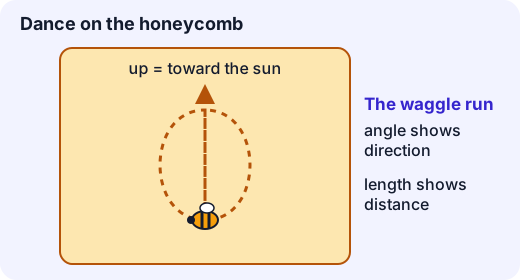
In the middle of the dance, the bee waggles her body as she walks in a straight line. The angle of that line, measured from straight up, shows the direction of the flowers compared with the sun.
The length of the waggle tells how far to fly. A short waggle means the flowers are near, and a long one means they are far. After the dance, many of the watching bees fly straight to the flowers.
Paragraph What it says 1 A bee that finds food dances for the other bees. 2 The direction of the waggle shows which way to fly. 3 The length of the waggle shows how far to fly. Put them together and you get the main idea of the whole passage: A honeybee tells its hive-mates where food is by dancing. Paragraphs 2 and 3 are the legs. Each one explains one piece of the message.
Ways to find the main idea
- Read the title and any headings. They often name the topic.
- Look at the first and last sentences. Authors often state the main idea there.
- Watch for repeated words. If "dance" appears again and again, the passage is about dancing.
- Ask: what does the author want me to understand? Then check your answer against the details.
Misconceptions
- "The main idea is always the first sentence." Often, but not always. Sometimes it comes last, and sometimes it is not written at all. You work it out from the details, and that is called an implied main idea.
- "The main idea is the most interesting fact." No. Interesting facts may be off-topic. The Pushkar fair is interesting, but it is not a leg of the camel table.
- "The main idea is the topic." No. "Camels" is a topic. "A camel's body is built for the desert" is a main idea.
- "More details means a better main idea." No. A main idea is short, and the details are what back it up.
Try it: Choose a paragraph from your science or social studies book. Write its topic in a few words. Then write its main idea as one sentence. List the sentences that support it, and look for any that do not.
Lab
Build the main-idea table
Read three short passages. For each one, pick the sentence that tells the main idea, then decide which details are legs that hold it up and which do not belong.
Your goals
- Pick the main idea of each of the three passages.
- Sort every detail into "supports the main idea" or "does not belong".
- Build all three tables.
The interactive lab opens once you register. Register to do this.
Quick check
Main idea check
Eight questions. Read each passage carefully before you answer.
1.Which of these is a main idea, not just a topic?
- Tigers
- The stripes of a tiger help it hide in tall grass.
- Tiger cubs
Choose one
2.Read this. Sanjay's school has started a paper-saving plan. Every class now uses both sides of a sheet before it goes to the recycling bin. Notices go out on the class chat instead of being printed. In one term, the school used 2,000 fewer sheets. What is the main idea?
- Sanjay likes paper.
- Sanjay's school found ways to use less paper.
- Notices should always be printed.
Choose one
3.Same passage: Sanjay's school has started a paper-saving plan. Every class now uses both sides of a sheet before it goes to the recycling bin. Notices go out on the class chat instead of being printed. In one term, the school used 2,000 fewer sheets. Which of these would be good supporting details for the main idea 'The school found ways to use less paper'? Pick all that apply.
- Classes use both sides of each sheet.
- Notices go out on the class chat.
- The school used 2,000 fewer sheets in a term.
- The school bell rings at nine.
- Sanjay's friend Omar sits near the window.
Choose all that apply
4.Why does an author include supporting details?
- To make the passage longer
- To explain or prove the main idea
- To name the topic
Choose one
5.A paragraph has the main idea 'Rivers rise quickly during the monsoon.' Which sentence does NOT help support that idea?
- Heavy rain runs off the hard ground into streams.
- Streams join together and carry the water into bigger rivers.
- Many people enjoy hot tea when it rains.
- By August some rivers are several times wider than they were in April.
Choose one
6.Match each detail to the main idea it supports.
- Other bees crowd around the dancer.
- A camel's wide, padded feet do not sink in sand.
- Neem leaves protect stored grain from insects.
Match each to: A camel's body suits the desert · Neem trees are useful · Honeybees share where food is
7.A fact, reason or example that helps prove the main idea is called a ____ detail.
Answer with a word or phrase
8.Read this. Kitchen waste such as peels and tea leaves can be turned into rich soil. Put the scraps in a pile or pit with dry leaves. Over weeks, tiny living things break the scraps down. The dark, crumbly compost helps plants grow. What is the main idea?
- Compost heaps smell bad.
- Kitchen waste can be turned into rich soil for plants.
- Dry leaves are brown.
Choose one
Answering and checking are for registered learners. Register to do this.
Quick check
New puzzles
Read this passage, then answer the questions. Some animals get through harsh weather by resting for weeks or months. In cold countries, bats hang in caves all winter while their heartbeat slows to a crawl. Some frogs bury themselves deep in the mud at the bottom of a pond and barely move until spring. In hot, dry places, a garden snail seals the opening of its shell with dried slime and waits inside for rain. By resting, each animal saves its energy until the weather is kinder.
1.What is the main idea of the passage?
- Some animals survive harsh weather by resting for a long time.
- Bats live in caves.
- Spring is the best season for frogs.
Choose one
2.How many different kinds of animal does the author name as examples of the main idea?
Answer with a number
3.Which sentence, if the author added it to the passage, would NOT support the main idea?
- Some snails rest for months when the weather is dry.
- Bats are the only mammals that can truly fly.
- A resting frog uses very little energy.
Choose one
4.Which title fits the whole passage best?
- Bats in Caves
- How Animals Rest Through Harsh Weather
- Snails and Slime
Choose one
Answering and checking are for registered learners. Register to do this.
Your turn
Prove the main idea
Read this paragraph.
A bicycle is a smart way to travel around a town. It uses no fuel, so it costs almost nothing to run and makes no smoke. It is small enough to slip through crowded lanes and park almost anywhere. Riding also gives your legs and heart a good workout. The first bicycle-like machine, built in 1817, was made of wood and had no pedals.
Write your answer in these parts.
- Main idea. One complete sentence, in your own words.
- Supporting details. Name three details from the paragraph that hold up your main idea. For each one, say in a few words how it helps.
- The one that does not belong. Which sentence does not support your main idea? Explain why it is not a leg of the table, even though it may be interesting.
- Why details matter. In two sentences, explain to a younger child why a main idea needs supporting details.
How it's judged
- States the main idea
- Chooses and explains supporting details
- Spots the off-topic sentence
- Explains why details matter
Writing and submitting your answer is for registered learners. Register to do this.
Like what you see?
Register for free to answer the quick checks, do the activities and save your work. Your work is saved on your device and syncs to your account.