Unit 12
Beyond Earth
Tour the Sun, planets and stars, learn what a light-year really measures, and build a scale model that shows how empty space is.
Read
A very big, very empty neighbourhood
Imagine a model of the solar system on your school ground. You put a small ball for the Sun at the gate, and Earth, a speck smaller than a grain of rice, one metre away. Where would the nearest other star go? Not at the end of the playground, or in the next town. It would be about 268 kilometres away. That one number tells you most of what this unit is about: space is very big, and most of it is empty.
Our solar system
The solar system is the Sun and everything that travels around it, held in orbit by the Sun's gravity.
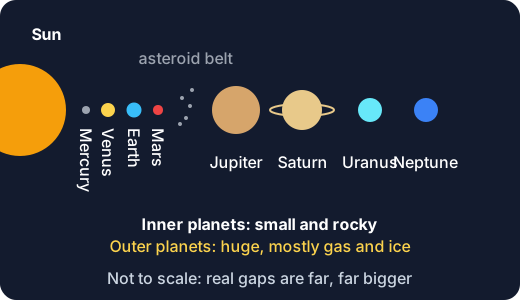
- The Sun is a star: a gigantic ball of hot gas that makes its own light and heat. It holds over 99 percent of all the mass in the solar system. About 109 Earths would fit side by side across its width.
- Eight planets orbit the Sun, in order: Mercury, Venus, Earth, Mars, Jupiter, Saturn, Uranus, Neptune. The four inner planets are small and rocky. The four outer planets are huge: Jupiter and Saturn are mostly hydrogen and helium gas, Uranus and Neptune are icy giants.
- Between Mars and Jupiter lies the asteroid belt, millions of rocky leftovers, the largest of which, Ceres, is a dwarf planet. Pluto is also a dwarf planet, beyond Neptune.
- Many planets have moons, natural satellites that orbit them. Earth has one; Mars has two small ones; Jupiter and Saturn have dozens each, and well over a hundred in Saturn's case.
- Comets are lumps of ice and dust on long orbits. Near the Sun they grow a glowing tail that always points away from it.
Mnemonic for the order: My Very Educated Mother Just Served Us Noodles. It is only a memory aid, but it works.
Misconception. "Summer is when Earth is closest to the Sun." No. The seasons come from Earth's tilt, not its distance, and Earth is actually closest to the Sun in early January.
Stars and constellations
Every point of light you see at night, except the Moon and a few bright planets, is a star: a Sun-like furnace so far away that it looks like a dot. The Sun looks big and hot only because it is the closest star by far.
Since ancient times people have joined groups of stars into pictures called constellations. In India the seven bright stars of the Great Bear are Saptarishi (the seven sages); the faint star near the sky's northern pole is Dhruva (the Pole Star), which seems to stay put while others wheel around it. The hunter Orion of Greek stories is Mriga (the deer) in Indian tradition, where the bright star Sirius is the hunter Mrigavyadha who chases it. Other cultures saw other pictures in the same stars.
Misconception. "The stars in a constellation are close to each other." They are not. They only look close because we see them from one side.
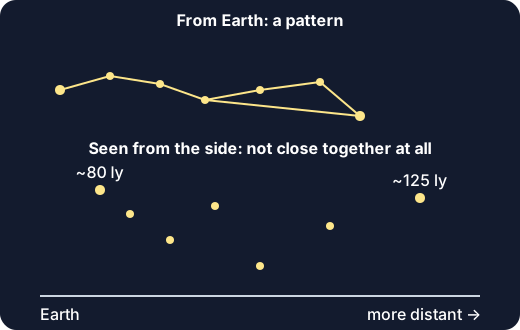
The stars of Saptarishi are roughly 80 to 125 light-years from us. A constellation is a pattern in our line of sight, not a family of neighbours. An astronomer on a planet of another star would see completely different patterns.
The light-year: a unit of distance
Space distances are so large that kilometres become awkward. Astronomers use light-years instead.
Light is the fastest thing there is: about 300,000 km every second. A light-year is the distance light travels in one year, about km, nearly 9.5 trillion kilometres. Notice what it is not: it is a distance, not a time.
To get a feel:
Trip for light Time Earth to the Moon (384,000 km) about 1.3 seconds Sun to Earth (150 million km) about 8 minutes 20 seconds Sun to Neptune about 4 hours Sun to the nearest star, Proxima Centauri 4.24 years Example. The light from a star 12 light-years away takes 12 years to reach us. So tonight you see it as it was 12 years ago. Looking far into space is also looking back in time.
Example. Sunlight takes about 500 seconds to reach Earth. Distance km. This matches the real distance.
Scaling the distances
Real distances are too large to draw. We use a scale: a fixed rule that shrinks everything by the same factor. Astronomers use the astronomical unit (AU), the average distance from Earth to the Sun, 150 million km.
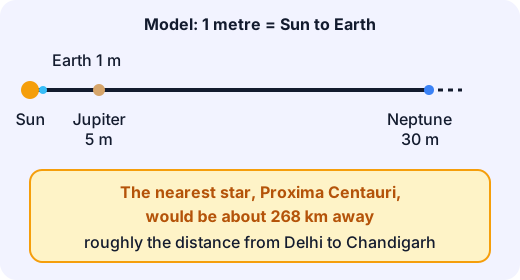
If we let 1 AU = 1 metre, the planets sit at:
Planet Distance in million km Distance in the model Mercury 58 0.4 m Venus 108 0.7 m Earth 150 1 m Mars 228 1.5 m Jupiter 778 5.2 m Saturn 1,427 9.5 m Uranus 2,871 19.1 m Neptune 4,495 30 m To convert, divide by 150 (million km per metre). For Jupiter: m.
The nearest star is 4.24 light-years away. One light-year is about 63,000 AU, so Proxima is AU, which in the model is 268,000 m, or 268 km. In the model the whole solar system fits on a school ground, and the next star is a day's drive away. Between them there is nothing but a few specks of dust.
The Sun is one of roughly a hundred billion stars in our galaxy, the Milky Way, which is about 100,000 light-years across. Beyond the Milky Way are billions of other galaxies.
Try it: The lab asks you to place the planets on a 30-metre strip using the distances above, then to scale out to the nearest star. Do the arithmetic yourself first, then check it against the model.
What to remember
- The Sun is a star; planets orbit it and moons orbit planets.
- Constellations are patterns, not groups of stars that are neighbours.
- A light-year measures distance, not time.
- To scale, use one rule for everything. Doing so shows that space is mostly empty.
Lab
Scale model of the solar system
Build a model in which 150 million km is 1 metre. Work out where each planet goes on a 30-metre strip, then find out how far away the nearest star would be on the same model.
Your goals
- Convert each planet's distance to metres in the model and place all eight planets.
- Use light-years to find how many kilometres away the nearest star would be on the same scale.
The interactive lab opens once you register. Register to do this.
Quick check
Beyond Earth check
Eight questions on the solar system, stars, constellations and scales in space.
1.Put the planets in order from nearest the Sun to farthest.
- Saturn
- Mercury
- Uranus
- Neptune
- Mars
- Jupiter
- Venus
- Earth
Put these in order
2.What is a light-year?
- The time light takes to go round the Sun
- The distance light travels in one year
- A year in which the Sun shines brighter
Choose one
3.The seven stars of Saptarishi form one pattern in the sky. What is true about them?
- They are all at exactly the same distance from Earth.
- They only look like a group from Earth; they lie at very different distances.
- They are all planets.
Choose one
4.The Sun is a star, like the stars at night. Why does it look so much bigger and brighter?
- It is the closest star to us by far.
- It is the only star that makes its own light.
- It is the only star with planets.
Choose one
5.A star is 12 light-years from Earth. How many years ago did the light you see tonight leave that star?
Answer with a number
6.Match each object to what kind of object it is.
- The Sun
- Jupiter
- Our Moon
- Ceres
Match each to: Dwarf planet · Star · Planet · Natural satellite
7.In a model where 150 million km is 1 metre, Jupiter is 778 million km from the Sun. How far from the Sun is Jupiter in the model, in metres?
Answer with a number
8.In a model where the Sun to Earth is 1 metre, the nearest star is about 268 km away. What does this show?
- Stars are separated by enormous gaps of almost empty space.
- The nearest star is part of our solar system.
- Space is crowded with stars close together.
Choose one
Answering and checking are for registered learners. Register to do this.
Quick check
Beyond Earth - new puzzles
Four problems that use the ideas of distance, light and scale in new settings.
1.Tonight you see a star that is 1,000 light-years away. What is true about the light reaching your eye?
- It left the star about 1,000 years ago, so you see the star as it was then.
- It left the star tonight.
- It left the star 1,000 days ago.
Choose one
2.Radio signals travel at the speed of light, 300,000 km per second. When Mars is 225 million km away, how many minutes does a signal take to reach a rover there?
Answer with a number
3.An astronomer lives on a planet orbiting a star 50 light-years from Earth. Would she see the same constellation shapes as we do?
- No, from there the nearby stars are at different angles, so the patterns would look different.
- Yes, constellations are fixed patterns in space.
- Yes, but only the planets would move.
Choose one
4.Why do textbook pictures of the solar system not show the planets at their true sizes and distances at the same time?
- The distances are so huge compared with the planets that the planets would be invisible specks on a page.
- Scientists do not know the distances.
- The planets are all the same size.
Choose one
Answering and checking are for registered learners. Register to do this.
Your turn
Explain space and scale
Answer in your own words.
- A friend says "A light-year is a very long time." Explain what a light-year really is, and use it to say what it means to look at a star 8 light-years away.
- Describe how the Sun, a planet and a moon are different kinds of object, and explain why the Sun looks so different from the other stars at night.
- "Space is mostly empty." Use a scale model (for example with 150 million km as 1 metre) to support this. Give at least two distances from the model.
How it's judged
- Light-year
- Kinds of objects
- Scale argument
Writing and submitting your answer is for registered learners. Register to do this.
Like what you see?
Register for free to answer the quick checks, do the activities and save your work. Your work is saved on your device and syncs to your account.