Unit 11
Nature's treasures
Sort resources into renewable and non-renewable, and find out why even renewable ones run out when we use them faster than they come back.
Read
Taking from nature without taking it all
Picture a village pond with 800 fish. Every year the fish breed and the pond fills up again. If the villagers take 40 fish a year, the pond hardly changes. If they take 120 a year, the pond looks fine for a few years, and then one year there are almost none left. The pond did not change. The rate did. This pond holds the whole lesson of this unit: resources run out if we use them faster than they renew.
What is a natural resource?
A natural resource is something from nature that people use. Air to breathe, water to drink and farm with, soil to grow crops in, sunlight and wind for power, wood from trees, fish from the sea, coal and petroleum for fuel, iron ore for steel, sand and stone for building: all of these are natural resources. A bicycle is made of them. So is your lunch.
Renewable and non-renewable
We sort resources by a single question: can nature replace it within a human lifetime?
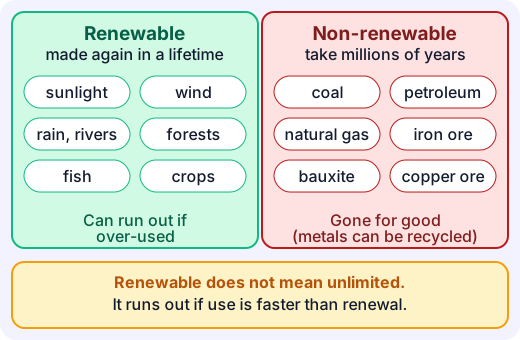
A renewable resource is replaced by nature fast enough to keep using. Sunlight and wind arrive every day. Rain refills rivers, lakes and the soil's water. Trees regrow, though a forest takes decades. Fish breed.
A non-renewable resource is replaced so slowly, or not at all, that for us there is only a fixed amount.
- Fossil fuels (coal, petroleum, natural gas) formed from the remains of ancient plants and tiny sea creatures that were buried and squeezed for millions of years. We burn in a day what took ages to make.
- Minerals and metal ores (iron ore, bauxite for aluminium, copper ore) were made by Earth's slow processes. The metal can be recycled, but the ore in the ground, once dug up, is not coming back.
Resource Renewable? Reason Sunlight Yes the Sun shines every day Wind Yes caused by the Sun heating Earth unevenly Rain and river water Yes the water cycle refills it Forest Yes, slowly trees regrow in decades Fish in a pond Yes fish breed each year Coal No made from plants that lived about 300 million years ago, buried for ages Petroleum No took millions of years Iron ore No a fixed amount in the ground The catch: renewable can still run out
Many learners remember "renewable means it never runs out". That is the classic mistake. Renewable only means it can be replaced. Whether it is replaced depends on us.
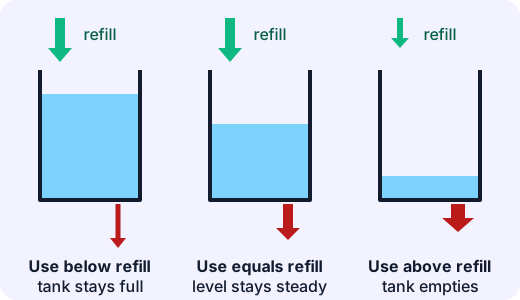
Think of a water tank with a tap running in (the renewal rate) and a tap running out (the use rate). If the use is below the refill, the tank stays full. If it equals the refill, the level is steady. If use goes above refill, the tank slowly empties, however "renewable" the water was.
Example. A village well is recharged by about 500 kilolitres of rain a year, and the villagers use 400. The store is safe. Then pumps arrive and they use 700. Each year the store falls by kilolitres. If it began with 1,000 kilolitres, it is empty in years.
This is not just a story. In parts of north-west India the underground water table has been falling for years, because more is pumped up than the rains put back. Off Newfoundland, in Canada, the huge Atlantic cod fishery collapsed in the early 1990s after years of taking more fish than were being born, and fishing was banned in 1992. Fish are renewable, but only if enough are left to breed.
Back to the pond. A computer can follow what happens year by year.
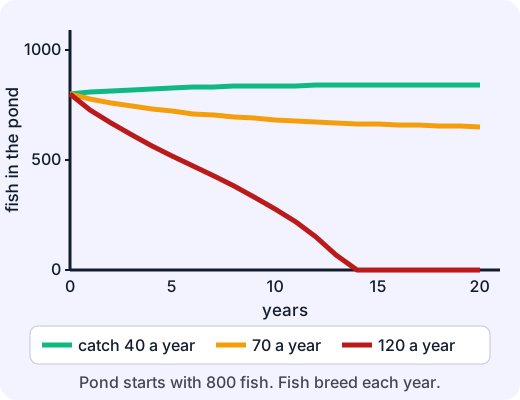
Taking 40 a year leaves a healthy pond of about 840 fish. Taking 70 a year is close to the most the pond can give each year, and the stock settles lower, around 650. Taking 120 a year is more than the pond can renew; the stock drops faster and faster and hits zero in 14 years. The lab lets you manage this pond yourself.
Looking after resources: conservation
Conservation means using resources carefully so they last. It has a few simple ideas.
- Reduce. Use less: switch off a fan, close a tap, say no to a plastic bag you do not need.
- Reuse. Use the same thing again: a school bag for a second year, a jar for storing spices.
- Recycle. Turn old things into new ones. Recycled aluminium needs only about one-twentieth of the energy of making new metal from ore.
- Repair. Fix instead of throwing out.
- Take no more than renews. Fish with nets that let young fish pass, plant a tree for every one cut, pump no more groundwater than the rain refills.
- Replace the non-renewable with renewable where we can, such as solar panels and wind turbines in place of burning coal. Burning fossil fuels also puts carbon dioxide into the air, which is warming Earth.
People have always done this. In Rajasthan, communities have built johads, small earthen dams that catch the monsoon rain and let it sink into the ground. In Alwar district, villagers rebuilt many of them from the 1980s on. Wells that had dried up began to fill again, and a river that had gone dry, the Arvari, flowed again. The idea is very old: catch the rain so that what you take out can be put back.
Investigating one resource
To study how a resource is used, pick one and gather evidence.
Try it: Choose water at home. For a day, write down every time you use water and an estimate in litres (a bucket bath is about 15 litres; a running tap uses about 6 litres a minute, so a two-minute tooth-brushing with the tap running is around 12 litres). Add it up. Then pick one use you could cut by a third, say how, and do the sum for a month.
Watch out for these mistakes:
- "Renewable means unlimited." No: it means replaceable, if use stays under the renewal rate.
- "Non-renewable means there is none left." No: there is a fixed amount. The question is how long it lasts and what we do when it is gone.
- "Recycling means the resource is renewable." Recycling stretches a non-renewable resource; it does not make more.
So the answer to "which resources are renewable?" is really two answers: whether nature can replace them, and whether we keep our use below the rate at which it does.
Lab
The village pond
You manage a village pond with 800 fish. Each year the fish breed, then you choose how many to catch. Try an over-fishing plan to see what happens, then find a catch the pond can renew.
Your goals
- Manage the pond for 15 years, catching at least 800 fish in total.
- Keep the pond above 200 fish all the time and finish with at least 400.
- Notice what happens to the pond when the catch is more than the fish can replace.
The interactive lab opens once you register. Register to do this.
Quick check
Nature's treasures check
Eight questions on renewable and non-renewable resources, and how to conserve them.
1.Which of these are renewable resources? Choose all that apply.
- Sunlight
- Coal
- Wind
- Petroleum
- Rainfall
Choose all that apply
2.Why is petroleum called a non-renewable resource?
- It takes millions of years to form, far slower than we use it.
- It is found only in one country.
- It cannot be burned more than once.
Choose one
3.A friend says "Fish are renewable, so we can catch as many as we like." What is the best reply?
- Right: renewable means it never runs out.
- Fish are renewable only if enough are left to breed; catching more than the stock can replace makes it shrink.
- Wrong: fish are non-renewable.
Choose one
4.A pond can add at most about 75 new fish a year. Which yearly catch could be kept up for many years?
- 30 fish
- 90 fish
- 150 fish
Choose one
5.A village water store holds 600 kilolitres of water. Rain adds 300 kilolitres a year and the village uses 450 kilolitres a year. In how many years is the store empty?
Answer with a number
6.Match each action to the word for it.
- Taking a shorter shower
- Using an old jam jar to store spices
- Melting old aluminium cans to make new metal
- Mending a torn school bag
Match each to: Reuse · Repair · Reduce · Recycle
7.Put the steps of how coal forms in order.
- The dead plants are buried under mud and sediment
- Plants grow in ancient swampy forests
- Coal is dug out of the ground by miners
- Heat and pressure act on them for millions of years
Put these in order
8.What word means using resources carefully so that they last?
Answer with a word or phrase
Answering and checking are for registered learners. Register to do this.
Quick check
Nature's treasures - new puzzles
Four situations that the reading did not cover. Apply the idea of renewal rate and use rate.
1.In a town, rain refills the underground water by about 1,000 million litres a year. The town's borewells pump out 1,500 million litres a year, and the water level in the wells drops each year. What is the best conclusion?
- Groundwater is renewable, but it is being used faster than it refills, so the supply is shrinking.
- Groundwater is non-renewable, so nothing can be done.
- The falling level shows that the rain has stopped completely.
Choose one
2.A plantation holds 300 trees and grows 50 new trees a year. A mill cuts 80 trees a year. If nothing changes, in how many years are the trees all gone?
Answer with a number
3.Which actions help to conserve petrol, a non-renewable resource? Choose all that apply.
- Five neighbours share one car for the school run
- Leaving the engine running while parked
- Walking or cycling for short trips
- Driving to a shop 300 metres away
Choose all that apply
4.Builders dig sand from a river bed. Nature slowly makes new sand by wearing down rocks, but this takes thousands of years. If sand is dug out every year, how is it best classed?
- Effectively non-renewable, because it is removed far faster than it forms.
- Renewable, because rocks never run out.
- Renewable, because rivers carry water.
Choose one
Answering and checking are for registered learners. Register to do this.
Your turn
Explain resources and rates
Answer in your own words. Use numbers where you can.
- A classmate says "Renewable resources can never run out, so we don't need to save them." Explain what is wrong, using one example of a renewable resource that has been or could be used up.
- A village pond gets 90 new fish a year and the villagers catch 60 a year. Next year they build a bigger boat and catch 150 a year. What will happen over the following years, and why? What would you advise?
- Investigate one resource you use at home or school (water, electricity, paper, cooking fuel). Describe how you would find out how much of it you use in a week, and give two ways to use less of it.
How it's judged
- Renewable is not unlimited
- Reasoning with rates
- Planning an investigation
Writing and submitting your answer is for registered learners. Register to do this.
Like what you see?
Register for free to answer the quick checks, do the activities and save your work. Your work is saved on your device and syncs to your account.