Unit 1
Measurement and motion
Measure lengths and times with SI units, say how sure you are, and describe motion that goes straight, round or to and fro.
Read
How long? How sure are we?
Meera and Arjun measure the same classroom desk with their hand spans. Meera says it is 9 spans long. Arjun says 10. Neither is lying, and neither is wrong, yet their numbers disagree. Now they both borrow the same wooden ruler and measure again. Meera gets 120.2 cm, Arjun gets 119.9 cm. The numbers are much closer, but still not identical.
Two ideas sit inside this little story. First, to share a measurement we need standard units. Second, even with a good instrument, every measurement has some uncertainty, and a careful scientist says how big it is.
Standard units: the SI system
Scientists everywhere use the SI system (from the French Système International). It has one base unit for each kind of quantity.
Quantity SI base unit Symbol Length metre m Mass kilogram kg Time second s Other units are made by multiplying by powers of ten. The prefixes are easy to learn:
Prefix Meaning Example kilo- (k) 1000 times 1 km = 1000 m centi- (c) one hundredth 1 cm = 0.01 m milli- (m) one thousandth 1 mm = 0.001 m So . Time is the odd one out: it keeps older units, and .
Example. Convert to metres, and to metres.
- .
- .
Reading a length from a ruler
Good habits make a measurement better:
- Start the object at the 0 mark (or, if the ruler's end is worn, start at a clear mark such as 1.0 cm and subtract it).
- Put your eye straight above the mark you read. Looking from the side makes the object appear to line up with the wrong mark. This sideways error is called parallax.
- Read to the nearest part of a division. The smallest division on most school rulers is 1 mm.
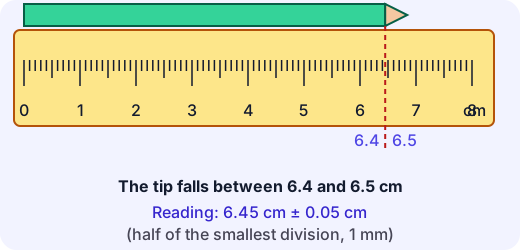
In the picture the pencil's tip falls between the 6.4 cm and 6.5 cm marks. The best estimate is the middle, 6.45 cm. We could be out by up to half of the smallest division, which is 0.5 mm or 0.05 cm. We write
The "" part is the uncertainty. It says: the true length is probably somewhere between 6.40 cm and 6.50 cm.
Why measurements vary
There are two different kinds of error, and they need different cures.
- Random errors push readings up or down by chance: your reaction time on a stopwatch, a ruler that you line up slightly differently each time. Repeating the measurement and taking the mean (average) helps, because the highs and lows partly cancel.
- Systematic errors push every reading the same way: a ruler whose end is worn off, a stopwatch that starts late every time, always reading from the left. Repeating does not remove them. You have to find the cause (check the zero, look from straight above) and fix it.
Example. Five students time a toy cart rolling down a slope: 4.2 s, 4.5 s, 4.3 s, 4.4 s, 4.1 s.
- Mean .
- The readings run from 4.1 s to 4.5 s, a range of .
- A simple estimate of the uncertainty is half the range, .
- Result: .
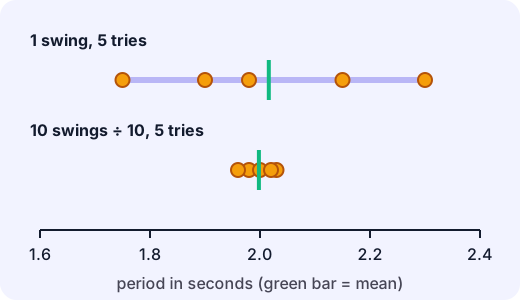
Notice what the picture shows. A tightly bunched set of readings is called precise; readings close to the true value are accurate. A systematic error can give readings that are precise but not accurate, like a very tidy group of darts that all miss the bullseye in the same direction.
Misconception. "A stopwatch that shows hundredths of a second times things to a hundredth of a second." It does not. Your thumb takes about 0.2 s to react at the start and again at the end, so a hand-timed result is uncertain by a few tenths of a second, whatever the display says. Also, "more digits" is not "more accurate": if the uncertainty is s, writing 4.3012 s is silly.
Kinds of motion
An object is in motion if its position changes with time. Scientists sort motion by the path it follows.
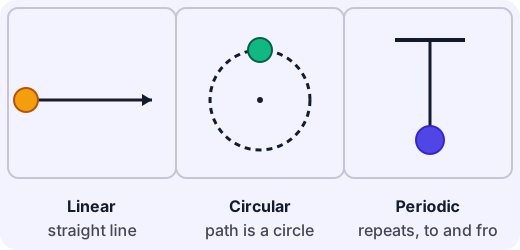
- Linear motion is along a straight line: a train on a straight track, an apple falling from a branch, a sprinter in a 100 m race.
- Circular motion is along a circle: the tip of a ceiling-fan blade, a stone whirled on a string, a seat on a Ferris wheel. (The Earth's path around the Sun is very nearly a circle, though not exactly.)
- Periodic motion repeats itself after equal intervals of time: a swing, a pendulum, your heartbeat, the Moon going once round the Earth in about 27 days, the Earth turning once in about 24 hours.
These groups overlap. The fan blade's tip moves in a circle and repeats, so its motion is both circular and periodic. A ball rolling off a table is neither: it never repeats.
The time for one complete repeat is the period, usually written . A pendulum that swings out and back to where it started in 2 s has .
Measuring a period well
Timing one swing by hand is a poor plan. Your reaction time (about 0.2 s) is a large fraction of a swing that lasts only 2 s. The trick is to time many swings and divide.
Example. A student times 20 complete swings of a pendulum and gets . Her reaction time makes the total uncertain by about .
- Period .
- Uncertainty in the period .
- Result: .
If she had timed only one swing, the same s would be more than a fifth of the whole period. By spreading the error over 20 swings she made it 20 times smaller. The same trick works for thin things: to find the thickness of one page, measure a stack of 100 pages and divide by 100.
Try it: Hang a small weight on a 1 m string from a fixed support (an adult checks it is secure). Time 10 swings, three times, and note the three totals. Find the mean total, divide by 10 for the period, and give half the range of your totals divided by 10 as the uncertainty. Then try just one swing three times and compare how much the readings jump around.
Key ideas
- SI units (m, kg, s and prefixes such as kilo-, centi-, milli-) let everyone share measurements.
- Every measurement has an uncertainty. Report it: value uncertainty.
- Repeat, average, and estimate the uncertainty as half the range. Fix systematic errors at their source.
- Motion can be linear, circular or periodic. The period is the time for one repeat, and timing many repeats gives a better period.
Lab
Pendulum timer
Time a pendulum with a hand stopwatch that has realistic reaction-time error. Compare timing one swing with timing many swings, and see how repeated readings show the uncertainty.
Your goals
- Take at least 5 readings timing 1 swing and at least 5 timing 10 or 20 swings on the same string length.
- Compare the range of the two sets and say which gives the smaller spread in the period.
The interactive lab opens once you register. Register to do this.
Quick check
Measurement and motion check
Eight questions on units, uncertainty and kinds of motion.
1.What is the SI base unit of time?
- second
- minute
- hour
Choose one
2.A table is 2.5 m long. How long is it in centimetres?
Answer with a number
3.Put these lengths in order from the shortest to the longest.
- 1 m
- 1 km
- 1 cm
- 1 mm
Put these in order
4.Four students time a trolley and get 2.31 s, 2.45 s, 2.38 s and 2.42 s. What is the mean time, in seconds?
Answer with a number
5.Using the same four readings (2.31, 2.45, 2.38, 2.42 s), estimate the uncertainty as half the range. Give it in seconds.
Answer with a number
6.Match each example to its kind of motion.
- A ball rolling straight down a smooth ramp
- A point on the rim of a turning bicycle wheel
- A child on a swing, going out and back
Match each to: Linear motion · To-and-fro periodic motion · Circular motion
7.Why is it better to time 20 swings of a pendulum than 1 swing?
- The stopwatch works better when it runs for longer.
- The reaction-time error is about the same size either way, so dividing it among 20 swings makes the error in one period much smaller.
- A pendulum swings faster after the first swing.
- It removes every error from the result.
Choose one
8.Which of these would make a length measurement more trustworthy? Pick all that apply.
- Repeat it several times and take the mean
- Use a ruler with smaller divisions, if the object needs it
- Look straight down at the mark you are reading
- Write down more digits than the ruler can show
Choose all that apply
Answering and checking are for registered learners. Register to do this.
Quick check
New puzzles on measuring and motion
Use the ideas in situations the reading did not show.
1.A student times 15 swings of a pendulum and gets 27.0 s, with an uncertainty of 0.6 s in the total. What is the uncertainty in the period of one swing, in seconds?
Answer with a number
2.A stack of 100 sheets of paper is 9.5 mm thick. How thick is one sheet, in millimetres?
Answer with a number
3.A toy car goes round a circular track, taking 40 s for each lap. How many complete laps does it make in 10 minutes?
Answer with a number
4.Sana measures a table three times with one ruler: 120.0, 120.2 and 119.9 cm. Dev measures it three times with another ruler: 121.5, 121.4 and 121.6 cm. His readings agree closely with each other but not with hers. What is the most likely explanation?
- Dev's readings are so close together that he must be exactly right.
- Something shifts all of Dev's readings the same way, such as a worn ruler end that he did not allow for.
- Random errors always make results agree with each other.
- A table has no true length.
Choose one
Answering and checking are for registered learners. Register to do this.
Your turn
Explain uncertainty and motion
Answer in your own words. Use numbers where you can.
- Ravi says, "My stopwatch shows hundredths of a second, so my hand timing of a 100 m run, 14.37 s, is accurate to 0.01 s." Explain what is wrong with this claim, and say what he should write instead.
- Describe how you would find the period of a swing in the playground as exactly as you can with only a phone stopwatch. Say how many swings you would time, what you would repeat, and how you would give your final answer with its uncertainty.
- Give one example each of linear, circular and periodic motion that you have seen this week, and say one thing that makes each example belong to its kind.
How it's judged
- Understanding uncertainty
- Planning a period measurement
- Kinds of motion
Writing and submitting your answer is for registered learners. Register to do this.
Like what you see?
Register for free to answer the quick checks, do the activities and save your work. Your work is saved on your device and syncs to your account.