Unit 2
Diversity of living things
Sort plants and animals by their features and habitats, and see why the sorting shows who is related to whom.
Read
Sorting the living world
Is a bat a bird? It flies, it has wings, it comes out at dusk like the swifts. Is a whale a fish? It lives in the sea, it has fins and a smooth streamlined body. Most people feel sure of their first answers, and most are wrong. To see why, we need to look at how scientists sort the living world, and what they pay attention to when they do it.
How many kinds are there?
People have given scientific names to about two million species of living things, and biologists think there are many millions more waiting to be found, especially insects, fungi and tiny creatures of the deep sea. One mango tree, one tiger and one mushroom look nothing alike. To make sense of this diversity, we sort organisms into groups. That sorting is classification.
Habitat: where something lives
A habitat is the place where an organism lives and finds what it needs: a desert, a coral reef, a pond, a mangrove forest like the Sundarbans, a mountain meadow. Living things have adaptations, features of their bodies or behaviour that help them survive in their habitat.
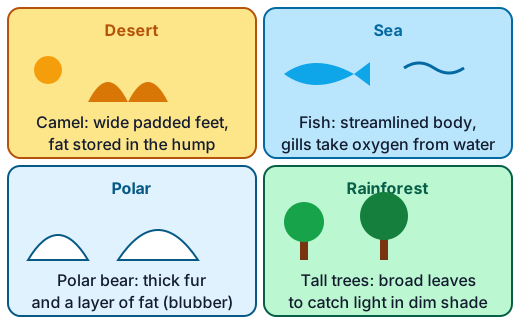
Habitat is a useful way to group organisms when we study ecosystems. But it is a poor way to find out who is related to whom. A shark and a dolphin both live in the sea, and both have a torpedo-shaped body and fins. Yet a shark is a fish and a dolphin is a mammal. Unrelated animals in the same habitat often end up looking alike, because the same problem (moving fast through water) has the same good solutions.
Features that reveal relatives
To group organisms by relationship, scientists look at features that are built into the body plan, not at where an animal lives or how it looks at a glance. A feature such as hair, a backbone or feathers is shared because the animals inherited it from a common ancestor. Today, scientists also compare DNA, and it usually agrees closely with the groups made from body features.
Example. A bat has wings, but its wings are skin stretched over long finger bones. It also has fur, and it feeds its babies on milk. Those are mammal features. A bird's wing is covered in feathers, and birds have beaks and lay hard-shelled eggs. Flying evolved separately in bats and birds, so a bat is a mammal.
The groups of animals
The first big split in the animal kingdom is whether the animal has a backbone.
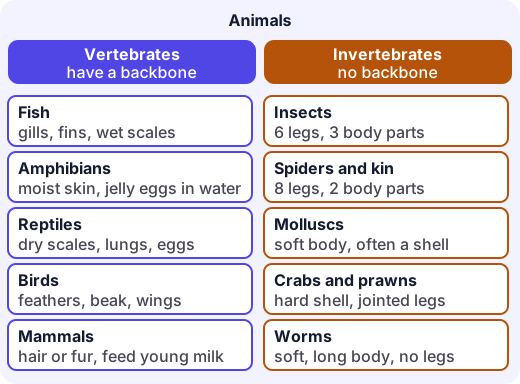
Some points to remember:
- Fish breathe with gills. Sharks, rohu and seahorses are fish. Whales and dolphins are not, because they breathe air with lungs.
- Amphibians (frogs, toads, newts) have moist skin and usually start life in water as tadpoles, then change body shape and live partly on land.
- Reptiles (snakes, lizards, turtles, crocodiles) have dry scaly skin and lungs.
- Birds are the only living animals with feathers.
- Mammals have hair or fur and feed their young on milk from the mother. Humans, bats, whales and elephants are all mammals.
- Insects have six legs and three body parts (head, thorax, abdomen). A spider has eight legs and two body parts, so it is not an insect. Octopus and snails are molluscs, not fish.
The groups of plants
In everyday life we sort plants by shape: herbs (small, soft green stems, like tulsi), shrubs (woody stems that branch near the ground, like hibiscus), trees (a tall, thick woody trunk, like neem), and climbers and creepers (weak stems that climb or spread, like the money plant or pumpkin).
Scientists also sort plants by how they reproduce:
Group How it reproduces Examples Flowering plants flowers, then seeds inside fruits mango, rice, sunflower Conifers seeds in cones pine, deodar Ferns tiny spores under the leaves; no flowers bracken, maidenhair fern Mosses spores; small, no true roots moss on a damp wall Mushrooms look like plants but are fungi: they cannot make food from sunlight and they absorb food from what they grow on. They have a kingdom of their own.
Groups inside groups
Classification works like folders on a computer. The biggest group is the kingdom, and each group is split into smaller ones:
A species is, roughly, a kind of organism whose members can breed with each other and have fertile young. Each species has a two-part scientific name in Latin, the genus then the species, written in italics: the tiger is Panthera tigris, the lion is Panthera leo, the mango is Mangifera indica and humans are Homo sapiens. One name is used all over the world, even though the peepal tree is called a different name in almost every Indian language.
The more levels two organisms share, the more closely related they are. Tiger and lion share a genus (Panthera). The domestic cat, Felis catus, shares only the family (cats) with them. A tiger and a bat share the class (mammals) but belong to different orders. That is the big idea of this unit: the groups are a family tree, so classification shows how organisms are related.
Using a key
A dichotomous key is a set of yes-or-no questions that leads you to a name. Each question splits the possibilities in two.
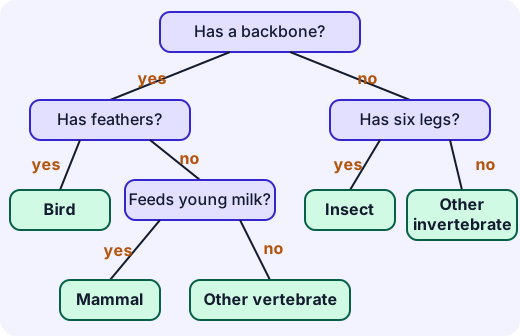
Example. Use the key for a crow. Backbone? Yes. Feathers? Yes. It is a bird. Now a bat: backbone, yes; feathers, no; feeds young milk, yes: a mammal. Notice that "has wings" was never a question, because it would have put bats and birds in the same group.
Misconception. "If it lives in water, it is a fish." Dolphins and whales are mammals, octopuses are molluscs, and a frog is an amphibian. Always check the features.
Classifying a mystery animal
Example. You find an animal with a backbone, dry scaly skin, four legs and soft-shelled eggs buried in sand. Work through the groups.
- Backbone: it is a vertebrate.
- No feathers and no fur, so not a bird or mammal.
- Dry scales and eggs on land, not moist skin and jelly eggs in water, so not an amphibian.
- No gills, so not a fish.
It is a reptile. Notice that you needed several features, not one.
Key ideas
- A habitat is where an organism lives; an adaptation is a feature that helps it survive there.
- Scientists classify by shared body features, because those show common ancestry. Habitat and outward look can mislead.
- Animals split into vertebrates and invertebrates; plants into flowering and non-flowering groups; fungi are a separate kingdom.
- The levels (kingdom, phylum, class, order, family, genus, species) make a family tree, and the two-part scientific name gives the genus and species.
Lab
Sort the organisms
Read the clue about each living thing, then choose its group and its habitat. The clues are about body features, so look for the ones that decide the group.
Your goals
- Put all 11 organisms in the right group and the right habitat.
- Notice which two organisms share a group but not a habitat.
The interactive lab opens once you register. Register to do this.
Quick check
Diversity of living things check
Eight questions on sorting living things.
1.Why is a blue whale classified as a mammal and not as a fish?
- It is very large.
- It breathes air with lungs, has a little hair and feeds its calf on milk.
- It does not live in a river.
- It swims very fast.
Choose one
2.Which of these animals is NOT an insect?
- Ant
- Spider
- Butterfly
Choose one
3.Match each animal to its group.
- Frog
- Crocodile
- Bat
- Peacock
Match each to: Reptile · Amphibian · Bird · Mammal
4.Which features do all vertebrates share? Pick all that apply.
- A backbone
- Feathers
- A skeleton inside the body
- Hair or fur
Choose all that apply
5.Why do scientists group animals by body features rather than by habitat?
- Habitat is always hard to find out.
- Shared body features come from common ancestors, but unrelated animals in the same habitat can look alike.
- Features never change, but habitats do.
- Every animal has the same habitat.
Choose one
6.In the scientific name Panthera tigris, what is the first word called? (One word.)
Answer with a word or phrase
7.Put these groups in order from the biggest group to the smallest.
- Family
- Genus
- Kingdom
- Species
- Class
Put these in order
8.A small key says: 1a Has a backbone, go to 2. 1b No backbone, it is an invertebrate. 2a Has feathers, it is a bird. 2b No feathers, go to 3. 3a Feeds young on milk, it is a mammal. 3b Does not feed young on milk, it is another vertebrate. A bat flies at night, has fur and feeds its young milk. Where does the key put a bat?
- Invertebrate
- Bird
- Mammal
- Another vertebrate
Choose one
Answering and checking are for registered learners. Register to do this.
Quick check
New puzzles on classifying
Use what you know about features to sort things you have not met before.
1.Explorers find a new animal in a dry cave. It has a backbone, dry scaly skin, breathes with lungs and lays leathery eggs on land. Which group does it belong to?
- Amphibian
- Reptile
- Fish
- Mammal
Choose one
2.A penguin cannot fly and spends most of its life swimming. Why is it still a bird?
- Because it lives near the sea.
- Because it has feathers, a beak and lays hard-shelled eggs.
- Because all swimmers are birds.
- Because it is a vertebrate, and all vertebrates are birds.
Choose one
3.A garden has 2 spiders, 5 ants, 3 butterflies, 1 beetle and 4 earthworms. How many of these animals are insects?
Answer with a number
4.A student puts shark, dolphin, seahorse and octopus into one group called 'fish' because they all live in the sea. Which of these animals are NOT fish? Pick all that apply.
- Shark
- Dolphin
- Seahorse
- Octopus
Choose all that apply
5.Lion is Panthera leo, tiger is Panthera tigris and domestic cat is Felis catus. Which statement is best supported by the names?
- The lion is more closely related to the tiger than to the domestic cat.
- The tiger is more closely related to the cat than to the lion.
- All three are in the same species.
- The cat and the lion are the same genus.
Choose one
Answering and checking are for registered learners. Register to do this.
Your turn
Explain how living things are sorted
Write in your own words.
- A friend says, "A bat is a bird because it flies, and a whale is a fish because it lives in water." Explain, using features, why both claims are wrong. Say what each animal actually is.
- Choose any three organisms from your home, street or school (at least one plant and one animal). For each, say its habitat and two features, and say which group it belongs to.
- Explain why classifying by shared body features tells us more about how organisms are related than classifying by habitat does. Use the shark and the dolphin to help.
How it's judged
- Using features to classify
- Classifying real organisms
- Why features show relatedness
Writing and submitting your answer is for registered learners. Register to do this.
Like what you see?
Register for free to answer the quick checks, do the activities and save your work. Your work is saved on your device and syncs to your account.