Unit 7
Adaptation and survival
Be the hungry bird, and find out why the animals that fit their habitat best are the ones that survive when the habitat changes.
Read
Who fits, who survives
Ishaan counts beetles on the school lawn for his science project. In September, after the rains, the lawn is bright green. He finds 10 green beetles and 10 brown beetles in his square metre. A few weeks later he counts again and finds lots of green ones and only a few brown ones. The crows and sparrows that hunt the lawn can spot a brown beetle on green grass from far away, but they often miss a green one.
Then a few dry years come. The lawn turns brown and crunchy each summer and stays that way. Ishaan, now in a higher class, counts again, and this time the brown beetles are the common ones.
Nobody moved the beetles and nobody painted them. So what changed? This unit gives you the idea that explains it.
Adaptations
An adaptation is a trait that helps a living thing survive and reproduce in its habitat, the place where it lives. Living things have a wonderful variety of them:
Living thing Adaptation How it helps Camel wide, padded feet walks on soft sand without sinking Duck webbed feet pushes against water for swimming Cactus thick, juicy stem stores water in a dry desert Owl soft-edged feathers flies almost silently to catch prey Mangrove tree roots that stick up out of the mud gets air in waterlogged soil Yak thick, shaggy coat stays warm in the cold Himalayas Adaptations are traits, so they are inherited. A baby duck is born with webbed feet. It does not have to grow them because it needs them.
Variation and survival
You know from the last unit that offspring vary. In any group of living things, some individuals have traits that suit the habitat a bit better than others. Some beetles are green and some are brown. Some finches have strong beaks and some have weak ones. Some plants have longer roots.
When life is easy, all of them may do fine. But when food or water is short, or when hunters are about, the ones with the better-fitting traits are more likely to survive. And the ones that survive are the ones that have young.
The beetle story, step by step
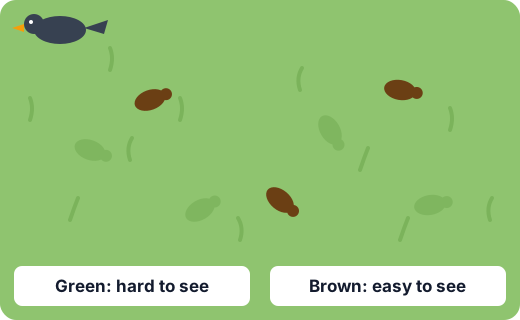
- Variation: the beetles in the meadow are green or brown.
- A challenge: birds hunt by sight, and a meadow of green grass hides green beetles better than brown ones.
- Survival: more brown beetles are eaten, so more green beetles survive.
- Young: the survivors lay eggs, and the young inherit their parents' colour. Green parents have green young.
- Over time: each generation has a larger share of green beetles.
Example. Here are the numbers for one meadow.
- At the start there are 10 green and 10 brown beetles.
- Birds eat 2 green beetles and 6 brown ones. That leaves 8 green and 4 brown.
- Each survivor has 2 young of its own colour. The next generation has 8 × 2 = 16 green and 4 × 2 = 8 brown.
Green beetles were 10 out of 20, which is half. Now they are 16 out of 24, which is two thirds. If the same thing happens again and again, the brown beetles become rarer and rarer.
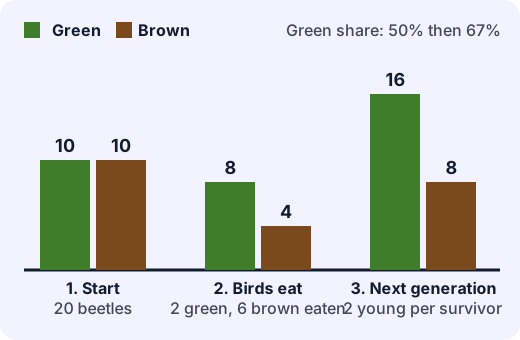
Notice what did not happen. No beetle turned green. No beetle decided anything. The green beetles were already there. The habitat simply "chose" which ones had more young. This takes many generations, not one afternoon.
When the habitat changes
Now the dry season comes, and the meadow turns brown.
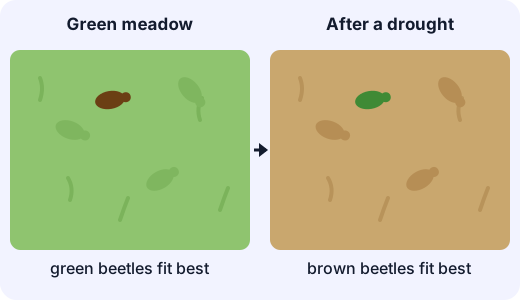
Everything flips. Green beetles now stand out, so birds eat more green ones, and the brown beetles have more young. That is why Ishaan found mainly brown beetles. A trait that helps in one habitat may not help in another.
You can use this to predict. When a habitat changes, ask: "Which traits help now?" The individuals that have them will do better, and over many generations that trait will become more common.
If none of the individuals has a trait that helps, the group may shrink and even die out. When a wetland is drained to make a car park, frogs that need water to lay eggs have nowhere to breed. A real example from England: about 150 years ago, factory smoke blackened tree trunks, and dark peppered moths, which are harder for birds to see on dark bark, became more common than pale ones. After cleaner air laws, trunks became paler, and the pale moths came back. Scientists have tested this with experiments and counts.
Mistakes to avoid
- "Animals change because they need to." No. Traits come from parents. An animal cannot choose to grow a new trait.
- "A giraffe stretched its neck, so its babies have long necks." No. Stretching during life is not inherited. Giraffes with longer necks reached more leaves, survived, and had more young with long necks.
- "The strongest always survives." Not always. What matters is how well a trait fits the habitat: the best-hidden beetle, the best-fitting beak.
- "It is just luck." Luck plays a part for any one beetle, but across many beetles the better-fitting ones survive more often.
Try it: Pick a plant or animal you know well. Name one adaptation. Then imagine its habitat changed (a drought, a cold winter, a new road). Which individuals would survive best, and why?
Remember
- An adaptation is a trait that helps a living thing survive and reproduce in its habitat.
- Individuals vary. Those with traits that fit the habitat survive more often and have more young, who inherit those traits.
- Over many generations the helpful trait becomes more common in the group.
- When the habitat changes, different traits may help. If none do, the group may die out.
Lab
The beetle meadow
A meadow has green and brown beetles. Be the bird in round 1, then watch what happens over the next generations. Then a drought turns the meadow brown. Predict what happens next.
Your goals
- Hunt in round 1, then run at least two more generations on the green meadow and watch the shares change.
- Predict which beetles will do better when the meadow turns brown, then run the generations to check.
- Explain why the brown beetles became more common.
The interactive lab opens once you register. Register to do this.
Activity
The paper beetle hunt
Model how hunting birds change a group of beetles over several generations, first on one background and then on another. About 45 minutes, with a partner.
You'll need
- Old newspaper (a page with printed text) for one background, and a sheet of plain bright colour (chart paper or a coloured cloth) for the other
- Paper in two kinds: pieces cut from the same newspaper, and pieces cut from a sheet of the same bright colour as the second background
- Scissors (an adult helps younger children)
- A watch or phone timer
- A partner to be the bird
- Pencil and paper for a results table
Steps
- Cut 20 small squares (about 1 cm) from the newspaper and 20 from the bright coloured paper (the same colour as your second background). These are your 'beetles'. Spread the newspaper page on a table or floor. This is the meadow.
- Predict first: write which beetles you expect to survive on the newspaper meadow, and why.
- While the bird looks away, scatter all 40 beetles on the newspaper. The bird turns around and picks up as many beetles as it can, one at a time, in 15 seconds. Stop when the time is up or when 15 have been picked.
- Count the beetles left of each kind (the survivors). Write the numbers in your table: generation 1.
- Breeding: for every survivor, add one more of the same kind. So each survivor has one young one, and the family doubles. If there are more than 40, remove some at random to keep the meadow full.
- Repeat the hunt, the count and the breeding two more times (three generations on the newspaper). Record the numbers each time and draw a bar graph.
- Change the habitat: swap the newspaper for the bright plain background. Use the beetles you have now, and run three more generations.
- Write what happened in each habitat, and explain it using these words: variation, inherited, survive, habitat.
Safety
- Take care with scissors. Cut away from your body and put them away when you finish.
- Paper squares are small. Keep them away from babies and pets, do not put them in your mouth, and collect every piece at the end.
- If you do this outdoors on grass, check the ground for ants, thorns and sharp things first.
Keeping a log of the activity is for registered learners. Register to do this.
Quick check
Adaptation and survival check
Eight questions about adaptations, variation and what happens when a habitat changes.
1.What is an adaptation?
- A trait that helps a living thing survive and reproduce in its habitat
- A change an animal makes on purpose when it feels cold
- The place where an animal lives
Choose one
2.Hungry birds hunt by sight in this green meadow. Which beetles are more likely to survive, and why?
- Green beetles, because they are harder for the birds to see
- Brown beetles, because brown is a stronger colour
- Both the same, because colour makes no difference
Choose one
3.A meadow has 12 green and 12 brown beetles. Birds eat 3 green beetles and 9 brown beetles. How many brown beetles are left?
Answer with a number
4.Match each adaptation to the job it does.
- A camel's wide, padded feet
- A duck's webbed feet
- A cactus's thick, juicy stem
- An owl's soft-edged feathers
Match each to: Walk on sand without sinking · Store water in the desert · Fly silently to catch prey · Push against water to swim
5.Dana says, "Giraffes stretched their necks to reach leaves, so their babies were born with longer necks." What is the best correction?
- Giraffes that happened to have longer necks reached more leaves, survived, and had more young with long necks
- Dana is right: stretching makes the neck longer for the babies
- Giraffes' necks are long by pure luck, and nothing helps them
Choose one
6.A wetland pond is drained and covered with a car park. Which animal in the area is most likely to disappear?
- Frogs, which need water to lay their eggs
- Crows, which eat all kinds of food
- Pigeons, which nest on buildings
Choose one
7.Put these steps in order, from first to last.
- Those animals survive more often and have more young
- The young inherit the helpful traits
- Some have traits that fit the habitat better
- The animals in a group vary in their traits
- Over many generations the helpful trait becomes more common
Put these in order
8.A brown beetle is being hunted on a green lawn. Can it turn green to survive?
- No. Its colour is inherited, so it cannot change it because it needs to
- Yes, animals change colour when they need to
- Yes, if it tries hard
Choose one
Answering and checking are for registered learners. Register to do this.
Quick check
New puzzles
Predict what will happen when living things face a new challenge.
1.A city's tree trunks are covered with dark soot from factory smoke. Birds hunt moths by sight. Some moths are pale and some are dark. Predict what will happen to the moths over many generations.
- Dark moths will become more common, because they are harder to see on dark trunks
- Pale moths will become more common, because pale is a lighter colour
- Nothing will change, because moths cannot change colour
Choose one
2.Years later, new laws clean the air and the tree trunks slowly become pale again. What would you expect next?
- Pale moths will slowly become more common again
- Dark moths will keep getting more common
- All the moths will die out
Choose one
3.A drought leaves an island with only big, hard-shelled seeds to eat. Look at the two finches. Which is more likely to survive and have young, and what would you expect in the next generations?
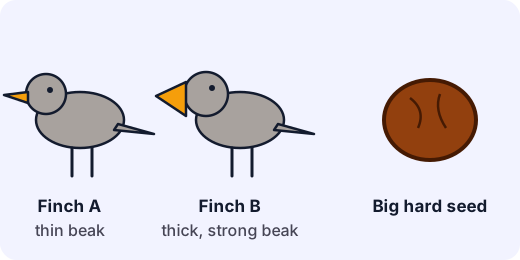
- Finch B, and more finches with thick strong beaks
- Finch A, and more finches with thin beaks
- Both the same, because the drought does not matter
Choose one
4.A farmer sprays a pesticide on a field every season. In the first year it kills nearly all the insects, but a few survive because they are slightly less affected. Years later, the same spray hardly works. Why?
- The survivors had young that inherited their ability to survive the spray, so those insects became common
- The insects learned to avoid the spray and taught their young
- The pesticide got weaker in the bottle
Choose one
5.A woodland has 20 pale moths and 20 dark moths on dark trunks. Birds eat 16 pale moths and 4 dark moths. Each surviving moth has 2 young of its own colour. How many dark moths are in the next generation?
Answer with a number
Answering and checking are for registered learners. Register to do this.
Your turn
Why did the beetles change?
A lake shore has two kinds of small fish: silver fish and dark fish. At first the lake bottom is pale sand, and herons catch the fish that they can see. A few years later, mud washes in and the lake bottom turns dark brown.
Write 6 to 10 sentences to explain what you expect to happen to the two kinds of fish.
- Before the mud: which fish do the herons catch more often, and which survive better? Explain why.
- How the group changes over many generations on the pale sand. Mention variation, young and inheritance.
- After the mud: predict what happens to the number of silver fish and dark fish, and say why.
- A mistake to avoid: say why it would be wrong to say that "the silver fish turned dark because they needed to".
How it's judged
- Variation and survival
- Inheritance and change over time
- Habitat change and misconception
Writing and submitting your answer is for registered learners. Register to do this.
Like what you see?
Register for free to answer the quick checks, do the activities and save your work. Your work is saved on your device and syncs to your account.