Unit 6
Traits and inheritance
Find out why puppies look like their parents but not like each other, and why the same seeds can grow into different plants.
Read
Like their parents, but not the same
Meera's neighbour has a brown dog called Moti with long floppy ears. One monsoon, Moti has four puppies. Their father is a cream dog with ears that stand straight up.
Meera visits the puppies every day. She notices two things. First, all four puppies look a bit like Moti and a bit like their father. Second, the four puppies do not look the same as each other! One is brown with floppy ears, one is cream with pointy ears, and two are mixtures.
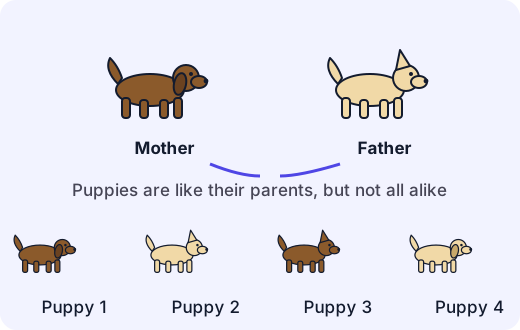
"Why are they alike, but not exactly alike?" Meera asks. Let us find out.
Traits
A trait is a feature of a living thing: the colour of a dog's coat, the shape of its ears, the colour of a flower, the shape of a leaf, how tall a tree grows, a person's eye colour or the curl of their hair.
Inherited traits
Many traits are inherited. That means they are passed from parents to their young, who are called offspring. Inside every living thing are tiny instructions for building its body. Parents pass copies of these instructions to their offspring. (Scientists call these instructions genes. You will learn much more about them in later years.)
So puppies are born with floppy or upright ears, brown or cream fur, because of what they inherited. A mango seed grows into a mango tree and never into a banyan, and a duck's egg hatches into a duckling and never into a chick. Offspring resemble their parents because traits are inherited.
Variation: alike but not identical
Each offspring gets its own mixture of instructions from its two parents. That is why offspring are not copies. The puppies in Meera's litter inherit coat colour from both parents in different mixes, so each puppy comes out a little different. The differences between individuals of the same kind are called variation.
You can see variation everywhere: in the shapes and sizes of beans in a packet of rajma, in the spots of a leopard (no two leopards have exactly the same pattern), in children in the same family. People who study tigers use this: each tiger has its own stripe pattern, so a photograph can tell scientists which tiger it is.
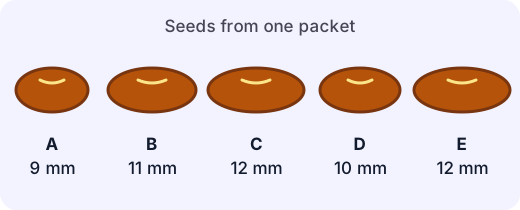
A big idea about variation: the offspring of the same parents can be different from each other and from their parents.
Traits that are not inherited
Not every difference between living things comes from parents. Some things are learned, and some things happen to you:
- Speaking Hindi, Tamil or English, riding a bicycle, or knowing how to read are learned.
- A scar on the knee, a short haircut, a sun tan, or big muscles from exercise come from what happened to you.
These are not passed on. A person who learns to swim does not have a baby who is born knowing how to swim. A dog with a notch cut in its ear does not have puppies with notched ears. Each baby starts out new, with only inherited instructions.
The environment shapes traits too
The environment is everything around a living thing: light, water, soil, food, temperature. The environment can change how an inherited trait turns out.
Example. Dev plants bean seeds from one packet in two pots. He puts one pot in a sunny window and the other in a dark cupboard, and gives both the same amount of water. After ten days:
Pot Where it sits Height of the plant How it looks A Sunny window 13 cm short, thick stem, green leaves B Dark cupboard 26 cm tall, thin stem, pale leaves 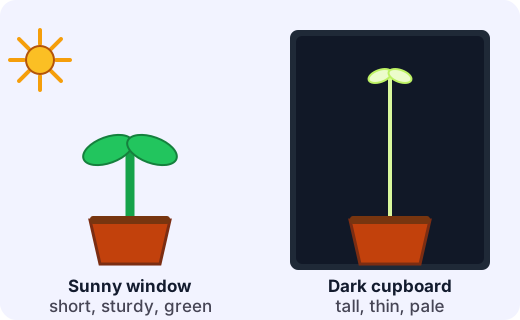
The seeds came from the same packet, so they were very much alike. The big difference between the pots cannot come from inheritance. It comes from the environment: the plants in the cupboard stretched upward to look for light, and without light their leaves stayed pale. Pot B plants are 13 cm taller than pot A plants (26 − 13 = 13), but they are not healthy, and they would soon die.
Most traits come from both. How tall a child grows depends on the height of their parents (inherited) and on food, sleep and health (environment). A mango tree from a very sweet variety bears sweet mangoes, but a tree that is starved of water gives small fruit.
Sorting traits
Mostly inherited Mostly from the environment or learning Both leaf shape, eye colour, number of legs a dog has, the spots of a leopard speaking a language, a scar, a haircut, riding a bike height of a person, weight of an animal, how tall a plant grows Common mistakes
- "Children are copies of their parents." No: they are a new mixture and they vary.
- "A trait you learned or gained can be passed on." No: a scar, a skill or big muscles are not inherited.
- "A trait is either inherited or from the environment." Many traits are shaped by both.
Try it: Look at the members of your family (or a pet's litter, or fruit from one tree). Which traits do they share? Which differ? Which differences might come from the environment?
Remember
- A trait is a feature of a living thing. Offspring inherit traits from their parents, so they resemble them.
- Offspring vary: they are not copies of their parents or of each other.
- Things you learn or things that happen to you are not inherited.
- The environment also shapes traits. Most traits come from both inheritance and the environment.
Lab
The puppy and bean nursery
At the nursery you will breed litters of puppies to see how offspring resemble their parents and vary, then grow bean seeds in different light and water to see how the environment changes a plant.
Your goals
- Breed three litters and tell how the puppies compare with their parents and with each other.
- Grow bean seeds in at least three different conditions, including a sunny window and a dark cupboard.
- Explain why seeds from one packet can grow into different plants.
The interactive lab opens once you register. Register to do this.
Activity
Seeds, light and family traits
Measure variation in a handful of seeds, then run a fair test to see how light changes a growing plant. About 30 minutes on the first day, then 5 minutes a day for a week.
You'll need
- A handful of seeds of one kind (10 for measuring: rajma, chana or pumpkin seeds work well) and a few moong (green gram) seeds for growing
- A ruler with millimetres
- Two small cups or jars, cotton wool or soil, and water
- A sunny windowsill and a dark cupboard or a box with a lid
- Paper and a pencil
Steps
- Variation: pick 10 seeds of one kind. Measure the length of each to the nearest millimetre and write them in a table. Line the seeds up from shortest to longest. What is the difference between the longest and the shortest? Are any two exactly alike?
- Set up a fair test. Put cotton wool or soil in two cups. Sow 3 moong seeds in each cup, and give both cups the same amount of water. Label the cups Light and Dark.
- Predict first: write down what you think the plants in each cup will look like after a week, and why.
- Put the Light cup on the sunny windowsill and the Dark cup in the cupboard. Do not change anything else. Add the same amount of water to both cups each day.
- Each day, measure the tallest shoot in each cup and note its colour and thickness. Make a table, and draw a line graph if you can.
- After a week, compare the plants. Write which trait differed (height, colour, thickness), what the seeds had in common, and which thing was different (the environment). Was your prediction right?
- Family traits (optional): choose three traits to compare (for example hair type, height, or how a pet's fur looks) in two or three family members, pets or friends. Write which look inherited and which might come from the environment, like a haircut or sun tan. If this does not suit your family, use plants or animals you know instead.
Safety
- Wash your hands after touching soil or seeds.
- Do not eat the seeds or the sprouts. Keep small seeds away from babies and toddlers, who can choke on them.
- If you use a cupboard, make sure it is one an adult says is safe to use and that the cups cannot spill onto anything.
Keeping a log of the activity is for registered learners. Register to do this.
Quick check
Traits and inheritance check
Eight questions about traits, inheritance, variation and the environment.
1.Which of these is an inherited trait?
- The colour of a kitten's fur
- Knowing how to ride a bicycle
- A scar on a knee
- Knowing the alphabet
Choose one
2.Which of these are NOT inherited? Pick all that apply.
- A scar from falling off a swing
- Speaking Tamil
- Eye colour
- Riding a bicycle
- The shape of a mango leaf
Choose all that apply
3.Look at the puppies and their parents. Why do the four puppies look different from each other?
- Each puppy inherits its own mixture of traits from both parents
- They were fed differently
- Puppies are copies of their mother, and the differences are mistakes
Choose one
4.A cricketer trains for years and builds strong arm muscles. Will her baby be born with the same strong muscles?
- Yes, traits you build are passed on
- No, muscles built by exercise are not inherited
- Yes, but only if the baby is a boy
Choose one
5.Two pots hold bean seeds from the same packet. Pot A sits in a sunny window and pot B in a dark cupboard. Pot B's plants are tall, thin and pale; pot A's are short, sturdy and green. What caused the difference?
- The environment: the amount of light
- The seeds in pot B inherited different traits
- Nothing, the difference is just chance
Choose one
6.Look at the five seeds from one packet. How many millimetres longer is the longest seed than the shortest seed?
Answer with a number
7.What does the height a child grows to depend on?
- Both what they inherited and things like food and health
- Only the heights of their parents
- Only the food they eat
Choose one
8.What word means the small differences between individuals of the same kind, such as between beans in a packet?
Answer with a word or phrase
Answering and checking are for registered learners. Register to do this.
Quick check
New puzzles
Use what you know about inheritance, variation and the environment in new situations.
1.A farmer sows the same variety of tomato seeds in two fields. The plants in Field A, with rich soil and plenty of water, grow tall. The plants in Field B, with poor dry soil, stay small. A neighbour says the seeds in Field B must be a different kind. Is that the only possible explanation?
- No, the soil and water in each field can change how the same kind of plant grows
- Yes, the same kind of seed always grows to the same size
- Yes, because plants inherit their size from the field
Choose one
2.Every tiger has its own pattern of stripes, a little different from every other tiger. How can scientists use this fact?
- They can tell individual tigers apart from photographs taken by camera traps
- They can tell exactly how old a tiger is
- They can tell what a tiger ate yesterday
Choose one
3.Which of these are traits that the environment, not only inheritance, can change? Pick all that apply.
- A sapling bending toward a sunny window
- The pattern of stripes on a tiger cub
- The colour of a person's eyes
- A pet's weight when it is fed too much
Choose all that apply
4.Imran wants to show that light affects how tall bean plants grow. Which plan is a fair test?
- Plant seeds from one packet in the same soil with the same water, one pot in light and one in a dark cupboard
- Plant different kinds of seeds in the light and in the dark
- Give the plant in the light lots of water and the plant in the dark none
Choose one
Answering and checking are for registered learners. Register to do this.
Your turn
Why are they different?
A younger cousin asks you two questions:
- "Our cat had four kittens. They all have the same mother and father, but one is black, one is orange and two are mixed. Why aren't they the same?"
- "I planted two beans from the same packet. One is in a sunny window and one is in a dark cupboard. The one in the cupboard is tall and pale. Does that mean it got different instructions from its parents?"
Write 6 to 10 sentences to answer both questions. Include:
- What a trait is, with an example, and what inherited means.
- Why the kittens are alike but not identical (use the word variation).
- Why the bean plants differ, and how you know it is the environment.
- An example of something that is not inherited (learned or from an experience), and a trait that comes from both inheritance and the environment.
How it's judged
- Inherited traits and variation
- Environment
- Not inherited and both
Writing and submitting your answer is for registered learners. Register to do this.
Like what you see?
Register for free to answer the quick checks, do the activities and save your work. Your work is saved on your device and syncs to your account.