Unit 1
Asking testable questions
Learn which questions an experiment can answer, and how to poke at a mystery to work out its rule.
Read
What if I change this?
Zainab is waiting for the school bus when a leaf drifts down onto her shoe. Then another. Then she wonders: "Why do some leaves spin and some just fall flat?"
It is a lovely question, but how would she find out? She could guess. She could ask a teacher. Or she could do something scientists love to do: turn her curiosity into a question she can test.
A question you can test
Zainab picks up two sheets of paper and crumples one. She thinks: "What if I change the shape of the paper? Will it fall slower or faster?"
That is a testable question, because it has two parts:
- Something you can change. Here, the shape of the paper. We call this the input (what you put in or change on purpose).
- Something you can watch or measure. Here, how long the paper takes to reach the floor. We call this the output (what comes out, what you observe).
A good question names something you can change and something you can watch.
Compare it to "Why are leaves so pretty?" There is nothing to change and nothing to measure. Feelings are real, but an experiment cannot answer them.
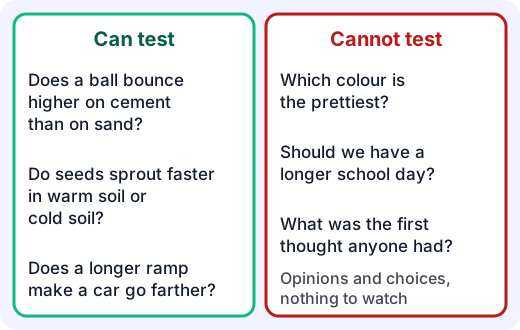
Kinds of question that an experiment cannot answer
Kind Example Why it can't be tested Opinion "Is mango the best fruit?" People can honestly disagree, and nothing can be measured. What we should do "Should we plant more trees on our street?" It is a choice about values. Science can give facts to help, but not make the decision. Not possible to watch "What would have happened if the Moon had never existed?" We cannot change that and look. Nothing is wrong with these questions. They are just answered in other ways: by talking, voting, thinking, or reading.
Turning curiosity into "what if I change X?"
Here is a recipe. Start with something you wonder about, then ask what could I change? and what could I watch?
Example. Wonder: "Do plants like sunshine?"
- "Like" is hard to watch. A plant can't tell us.
- What could we change? How many hours of light the plant gets.
- What could we watch? How tall the plant grows, in centimetres, after two weeks.
Testable question: "Does a bean plant grow taller with 6 hours of light a day than with 2 hours?"
Notice how it got specific. It names the plant, the thing we change (hours of light) and the thing we measure (height).
Try it: Turn this into a testable question: "Is it better to dry clothes in the sun?" What could you change? What could you measure? (One answer: "Do wet socks dry faster in the sun than in the shade?" Measure how long until they feel dry.)
Systems with inputs and outputs
A system is anything that does something when you put something in. A toaster takes in bread and a dial setting, and puts out toast of some colour. A bicycle takes in your pedalling and puts out speed. A tap takes in a twist and puts out water.
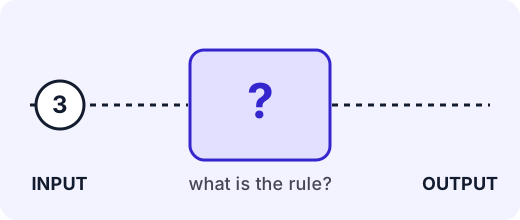
Sometimes you cannot see inside a system. You can still learn how it works by poking it: change one input, watch the output, write it down, and repeat.
Reverse-engineering a rule
Say a mystery machine gives these results:
Input Output 1 5 4 8 10 14 Step 1: look for a pattern. Each output is 4 more than its input: , , .
Step 2: guess the rule. "The machine adds 4."
Step 3: test the guess with a new input. Try 20. Your rule predicts 24. If the machine gives 24, great. If it gives 40, your rule was wrong, and that is useful information too!
Why test a new input? Because several rules can fit a few results. If you had tried only the input 4, then "add 4" and "multiply by 2" would both give 8. More pokes means fewer wrong guesses.
A common mistake
Many people think a scientist's job is to prove they are right. Really it is to find out what is true, even when the answer is a surprise. A good test is one that could have shown your idea was wrong.
Remember
- A testable question names something you can change (input) and something you can watch (output).
- Opinions and "should we" questions are real questions, but experiments don't answer them.
- To work out a hidden rule, poke it with several inputs, look for a pattern, guess, then test the guess with a new input.
Lab
Poke the mystery machines
Three machines have secret rules. Put in numbers, watch what comes out, and work out each rule. Test at least three different inputs before you guess.
Your goals
- Put several different numbers into each machine and read the table of results.
- Find the secret rule of all three machines.
The interactive lab opens once you register. Register to do this.
Activity
Question makeover and a hidden-rule game
Practise turning curiosity into testable questions, then play a hidden-rule game with a friend or family member. About 30 minutes.
You'll need
- Paper and a pencil
- A partner (a friend, brother, sister or grown-up)
- Optional - a ruler, a toy car and some books to make a ramp
Steps
- Write down 5 things you wonder about from around home or school (for example: Why does ice melt faster in my hand? Which paper plane flies farthest?).
- For each one, make two columns: what I could change, and what I could watch or measure. If you cannot fill both columns, the question is not testable yet.
- Rewrite your best two as 'What if I change X? Will Y change?' questions. Make them specific: name what you change and how you will measure.
- Optional: test one. Lean a book on a stack of books to make a low ramp. Roll a toy car down it and measure how far it travels past the bottom with a ruler. Change only the height of the ramp, and measure three times for each height.
- Hidden-rule game: Player A secretly picks a rule for numbers, such as 'add 3', 'double it', or 'double it and add 1'. Player B says any number from 1 to 20 and A answers with the number the rule gives. B writes the results in a table.
- When B thinks they know the rule, B must first test it with a number they have not tried yet. Then B says the rule. Swap roles and play three rounds.
Safety
- If you build a ramp, keep it low and on the floor, and put the books away afterwards so nobody trips.
- Do not test anything that involves fire, mains electricity, sharp tools or tasting unknown things.
Keeping a log of the activity is for registered learners. Register to do this.
Quick check
Testable questions check
Seven questions about questions. Take your time.
1.Which of these questions can you answer with an experiment?
- Is mango juice tastier than orange juice?
- Does a ball bounce higher on a hard floor than on grass?
- Why are rainbows so beautiful?
- Should our family get a dog?
Choose one
2.Pick every question that is testable.
- Does salt in the water make an egg float more easily?
- Is cricket a better game than football?
- Do paper planes with longer wings fly farther?
- Do ghosts live in old houses?
Choose all that apply
3.A student tests whether the amount of water changes how tall a bean plant grows. Match each part to its job.
- How much water the plant gets
- The plant's height in cm after two weeks
- Same kind of seed and same pot
Match each to: Output (what you watch) · Keep the same · Input (what you change)
4.A mystery machine gave the results in the table. What will it give when you put in 20?
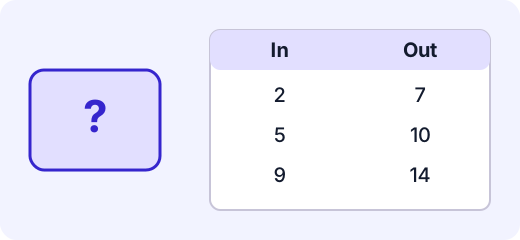
Answer with a number
5.In a test, the thing you change on purpose is called the ____ (one word).
Answer with a word or phrase
6.Zainab wonders, 'Do plants like sunshine?' Which version is best for an experiment?
- Do plants love the sun?
- Does a bean plant grow taller with 6 hours of light a day than with 2 hours?
- Are sunny windows nicer than shady ones?
Choose one
7.Put these steps in the best order for working out a hidden rule.
- Test your guess with a new number
- Write down the number that comes out
- Look for a pattern in your table
- Guess the rule
- Put a number into the machine
Put these in order
Answering and checking are for registered learners. Register to do this.
Quick check
New puzzles
Use what you know about testable questions and hidden rules in situations you have not seen before.
1.A machine turns 1 into 3, 2 into 5, and 3 into 7. Which rule fits all three?
- Add 2
- Double it, then add 1
- Multiply by 3
Choose one
2.Using the rule you found (1 gives 3, 2 gives 5, 3 gives 7), what comes out when 10 goes in?
Answer with a number
3.Ravi asks, 'Does the colour of a paper cup change how fast ice melts in it?' What should he watch or measure?
- Which cup looks the prettiest
- How much of the ice has melted after 20 minutes
- Which colour he likes best
Choose one
4.Which question can NOT be answered by doing an experiment?
- Does sugar dissolve faster in warm water than in cold water?
- Is it wrong to be unkind to a classmate?
- Does a heavier toy car roll farther down a ramp?
Choose one
Answering and checking are for registered learners. Register to do this.
Your turn
Explain a testable question
Your younger cousin says, "Science is just guessing. You can ask anything and science finds out."
Write a short explanation (6 to 10 sentences) to help your cousin. Include:
- Two questions: one that is testable and one that is not. Use your own examples, not ones from the reading.
- For the testable one, say what you would change and what you would watch or measure.
- Why can't an experiment answer the other one? What could people do instead to answer it?
How it's judged
- Testable and not-testable examples
- What you change and what you watch
- Why the other question cannot be tested
Writing and submitting your answer is for registered learners. Register to do this.
Like what you see?
Register for free to answer the quick checks, do the activities and save your work. Your work is saved on your device and syncs to your account.