Unit 2
Hypotheses and predictions
Write down what you expect before you test, and find out why a surprise is the best thing that can happen in science.
Read
Guess first, then look
Neha is helping her uncle in the kitchen. He holds up an orange and asks, "If I drop this into the water bowl, will it sink or float?"
"Sink!" says Neha at once. "It's heavy and it's full of juice."
Splash. The orange floats.
Neha's mouth falls open. "What? Why?"
That little jolt of "what?!" is one of the most useful feelings in science. To see why, we need four words.
Four words scientists use
Word What it means Neha's example Hypothesis A possible explanation that you can test "Heavy things sink." Prediction What you expect to see in one particular test, if your hypothesis is true "This orange will sink." Evidence What you actually observe when you run the test "The orange floated." Result Putting the evidence next to your prediction: did they match? "My prediction was wrong." A hypothesis is more than a wild guess. It is an idea that tries to explain something and that gives us predictions to check. Often we write it as: "If … then … because …"
If heavy things sink, then this big orange will sink because it is heavy.
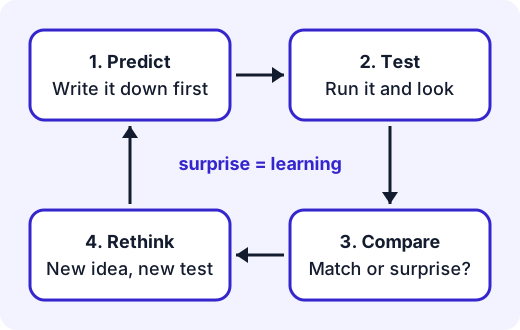
Why do we guess before we look?
Your brain is a prediction machine. When you step onto a stair you expect it to be there. When someone throws you a ball, your hands move to where the ball will be, not where it is. And when a stair is missing or the ball is lighter than you thought, you notice the surprise straight away.
That is the key. A surprise only happens if you expected something. If Neha had not predicted anything, the floating orange would just be a fact, and she might not think about it at all.
Write the prediction down first
Here is a trick that our brains play on us. After we see a result, we often feel we "knew it all along". Scientists call this hindsight. If Neha did not write down "sink", she might later say, "I thought it would float." Her memory would quietly change.
So a good scientist writes the prediction before the test. Then it cannot be changed. When the result arrives, there is a fair comparison:
- Match. The evidence supports the hypothesis. (It does not prove it forever, but it fits so far.)
- Surprise. The evidence does not fit. Something about the hypothesis needs to change.
A prediction must be able to be wrong. "The orange might sink or might float" can never be wrong, so it tells you nothing. "The orange will sink" can be wrong, so it is worth testing.
Worked example: what happened to the orange?
Step 1. Evidence. The orange floated, though Neha predicted sink.
Step 2. Think of a new hypothesis. Neha asks: "What if heavy is not the whole story? Maybe the orange's peel has little pockets of air that help it float."
Step 3. Make a new prediction from it. "If the peel's air helps it float, then an orange without its peel will sink."
Step 4. Test. Uncle peels the orange and Neha drops it in. It sinks! (In plain water, a peeled orange usually does.)
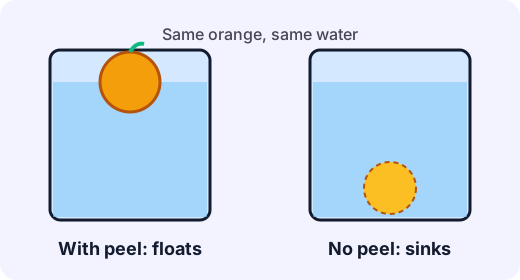
Notice what happened. Neha's first hypothesis was wrong, but being wrong led her to a better hypothesis, and to a new test. Without her first prediction, she would never have asked.
Mistakes that people make
- "If my prediction is wrong, I failed." No! A wrong prediction is information. Some of the biggest discoveries began with someone saying "that's strange."
- Changing the prediction afterwards. This is cheating yourself. Write it, then leave it alone.
- Making the prediction so vague it can't be wrong. Say exactly what you expect to see.
- Thinking a match proves the hypothesis for ever. A match means the idea survived this test. We keep testing it in new ways.
Try it: Pick a coin and a plastic bottle cap. Write down for each: "sink" or "float". Then test in a bowl of water. How many of your predictions matched?
Remember
- A hypothesis is a testable explanation. A prediction is what you expect in one test. Evidence is what you see.
- Predict before you test, and write it down.
- Compare the result with the prediction. A surprise tells you your idea needs work, and that is how you learn.
Lab
Predict, drop, compare
Eight objects, one tank of water. Choose sink or float for each object before you drop it. Your prediction is locked once you press Drop, so you can compare honestly.
Your goals
- Predict, then test, all eight objects.
- Count your surprises and choose the idea that best explains the orange.
The interactive lab opens once you register. Register to do this.
Activity
Predict how far it rolls
Write predictions first, then test them with a ramp and four small objects. About 30 minutes.
You'll need
- A smooth board, tray or thick piece of cardboard for a ramp
- Two or three books to prop it up
- Four small round or rolling things, for example a marble, a small ball, a round pencil and an empty tin or jar lid on its edge (anything that rolls)
- A ruler or tape measure
- Paper and a pencil
Steps
- Set up a ramp: lean the board on the books so it slopes down onto a smooth floor. Mark the bottom of the ramp with tape.
- Write a hypothesis in the form 'If … then … because …' about which object will roll the farthest (for example: 'If an object is heavier, then it will roll farther because there is more push behind it.' It may turn out to be wrong, and that is fine.).
- Before you test anything, write a prediction for each object: the order from farthest to shortest. Put the paper face down so you cannot peek.
- Release each object from the same spot at the top. Do not push. Measure how far from the tape each one stops. Do each one twice and write both distances.
- Compare: lay your prediction next to the results. Mark each object where the order matched, and mark any surprise with a star.
- Pick your biggest surprise. Write a new hypothesis that would explain it and a new prediction you could test (for example, on carpet instead of a smooth floor).
Safety
- Keep the ramp low and stable, and keep marbles away from very young children (choking hazard).
- Work on the floor, clear the area so nobody trips over rolling objects, and pick up the marbles afterwards.
Keeping a log of the activity is for registered learners. Register to do this.
Quick check
Hypotheses and predictions check
Seven questions. Think about what each word means.
1.Match each word to its meaning.
- Hypothesis
- Prediction
- Evidence
Match each to: What you actually observe · A possible explanation that you can test · What you expect to see in one particular test
2.Which of these is a prediction?
- Things with air trapped inside tend to float.
- This cork will float when I put it in the bowl.
- The cork floated.
Choose one
3.When should you write your prediction?
- Before running the test
- While the test is running
- After you see the result, so it is correct
Choose one
4.Kabir predicted his toy car would roll farther on the smooth floor, but it went farther on the rug. What is the best thing to do?
- Change the written prediction so that it matches
- Keep the prediction, record the result, and ask why it differed
- Throw away the result because it was wrong
Choose one
5.Put the steps of a fair prediction test in order.
- Run the test
- Compare the result with the prediction
- Decide if your idea needs to change
- Record what happened
- Write your prediction
Put these in order
6.Look at the table. For how many of the four objects did the prediction match what happened?
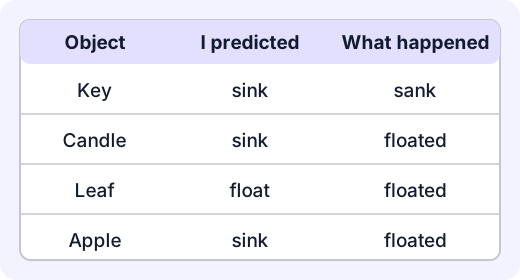
Answer with a number
7.Why does writing a prediction first help? Pick all that are true.
- It stops us from pretending afterwards that we knew the answer
- It lets us notice when a result surprises us
- It guarantees that our prediction is right
- It gives us something definite to compare the result with
Choose all that apply
Answering and checking are for registered learners. Register to do this.
Quick check
New puzzles
Use hypotheses, predictions and evidence in some new situations.
1.Dev has this hypothesis: 'A bigger wheel rolls farther than a small wheel.' Which prediction follows from it?
- A large toy wheel will roll farther down the ramp than a small one
- Wheels are round
- Dev likes big wheels
Choose one
2.Mina watched an egg float in salty water and said, 'I knew it would!' But she never wrote a prediction down. What is the problem?
- There is no problem. Saying it afterwards is just as good
- Without a written prediction, nobody can tell whether she really knew, or just remembers it that way afterwards
- Eggs cannot float
Choose one
3.Which prediction is the most useful to test?
- The leaf might float or it might sink
- The leaf will float
- Something will happen to the leaf
Choose one
4.A test gives a result that surprises you. What would a good scientist do next?
- Think of an idea that explains it, and plan a new test
- Decide the experiment was silly and forget it
- Change the old prediction and say nothing
Choose one
Answering and checking are for registered learners. Register to do this.
Your turn
A prediction story
A friend says, "Why bother writing a prediction? I'll just do the test and see what happens."
Write a reply (6 to 10 sentences) that helps your friend. Include:
- A short story of a test where you (or an invented person) predicted something. State the hypothesis, the prediction, the evidence and whether there was a match or a surprise.
- Why it matters to write the prediction before the test.
- What you or the person would do next if the result was a surprise.
How it's judged
- Using the words hypothesis, prediction and evidence correctly
- Why a written prediction matters
- What to do after a surprise
Writing and submitting your answer is for registered learners. Register to do this.
Like what you see?
Register for free to answer the quick checks, do the activities and save your work. Your work is saved on your device and syncs to your account.