Unit 4
Polite forms, places and festivals
Choose the right polite form for each person, and meet the places and festivals where Hindi lives.
Read
Aap, tum and the world of Hindi
Sam is visiting Meera's family in Jaipur. Meera's grandfather, whom she calls Dada ji, opens the door. Sam has practised all week, and he says in his best Hindi: "तुम कैसे हो?"
The room goes quiet for a moment. Then Dada ji laughs kindly. Meera whispers, "Say आप! You say aap to an elder." Sam tries again: "आप कैसे हैं?" Dada ji beams. "Main theek hoon, beta. Aaiye, baithiye!"
Sam's words were not wrong in grammar. But Hindi cares about who you are talking to. A language is not only words and rules. It also comes with the manners of the people who speak it.
Three ways to say "you"
English has one word, "you". Hindi has three, each with its own verb ending.
Form Used for "How are you?" आप (aap) elders, teachers, strangers, anyone you want to show respect आप कैसे हैं? (aap kaise hain?) तुम (tum) friends, classmates, younger relatives, people close to you तुम कैसे हो? (tum kaise ho?) तू (tu) very close friends, small children, or in prayer तू कैसा है? (tu kaisa hai?) 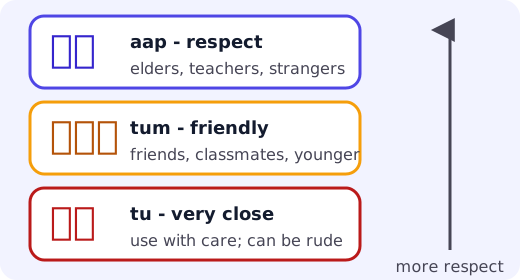
Notice that the verb changes too: aap ... hain, tum ... ho, tu ... hai. If you use the wrong "you" with an adult you do not know, it can sound rude. Using tu with a stranger is the most likely to cause offence.
When you are unsure, use aap. Nobody is upset to be shown too much respect. As a learner, use aap for everyone except friends your own age.
Words of politeness
Hindi Say it Use कृपया kripayaa please धन्यवाद / शुक्रिया dhanyavaad / shukriya thank you माफ़ कीजिए maaf kijiye excuse me, I'm sorry जी jee yes, respectfully; also added to a name नमस्ते namaste hello and goodbye, with palms together The little word जी (jee) is a gift. Added after a name or title, it adds warmth and respect: Dada ji (grandfather), Dadi ji (paternal grandmother), Mata ji (mother), Gupta ji. Alone, "जी" means a polite "yes" or "pardon?".
The "-iye" ending: polite requests
When you ask or invite someone politely, Hindi uses verbs that end in -iye or -iyega:
Hindi Say it Meaning आइए aaiye please come in बैठिए baithiye please sit पानी लीजिए paani leejiye please have some water माफ़ कीजिए maaf kijiye please excuse me To a friend your age you could say the shorter बैठो (baitho, sit) or पानी लो (paani lo, take some water), the tum forms. To an elder or guest, say the -iye form.
Example. Your friend's grandmother arrives. You should (1) put your palms together, (2) say नमस्ते, दादी जी, (3) ask आप कैसी हैं? (use kaisi for a woman), and (4) offer her a seat with बैठिए. That is a complete, polite welcome using words you already know.
Try it: With a grown-up, practise the welcome above. Then change the person: how would you say it to a friend your own age? Which words change?
Greetings change with community
Namaste is the most common Hindi greeting, but it is not the only one. In many families, young people greet elders by bending to touch their feet, a custom called charan sparsh. In some families and communities people say adaab or salaam, and Sikh families often greet with sat sri akaal. You do not have to do all of them. Watch what the people around you do and follow their lead.
Places where Hindi lives
Hindi is a language of north and central India: Uttar Pradesh, Madhya Pradesh, Rajasthan, Bihar, Haryana, Himachal Pradesh, Uttarakhand, Jharkhand, Chhattisgarh and Delhi. Cities you may hear about include Delhi, Jaipur (the "Pink City"), Agra (home of the Taj Mahal), Varanasi (on the river Ganga, one of the oldest cities still lived in) and Lucknow (famous for its food and its polite way of speaking).
But India has many languages. The country's constitution lists 22 of them, and states like Tamil Nadu, Kerala, West Bengal and Gujarat have their own. Many people in India speak two or three languages, and Hindi is not the first language of everyone in India.
Hindi travels. Families from India moved to Fiji, Mauritius, Trinidad, Guyana and Suriname generations ago, and their communities still speak languages related to Hindi, sing Hindi songs and watch Hindi films. There are large Hindi-speaking communities in Nepal, the UAE, the UK, the USA, Canada and Singapore. Hindi and Urdu sound very similar in everyday talk, though they are written in different scripts.
Festivals
Festivals are where a language comes alive: songs, food, greetings. Many follow a lunar calendar, so their dates move from year to year.
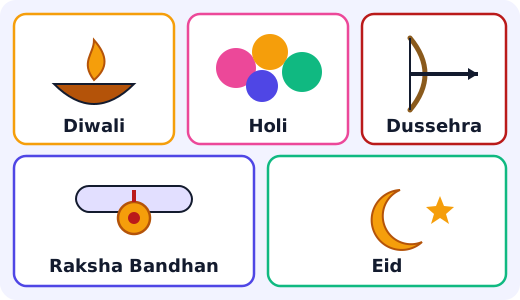
Festival When (about) What happens A greeting Diwali (दिवाली) October or November The festival of lights: rows of clay lamps (diyas), sweets, rangoli patterns शुभ दीपावली (shubh deepaavali) Holi (होली) March Spring and colours: people play with coloured powder and water होली मुबारक (holi mubaarak) Dussehra (दशहरा) September or October Good wins over evil; plays about the story of Rama, and large figures of Ravana are burnt दशहरा की शुभकामनाएँ Raksha Bandhan (रक्षाबंधन) August Sisters tie a thread (rakhi) on their brothers' wrists, and brothers promise to care for them रक्षाबंधन की शुभकामनाएँ Eid (ईद) after the month of Ramzan Prayers, new clothes, sweets, visiting friends ईद मुबारक (eed mubaarak) Shubhkaamnaayein means "good wishes", and it can follow any festival name. For a birthday, say जन्मदिन मुबारक हो (janmadin mubaarak ho).
Common mistakes
- Using tu or tum with elders. Use aap.
- Thinking Hindi is the language of all of India. It is one of many, and a language of many other countries too.
- Treating every festival the same. Different families and communities celebrate different festivals in different ways. Ask politely and listen.
What to remember
A language comes with the ways of the people who speak it. Use aap for people you respect, tum for friends, add ji, use the -iye requests, and greet a festival with the right wish. Look and listen to how people greet each other, and join in with a smile.
Lab
Manners and meanings
Choose the polite word, the right festival or the right place in ten short situations. Each answer tells you why.
Your goals
- Choose the polite form for elders, friends and strangers.
- Name festivals, a city and a country where Hindi or a related language is spoken.
The interactive lab opens once you register. Register to do this.
Activity
A festival card and a polite welcome
Make a greeting card for a festival where Hindi is spoken, and practise a polite welcome in Hindi with a family member. About 30 minutes.
You'll need
- A sheet of paper or card, folded in half
- Coloured pencils or crayons
- The reading page, for the festival greetings
- A family member or friend to practise with
Steps
- Pick one festival from the reading - Diwali, Holi, Dussehra, Raksha Bandhan or Eid - or another festival from a Hindi-speaking community that you know about.
- On the front, draw a picture that shows what happens at the festival (for example a row of lamps, colours, or a rakhi thread).
- Inside, write the festival greeting in Hindi, copying carefully, and sign your name at the bottom.
- Write one sentence in English that tells the reader something true about the festival, such as when it is held or what people eat.
- Now practise the welcome. Ask your partner to be a grandparent arriving at your door. Say namaste, add ji after a title, ask aap kaise hain / aap kaisi hain, and offer them a seat with baithiye.
- Swap. This time you are the guest and your partner welcomes you. Notice which forms they use (aap or tum).
- Give your card to someone, or keep it in your folder.
Safety
- Do not light diyas, candles or fireworks yourself. If your family lights lamps, a grown-up does it.
- Coloured powders (for Holi) can irritate eyes and skin. Only make a drawing of them for this activity.
Keeping a log of the activity is for registered learners. Register to do this.
Quick check
Polite forms and places check
Seven questions about polite forms, festivals and the places where Hindi is spoken.
1.Who would you normally say आप (aap) to?
- A teacher, an elder or someone you have just met
- A baby or a pet only
- Nobody; it is a rude word
Choose one
2.Match each situation to the best Hindi.
- Asking your teacher how she is
- Asking your best friend, who is your age
- Inviting a guest to sit down
- Saying thank you
Match each to: बैठिए · धन्यवाद · आप कैसी हैं? · तुम कैसे हो?
3.What does adding जी (ji) after a name, as in दादा जी, do?
- It adds respect and warmth
- It puts the sentence in the past
- It turns the sentence into a question
Choose one
4.Match each festival to something people do at it.
- Diwali
- Holi
- Raksha Bandhan
- Dussehra
Match each to: Burn large figures of Ravana · Light rows of small lamps · Play with coloured powder · Tie a thread on a wrist
5.Which statement about languages in India is true?
- India has many languages, and Hindi is the main everyday language in only part of the country
- Everyone in India speaks Hindi as their first language
- Hindi is spoken only in India and nowhere else
Choose one
6.Why does Diwali fall on a different date each year on the usual calendar?
- It follows a lunar calendar, so the date moves
- A new date is chosen at random every year
- It is always on the first day of the month
Choose one
7.Where are Hindi or Hindi-related languages spoken? Choose all that apply.
- Jaipur
- Varanasi
- Fiji
- Iceland, as the language of most families
Choose all that apply
Answering and checking are for registered learners. Register to do this.
Quick check
New puzzles - what would you say?
Think about who you are talking to and what the occasion is.
1.Your friend's grandfather has come to visit. You want to offer him some water politely. Which is best?
- पानी लीजिए (paani leejiye)
- पानी लो (paani lo)
- पानी कहाँ (paani kahaan)
Choose one
2.It is Diwali, and your friend's mother gives you a sweet. What do you wish her?
- शुभ दीपावली (shubh deepaavali)
- ईद मुबारक (eed mubaarak)
- जन्मदिन मुबारक हो (janmadin mubaarak ho)
Choose one
3.On a visit to Trinidad, you hear an older man singing in a language related to Hindi. Why is Hindi music there?
- Families from India moved there generations ago and kept their language and songs
- A law says every school must teach only Hindi
- It is the only language spoken on the island
Choose one
4.You call your mother's mother Nani. Which small word do you add after it to show respect: Nani ___ ? Type it in English letters.
Answer with a word or phrase
5.A friend invites you to celebrate Holi. What should you expect?
- Coloured powder, water and playing outdoors
- Rows of clay lamps in the evening, as at Diwali
- Sisters tying threads on their brothers' wrists
Choose one
Answering and checking are for registered learners. Register to do this.
Your turn
A guide for a visitor
A friend from another country is going to spend a week with a Hindi-speaking family. Write a short guide to help them be polite and enjoy the visit.
- Explain when to use aap and when to use tum. Give one person you would say each to, and the Hindi question "How are you?" in each form.
- Name two polite words or phrases (other than namaste) and say when to use each.
- Choose one festival and describe it in three or four sentences: when it falls, what people do, and a greeting you can say in Hindi.
- Name one city or country where Hindi or a related language is spoken, and say why it matters that Hindi is not the language of everyone in India.
How it's judged
- Polite forms
- Words of politeness
- Festival and places
Writing and submitting your answer is for registered learners. Register to do this.
Like what you see?
Register for free to answer the quick checks, do the activities and save your work. Your work is saved on your device and syncs to your account.