Unit 3
Writing Hindi, one careful stroke at a time
Copy Devanagari letters and marks carefully, then write short words and sentences of your own.
Read
Copy first, then choose your own words
Zara wants to write a birthday card for her friend Ravi, whose family speaks Hindi at home. She has one idea: write "Happy birthday" in his language. She finds the Hindi words in a book, takes out a pencil, and discovers that the hard part is not knowing the words. It is making her hand draw shapes it has never drawn.
Every new alphabet feels like this. The way in is the same for everyone: copy carefully, slowly, and at first not too small. After a week of copying your hand starts to remember the shapes, and then you can begin choosing your own words.
Set up your page
- Use lined paper if you can. Devanagari letters hang from a line, so a ruled line helps you keep every letter at the same height.
- Write big at first, about as tall as two lines of ordinary writing. Shrink later.
- Use a pencil, so you can rub out and try again.
The headline goes last
Almost all Devanagari letters hang from a line on top, the shirorekha (headline). You do not draw a headline on each letter one by one. Instead:
- Write the letters of the word, left to right, without the headline.
- Add any small marks (vowel marks, dots).
- When the word is finished, draw one line across the top of the whole word, joining every letter.
So a word looks like a row of washing hanging from one line. The line is the last stroke.
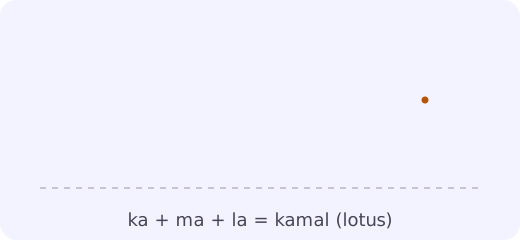
Because every letter has its own shapes and little loops, take stroke order from a chart or from a teacher. A useful general pattern is: draw the curved body of the letter, then its vertical bar, and then add the headline when the word is done.
Marks go where they belong
Vowel marks are part of the spelling. If you leave one out, you write a different word. Their places are fixed:
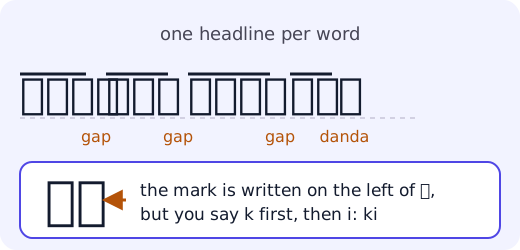
Mark Where it goes Example ा and ी to the right of the letter पानी (paani) ि to the left of the letter किताब (kitaab) ु and ू below the letter दूध (doodh) े ै and ो ौ above the letter के, को ं and ँ on top of the letter they follow बंद, पाँच The mark ि is the one to watch. In कि the mark is written to the left of क, but you say ki, with the k first. When you build a word, think of the sound order first (ka, i), then place the mark where the table says.
Spaces, danda and digits
- Leave a small gap between words so that headlines do not join one word to the next.
- A sentence ends with a tall line । called a danda, not with a full stop dot. (A question ends with ? as in English.)
- Hindi has its own digits: १ २ ३ ४ ५ are 1, 2, 3, 4, 5. People also use the digits you already know, so you will see both.
Your first sentences
Copy these until your hand is steady.
- मेरा नाम मीरा है। (mera naam Meera hai.) My name is Meera.
- यह मेरा घर है। (yeh mera ghar hai.) This is my house.
- मुझे आम पसंद है। (mujhe aam pasand hai.) I like mangoes. (Word by word: "to me mango liking is".)
The last one gives you a template: मुझे ___ पसंद है। Put a food or thing you like in the gap and it stays correct: मुझे चाय पसंद है। (I like tea.) मुझे दूध पसंद है। (I like milk.) You are now choosing your own words.
Example. Write मेरा नाम रवि है।
- Say the words aloud and split them: me-raa, naam, ra-vi, hai.
- Write the letters of the first word, म े र ा, the marks े and ा placed as in the table. Leave a gap.
- Write न ा म. Leave a gap.
- Write र व ि. Remember ि goes to the left of व. Leave a gap.
- Write ह with the mark ै above it to make है, then the danda ।.
- Go back and draw a headline across each word, lifting your pencil at the gaps.
Try it: Write मुझे ___ पसंद है। three times, each time with a different thing you like, using words you know from the reading in the last unit. Then check each one against a chart.
Common mistakes
- Forgetting the headline. The word looks unfinished and can be harder to read.
- Putting ि on the wrong side. Write कि, not a mark after क.
- Mixing look-alike letters: ब and व, घ and ध, म and भ. Compare each one with the chart before you copy.
- Skipping spaces. A long line of letters is hard to read.
- Leaving out a mark. पानी without ी is not a word; दूध and दुध are different.
What to remember
Writing in a new language begins with copying carefully, then choosing your own words. Draw the letters, add the marks in their fixed places, draw the headline last, leave gaps between words and end with a danda. Do it a little each day.
Lab
Word builder
Build Hindi words and short sentences by tapping letters and vowel marks in the right order. The English word and its sound help you; turn the English letters off for a harder try.
Your goals
- Build eight words correctly, with the right letters and marks.
- Build two short sentences by putting the words in the right order.
The interactive lab opens once you register. Register to do this.
Activity
Copy, then compose
Practise writing Hindi on paper. First copy eight words, then write three sentences of your own. About 25 minutes. Do a little each day for the best result.
You'll need
- Lined paper
- A pencil and an eraser
- A coloured pencil for the headline
- The reading page or a Devanagari chart to copy from
Steps
- Write these eight words big, one per line, copying from the reading: बस, कमल, घर, पानी, चाय, किताब, आम, दूध.
- Write the letters first. Add marks like ा, ि, ी and ू in their places. Draw the headline last, in your coloured pencil, in one line across the whole word.
- Say each word aloud when it is finished.
- Look at your page and circle one word you are proud of and one you want to try again. Write the second one two more times.
- Write three sentences using the patterns from the reading: मेरा नाम ___ है। / मुझे ___ पसंद है। / यह ___ है।
- Leave a gap between words and end every sentence with a danda ।.
- Check your sentences against the chart. Check that every word has its headline and every vowel mark is in the right place.
- Read your sentences aloud to a grown-up or friend.
Safety
- Sharpen pencils away from your face and keep the shavings in a bin.
- Take a short stretch break every ten minutes so your hand does not get tired.
Keeping a log of the activity is for registered learners. Register to do this.
Quick check
Writing check
Seven questions on writing Hindi letters, marks and short sentences.
1.When do you draw the headline (the line across the top) in a Hindi word?
- At the end, in one line across the whole word
- Before any letters
- Separately on every letter, before you write it
Choose one
2.In the syllable कि (ki), where is the short i mark ि written?
- To the left of क
- To the right of क
- Below क
Choose one
3.Put the letters in order to write कमल (kamal, lotus).
- क
- ल
- म
Put these in order
4.Put the pieces in order to write पानी (paani, water).
- प
- न
- ा
- ी
Put these in order
5.Which mark usually ends a Hindi sentence?
- ।
- ,
- |
Choose one
6.What does मुझे आम पसंद है। mean?
- I like mangoes.
- My name is Aam.
- Where is the mango?
Choose one
7.Which are good habits when you write Hindi? Choose all that apply.
- Leave a small gap between words
- Draw one headline across the whole word
- Write from right to left
- Leave out the small vowel marks
Choose all that apply
Answering and checking are for registered learners. Register to do this.
Quick check
New puzzles - write new words
These are new words and sentences. Use the letters, marks and patterns you know.
1.Put the pieces in order to write बाल (baal, hair).
- ा
- ल
- ब
Put these in order
2.Put the words in order to say 'I like tea': मुझे चाय पसंद है।
- पसंद
- है
- मुझे
- चाय
Put these in order
3.Which is the correct way to write chaay (tea)?
- चाय
- चय
- चायी
Choose one
4.Which spelling of doodh (milk) has the long oo?
- दूध
- दुध
- दीध
Choose one
5.Which number is written in Hindi digits as ४?
Answer with a number
Answering and checking are for registered learners. Register to do this.
Your turn
Write a short note about yourself
Write a short note about yourself in Hindi for a pen friend.
- Write three sentences using these patterns, filling in your own words: मेरा नाम ___ है। / मुझे ___ पसंद है। / यह ___ है। Use Hindi letters if you can type or copy them. If you cannot, write the sentences in English letters (for example, mera naam Asha hai.) and write the Devanagari on paper to check.
- Choose one word from your note. Explain in two or three sentences how you wrote it: what letters you used, where any vowel marks go, and when you drew the headline.
- Say one mistake that is easy to make when writing Hindi, and how you check for it.
How it's judged
- Three sentences
- Explaining one word
- Spotting mistakes
Writing and submitting your answer is for registered learners. Register to do this.
Like what you see?
Register for free to answer the quick checks, do the activities and save your work. Your work is saved on your device and syncs to your account.