Unit 1
Hello, and how are you?
Greet someone, say your name and where you live, and ask and answer simple questions in Hindi.
Read
A few words go a long way
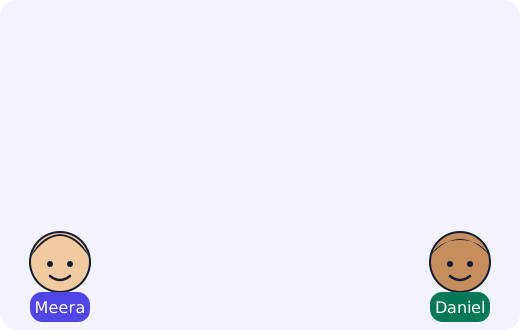
Meera has just started at a new school in Jaipur. A boy she has never met sits down next to her. He smiles, puts his palms together and says one word: नमस्ते.
Meera knows what to do. She smiles, puts her palms together and says it back. They have not said a single sentence yet, but already they have said hello, and they both feel a little less shy.
This unit is about that moment: how to start a conversation in a new language with only a few words. This course teaches Hindi as your second language. Hindi is one of the most widely spoken languages in the world, and it is one of the official languages of India. (If you are learning a different language, the same ideas work for it. The examples here use Hindi, because it is the default.) You will see each Hindi word two ways: in the Hindi script, called Devanagari, and in English letters so you can say it. The English-letter spellings are only a guide to the sounds. You will learn to read the script itself in the next unit.
Say hello
Hindi How to say it Meaning नमस्ते na-mas-TAY hello (and goodbye) आप कैसे हैं? aap KAI-se hain How are you? मैं ठीक हूँ main theek hoon I am fine धन्यवाद dhan-ya-VAAD thank you शुक्रिया shuk-ri-YAA thank you (everyday) हाँ / नहीं haan / na-heen yes / no Namaste is used when you meet and when you leave. Many people press their palms together near the chest when they say it, and a small nod goes with it. A smile and a gesture are part of the language. You can say a lot before you know many words.
Your name and where you live
Here is the whole conversation between Meera and her new neighbour Daniel.
Meera: नमस्ते! मेरा नाम मीरा है। आपका नाम क्या है? (na-mas-tay! MAY-raa naam Meera hai. AAP-kaa naam kyaa hai?)
Daniel: नमस्ते! मेरा नाम डैनियल है। (na-mas-tay! MAY-raa naam Daniel hai.)
Meera: आप कहाँ रहते हैं? (aap ka-HAAN reh-te hain?)
Daniel: मैं जयपुर में रहता हूँ। आप कैसी हैं? (main jai-pur mein reh-taa hoon. aap KAI-see hain?)
Meera: मैं ठीक हूँ, धन्यवाद। (main theek hoon, dhan-ya-vaad.)
Look for the patterns:
- मेरा नाम ___ है means "My name is ___." Word by word it is "my name ___ is". Hindi puts the verb at the end. That is the biggest difference from English.
- आपका नाम क्या है? means "What is your name?" Notice that mera (my) became aapka (your), and kyaa (what) was added.
- मैं ___ में रहता हूँ means "I live in ___." Mein works like "in".
Boys and girls say it differently
Look at Daniel's sentence: rehta hoon. A girl or woman says रहती (rehti) instead: मैं दिल्ली में रहती हूँ. In the same way you ask a man आप कैसे हैं? and a woman आप कैसी हैं?. Hindi verbs and some other words change with the gender of the person they describe. It is only a small change at the end of the word, but it matters. Listen for it.
Question words
Three little words let you ask about almost anything.
Hindi Say it Meaning Example क्या kyaa what यह क्या है? (What is this?) कौन kaun who कौन है? (Who is it?) कहाँ ka-HAAN where पानी कहाँ है? (Where is the water?) 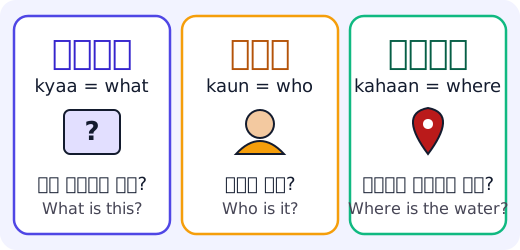
To answer "What is this?" you say यह ___ है (yeh ___ hai), "This is a ___." Some words to put in the gap:
Hindi Say it Meaning पानी paa-nee water किताब ki-taab book घर ghar house, home दूध doodh milk बिल्ली bil-lee cat And to count: एक (ek) 1, दो (do) 2, तीन (teen) 3, चार (chaar) 4, पाँच (paanch) 5.
Example. You want to ask where the water is. You know paani (water) and kahaan (where). Because the verb goes at the end, you say: पानी कहाँ है? (paani kahaan hai?), "Water where is?" That is a perfectly good question.
Try it: Say the whole Meera and Daniel conversation out loud with a friend or grown-up, one of you for each part. Then say it again, but use your own name and your own town.
Listening tips
- You do not need to understand every word. Catch the question word first (kyaa, kaun, kahaan) and you know what kind of answer is wanted.
- If you do not understand, say फिर से, कृपया (phir se, kripayaa), "Again, please."
- Say new words out loud, again and again. Your mouth needs to practise, not only your eyes.
- A common mistake is thinking you must translate each word from English in the same order. Hindi has its own order, with the verb last. Learn whole little sentences like mera naam ___ hai as one block.
What to remember
A few words, a smile and a gesture can start a real conversation: namaste, your name, where you live, and one question word. Next you will meet the Hindi script, so you can read these words and not only say them.
Lab
Reply to the speaker
Read what the speaker says in Hindi and choose the best reply. Turn on "Show English letters" if you want help with the sounds.
Your goals
- Choose a good reply in all eight short conversations.
- Notice the small words for who, what and where.
The interactive lab opens once you register. Register to do this.
Activity
Say it out loud
Practise a real conversation in Hindi with a family member or friend. About 15 minutes. You will have a short conversation twice, and if you can, record it.
You'll need
- A family member or friend to talk with
- Paper and pencil
- Optional, if a grown-up agrees - a phone or tablet to record your voice
Steps
- Write these five lines in English letters on paper: namaste; mera naam ___ hai; aapka naam kya hai?; main ___ mein rehta (boy) or rehti (girl) hoon; aap kaise hain?
- Say each line aloud three times by yourself. Press your palms together when you say namaste.
- Ask your partner to be a new classmate. Greet them, say your name, ask theirs, ask where they live and how they are, and answer when they ask you. Use gestures freely.
- Swap parts. Now you are the new classmate and they start the conversation.
- If you do not understand, try "phir se, kripya" (again, please) before switching to English.
- Finish with "dhanyavaad" and "namaste". Then count from ek to paanch together.
- Talk the conversation through once more without looking at your paper.
Safety
- Only record your voice if a grown-up at home agrees, and keep the recording to yourself, your teacher and your family.
Keeping a log of the activity is for registered learners. Register to do this.
Quick check
Greetings and questions check
Seven questions about greeting, introducing yourself and asking simple questions in Hindi.
1.Someone says to you: आपका नाम क्या है? (aapka naam kya hai?) What are they asking?
- What is your name?
- How are you?
- Where do you live?
Choose one
2.Someone asks you: आप कैसे हैं? (aap kaise hain?) Which reply makes sense?
- मैं ठीक हूँ, धन्यवाद। (main theek hoon, dhanyavaad.)
- मेरा नाम मीरा है। (mera naam Meera hai.)
- यह घर है। (yeh ghar hai.)
Choose one
3.Match each Hindi word to its meaning.
- पानी (paani)
- किताब (kitaab)
- घर (ghar)
- दूध (doodh)
Match each to: milk · water · book · house, home
4.The word कहाँ (kahaan) asks about...
- a person
- a thing
- a place
Choose one
5.Which of these are questions? Choose all that apply.
- आपका नाम क्या है? (aapka naam kya hai?)
- मेरा नाम मीरा है। (mera naam Meera hai.)
- आप कहाँ रहते हैं? (aap kahaan rehte hain?)
- मैं ठीक हूँ। (main theek hoon.)
Choose all that apply
6.The Hindi number पाँच (paanch) is which number?
Answer with a number
7.A shopkeeper hands you a bottle of water. What do you say in Hindi?
- धन्यवाद (dhanyavaad)
- माफ़ कीजिए (maaf kijiye)
- नहीं (nahin)
Choose one
Answering and checking are for registered learners. Register to do this.
Quick check
New puzzles - speaking up
These situations were not in the reading. Use what you know about Hindi words and sentence order.
1.You are at a railway station and want to ask where the water is. You know पानी (paani) is water and कहाँ (kahaan) is where. Which question works?
- पानी कहाँ है? (paani kahaan hai?)
- पानी क्या है? (paani kya hai?)
- पानी कौन है? (paani kaun hai?)
Choose one
2.Zoya is a girl who lives in Mumbai (मुंबई). Someone asks her: आप कहाँ रहते हैं? Which answer is right for her?
- मैं मुंबई में रहती हूँ। (main Mumbai mein rehti hoon.)
- मैं मुंबई में रहता हूँ। (main Mumbai mein rehta hoon.)
- मेरा नाम मुंबई है। (mera naam Mumbai hai.)
Choose one
3.You hold up चार (chaar) fingers on one hand and एक (ek) finger on the other. How many fingers is that in all?
Answer with a number
4.Someone knocks on your door and you want to ask who it is. Which Hindi word do you use?
- कौन (kaun)
- क्या (kya)
- कहाँ (kahaan)
Choose one
5.In English, what does किताब (kitaab) mean? Type one word.
Answer with a word or phrase
Answering and checking are for registered learners. Register to do this.
Your turn
Explain how a conversation works
Imagine your cousin is going to visit a family in India and knows no Hindi. Help them with a short guide.
- Write a six-line conversation in which your cousin meets a new friend. Use English letters for the Hindi (for example, namaste) and put the English meaning in brackets after each line. Include a greeting, your cousin's name, a question about the friend's name, and a question about where the friend lives.
- Explain in your own words one way Hindi sentences are put together differently from English sentences.
- Name one thing your cousin can do, besides speaking, to make the greeting friendly, and say why it helps when they know only a few words.
How it's judged
- The conversation
- Sentence order
- Gestures and manners
Writing and submitting your answer is for registered learners. Register to do this.
Like what you see?
Register for free to answer the quick checks, do the activities and save your work. Your work is saved on your device and syncs to your account.