Unit 2
Cracking the Hindi script
Match the shapes of Devanagari to sounds, then read signs, labels and short sentences.
Read
Shapes that make sounds
Aarav is at a bus station in Lucknow with his aunt. Everything around him is covered in writing he cannot read: signs, tickets, tea stalls. His aunt points to a board and asks, "What does that say?" He looks at the shapes, each with a line across the top, and has no idea.
Then she shows him a trick. "Every shape is a sound. Put the sounds together and the word comes out." She points at बस and says it slowly: ba... sa... bas. "Bus!"
That trick is what this unit is about. The Hindi script is called Devanagari (say dev-na-GAA-ree). It is also used for Marathi, Nepali and Sanskrit, so learning it opens many doors. Devanagari is much more regular than English spelling. A letter usually has one sound, and you can read a word by joining the sounds.
Three things to know first
- Devanagari is read from left to right, like English.
- Most letters hang from a line along the top, called the shirorekha (the "headline"). When letters join into a word the headline joins too, so a word looks like a row of washing hanging on a line.
- There are no capital letters.
Consonants with a hidden "a"
Each consonant letter carries a short "a" sound inside it. So क is not just "k", it is ka.
Letter Sound Letter Sound Letter Sound Letter Sound क ka ख kha ग ga घ gha च cha ज ja ह ha स sa त ta थ tha द da ध dha न na प pa फ pha ब ba म ma य ya र ra ल la व va श sha ट ta ठ tha ड da The letters ट ठ ड are said with the tongue curled back a little, while त थ द ध are said with the tongue touching the teeth. English speakers often hear both as "t" and "d", but Hindi speakers hear the difference. Listen for it as you learn.
Vowels
Vowels have two forms. At the start of a word (or on their own) they are full letters:
अ आ इ ई उ ऊ ए ऐ ओ औ a aa i ee u oo e (ay) ai o au A word like आम (aam, mango) starts with the full vowel आ.
After a consonant, the vowel shrinks to a small mark called a maatraa. The mark changes the "a" inside the consonant. Here it is with क:
Mark + क Sound ा का kaa ि कि ki ी की kee ु कु ku ू कू koo े के ke (kay) ै कै kai ो को ko ौ कौ kau 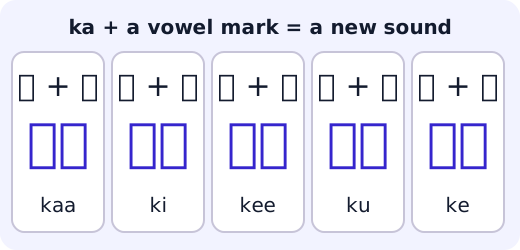
Look closely at ि in कि. The mark sits to the left of the letter but is said after it: k-i. This surprises almost everyone at first. Other marks sit above (े ै), below (ु ू), or to the right (ा ी).
The silent "a" at the end
If every consonant ended in "a", कमल (lotus) would be ka-ma-la. But Hindi speakers say kamal. A consonant at the end of a word usually loses its hidden "a". The same happens in फल (phal, fruit) and बस (bas). Spelling aloud each letter gives ba-sa, but you say bas. So read the sounds, then drop the "a" at the very end.
Two dots and a moon
Two little marks make a nasal sound, a bit like the "n" in "sing" or a hum through the nose:
- ं (a dot on top) as in बंद (band, closed).
- ँ (a moon with a dot) as in पाँच (paanch, five) and हूँ (hoon, I am).
Reading a word, step by step
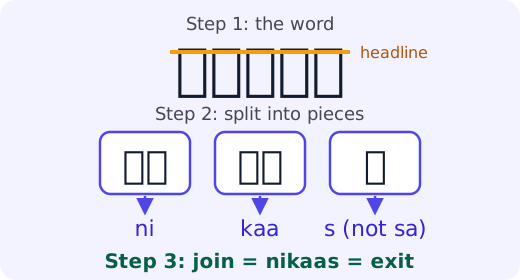
Example. Read निकास.
- Split it into pieces: नि + का + स.
- Say each piece: नि = ni (the mark ि on न), का = kaa, स = sa.
- Join them: ni-kaa-sa. The last "a" is silent, so you say nikaas.
- Think: where have I seen this? On a sign by a door. It means exit.
Signs and labels you can read now
Word Say it Meaning निकास nikaas exit खुला khulaa open बंद band closed पानी paani water दूध doodh milk चाय chaay tea फल phal fruit दवा davaa medicine Now whole sentences. A Hindi full stop is a tall line । called a danda.
- यह आम है। (yeh aam hai.) This is a mango.
- चाय गरम है। (chaay garam hai.) The tea is hot.
- दूध ठंडा है। (doodh thandaa hai.) The milk is cold.
A few very common words do not follow the pattern exactly. यह looks like ya-ha but is said yeh. है is hai. मैं is main. Learn these as whole words.
Try it: Find three words on this page that you can read without looking at the Roman letters. Say them aloud. Then cover the right-hand column of the signs table and read them again.
Common mistakes
- Forgetting the silent "a". Read kamal, not kamala. The word ka-ma-laa, कमला, is a different word: a girl's name.
- Reading ि in the wrong place. It is said after the letter even though it is written before it.
- Mixing similar shapes. Some letters look alike (ब and व, घ and ध). Look at them slowly and compare.
What to remember
Reading a new script starts with matching shapes to sounds. Consonants carry a hidden "a", vowel marks change it, and a silent "a" at the end of a word is dropped. Practise on real signs and you will find the Hindi script is waiting for you everywhere.
Lab
Sign reader
Read signs, labels and short sentences in Hindi and pick what each one means. Press "Show the sounds" to see how a word splits into pieces, then try reading without help.
Your goals
- Read eight signs and labels and match each to its meaning.
- Read three short sentences and say what they mean.
The interactive lab opens once you register. Register to do this.
Activity
Sign hunt
Hunt for Hindi writing around you - on packets, books, posters or a screen - and read it with the sounds you know. About 20 minutes.
You'll need
- Paper and pencil
- Packets, bottles, newspapers, calendars or posters with Hindi writing (at home, or on a screen a grown-up has opened for you)
- A copy of the reading page to check letters
Steps
- Look for three pieces of Hindi writing. Good places are food packets, medicine boxes, a school book, a bus ticket, or a Hindi website a grown-up opens for you.
- Copy one short word from each onto your paper. Draw the shirorekha (headline) across the top.
- Split each word into pieces. Under each piece, write its sound in English letters.
- Join the sounds and say the word aloud. Remember to drop the silent "a" at the end.
- Try to guess the meaning from where you found it (a drink packet might say paani or doodh).
- Ask a grown-up who reads Hindi, or look in the reading, to check at least one word.
- Pick your favourite word and draw a small picture to go with it.
Safety
- If you look for signs outside, a grown-up goes with you and you stay on the pavement away from the road.
- Do not taste, open or play with medicine boxes. Leave them where a grown-up has put them and only look at the writing.
Keeping a log of the activity is for registered learners. Register to do this.
Quick check
Script reading check
Seven questions about reading Hindi letters, marks, signs and short sentences.
1.What is the line that runs along the top of Hindi letters in a word called?
- The shirorekha (headline)
- The danda (full stop)
- The maatraa (vowel mark)
Choose one
2.Match each letter to the sound it makes (with its hidden a).
- ब
- म
- स
- न
Match each to: ma · na · sa · ba
3.How do you say the word कमल (it means lotus)?
- kamal
- kamala
- kaamal
Choose one
4.How is this read?

- kee
- ki (short)
- kaa
Choose one
5.You see this sign above a door. What does it say?
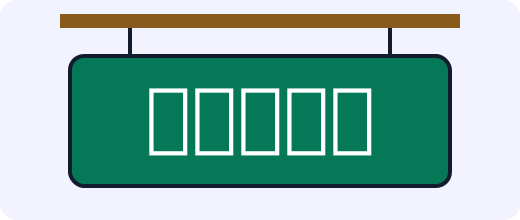
- exit
- open
- water
Choose one
6.Which of these words are things you can drink? Choose all that apply.
- पानी
- दूध
- किताब
- चाय
Choose all that apply
7.What does this sentence mean? चाय गरम है।
- The tea is hot.
- The tea is cold.
- This is a mango.
Choose one
Answering and checking are for registered learners. Register to do this.
Quick check
New puzzles - decode new words
These words were not in the reading. Use the letter sounds, the vowel marks and the silent-a rule to decode them.
1.Decode this word: मकान (it means house). Which sounds right?
- makaan
- makan
- maakan
Choose one
2.Decode this word: नमक (you find it in the kitchen). Which sounds right?
- namak
- namaka
- naamak
Choose one
3.Decode this name: सीता. Which is right?
- seetaa
- sitaa
- saitaa
Choose one
4.Match each Hindi word to the way it is said.
- सब
- कल
- नाम
- दिन
Match each to: kal · din · sab · naam
5.Ria reads चाय as chaaya, with an extra a at the end. What rule did she forget?
- A consonant at the end of a word usually loses its hidden a.
- Every word needs a headline on top.
- Every word ends with a nasal dot.
Choose one
Answering and checking are for registered learners. Register to do this.
Your turn
Teach someone to read a Hindi word
A younger friend sees the word किताब on a book cover and asks you how to read it. Explain, step by step, how you would work it out.
- Write the pieces of the word and the sound of each piece (in English letters).
- Explain what the small mark in the second piece does and where it sits compared with where you say it.
- Say how the whole word is spoken, and explain why you do not say a at the very end.
- Tell your friend one thing to do if they meet a word they cannot read.
How it's judged
- Splitting and sounding the word
- Vowel marks and the silent a
- Helping a friend
Writing and submitting your answer is for registered learners. Register to do this.
Like what you see?
Register for free to answer the quick checks, do the activities and save your work. Your work is saved on your device and syncs to your account.