Unit 11
Economic activities
Sort the ways people earn a living into primary, secondary and tertiary, and follow one product from field to shop to see how value is added.
Read
From field to shelf
Take out a slice of bread. Who helped to put it in your hand?
A farmer grew the wheat. A truck carried the grain to a mill. The mill ground it into flour. A bakery mixed, kneaded and baked it. Another truck drove the loaves to a shop. A shopkeeper stacked them on a shelf and sold you one. And behind all of them are people you never think about: the engineer who built the mill, the banker who lent the farmer money, the radio station that told the shop about a festival sale.
Every one of these people was doing an economic activity: work done to produce goods or provide services that people want, usually to earn a living. In this unit we will sort the activities into three families and follow the bread from field to shelf.
Three sectors
Geographers and economists divide economic activities into three sectors.
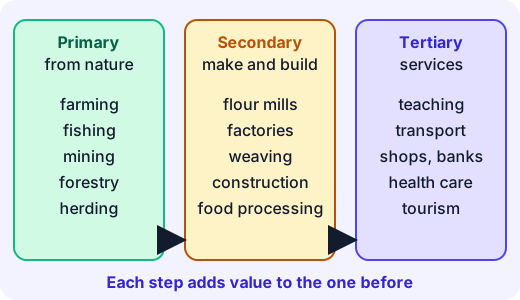
Primary activities take or grow things directly from nature: farming, fishing, mining, quarrying, forestry, herding cattle, gathering honey. They provide raw materials.
Secondary activities turn raw materials into something more useful: grinding wheat into flour, smelting iron ore into steel, spinning cotton into thread, weaving thread into cloth, building a house from bricks and cement. This sector includes manufacturing, food processing and construction.
Tertiary activities do not make a physical product; they provide services that help people and the other two sectors: trading in shops and markets, transport, storage, banking and insurance, teaching, health care, entertainment, tourism, repair, government service.
Some economists add a quaternary sector for knowledge-based work such as research, software and data analysis. Many put it inside the tertiary sector, as we will here.
Tip for classifying: ask "what is this person doing to the thing?" Taking it from nature is primary. Changing it into something else is secondary. Moving it, selling it, financing it, or helping people directly is tertiary.
Example. Classify: a fisherman, a fish canning plant, a fish seller, a fisheries scientist. The fisherman catches fish from the sea: primary. The canning plant turns fish into a packaged product: secondary. The seller and the scientist provide services: tertiary.
Adding value
A key idea in economics is value added: the new worth that an activity creates, equal to what it sells its output for minus what it paid for the inputs it bought from others. Look at the loaf of bread. (To keep the numbers simple, we ignore the farmer's seed and fertiliser, and treat half a kilogram of wheat as the input to one loaf.)
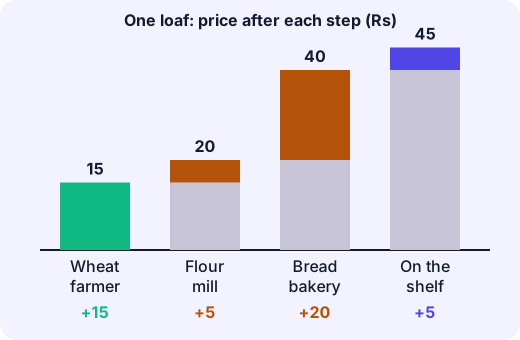
Step Sector Buys for Sells for Value added Farmer grows wheat Primary 0 Rs 15 Rs 15 Mill grinds flour Secondary Rs 15 Rs 20 Rs 5 Bakery bakes bread Secondary Rs 20 Rs 40 Rs 20 Shop sells the loaf Tertiary Rs 40 Rs 45 Rs 5 Add the last column: . The values added add up exactly to the final price, which is no accident. The final price is the sum of the value added at every step, because each step's inputs were someone else's output.
In real life the truck drivers who carry the grain and the loaves add value too (tertiary activity); we leave them out to keep the table short.
This is why economies grow by adding value. Selling the wheat as wheat earns Rs 15. Turning it into bread and getting it to the customer brings Rs 45, three times as much, and gives work to a miller, a baker and a shopkeeper along the way.
A local example: milk
Trace a local product in your own area. Here is one from a village dairy.
- A farmer milks buffaloes: primary.
- A cooperative collects the milk in vans, tests it and chills it: tertiary (transport and testing).
- A dairy plant pasteurises it, packs it in pouches, and makes curd, butter and paneer: secondary.
- A delivery rider and a sweet shop sell the products: tertiary.
- A vet who treats the buffaloes and a bank that lends money for a new cow are tertiary support.
Amul in Gujarat is a famous cooperative that works like this across thousands of villages.
How the mix changes
Poorer, farming-based economies have most people in the primary sector. As societies grow richer they use machines and become industrial, so the secondary sector grows. Later, the tertiary sector grows, and services such as health, education, banking and software employ more and more people. In India, in recent years, services produce more than half of the country's output, while agriculture produces under a fifth of output but still employs more than 40 per cent of workers. That means farm workers earn less on average, which is why many families want to move toward other work.
Common misconceptions
- "Secondary means second in importance." It means second in the chain. All three sectors depend on each other: a baker needs a farmer, and a farmer needs a seed seller and a bank.
- "Services don't produce anything." A doctor, teacher or truck driver creates real value; you can see what would be lost without them.
- "An activity belongs to a sector for ever." The same object can pass through all three. The same person can do two. A farmer who also runs a roadside stall is primary and tertiary.
- "Value added is the same as profit." Value added is what is left after buying inputs. From it come wages, rent, interest and profit. A worker's wage is part of value added.
- "Tertiary jobs are more modern, so primary ones don't matter." Without primary products there would be nothing to process or sell.
Think about it
Pick something in your bag or lunchbox and trace it back as far as you can. How many sectors did it pass through, and who added value at each stage?
Lab
Sort the sectors, add the value
First sort twelve activities into primary, secondary and tertiary. Then follow a cotton T-shirt from the field to the shop, naming each step's sector and working out the value it adds.
Your goals
- Classify all twelve activities correctly.
- Trace the T-shirt through all three sectors and show that the values added add up to the final price.
The interactive lab opens once you register. Register to do this.
Quick check
Economic activities check
Eight questions on the three sectors and on adding value.
1.Which is a primary activity?
- Catching fish from the sea
- Canning fish in a factory
- Selling fish in a shop
Choose one
2.Match each activity to its sector.
- Collecting honey from beehives
- Making biscuits in a factory
- Giving loans at a bank
Match each to: Secondary · Primary · Tertiary
3.Which of these are tertiary activities?
- A doctor treating patients
- A bus driver carrying passengers
- A steel plant making steel from iron ore
- A miner digging iron ore
Choose all that apply
4.A tailor buys cloth worth Rs 120 and sells the stitched shirt for Rs 300. Ignoring other costs, what is the value added by the tailor, in rupees?
Answer with a number
5.Put the steps from wheat to bread in order, starting at the field.
- A mill grinds the wheat into flour
- A bakery bakes bread
- A shop sells the bread
- A farmer grows wheat
Put these in order
6.Why is manufacturing called the secondary sector?
- It is second in the chain: it works on raw materials taken by the primary sector
- It is the second most important sector
- It was invented second
Choose one
7.A farmer grows vegetables and also sells them at her own roadside stall. Which sectors is she working in?
- Only primary
- Primary and tertiary
- Only secondary
Choose one
8.A product passes through three steps. The values added are Rs 12, Rs 28 and Rs 10, and the first step buys nothing. What is the final price, in rupees?
Answer with a number
Answering and checking are for registered learners. Register to do this.
Quick check
New puzzles
Use the three sectors and the idea of value added in new situations.
1.A cup of tea in a cafe starts on a hill. Put the steps in order from the earliest.
- A factory dries and processes the leaves into tea
- Tea is packed, then trucked to cities
- A cafe brews and serves the tea
- Workers pluck tea leaves on an estate
Put these in order
2.In the tea story, which step is a secondary activity?
- Plucking the leaves
- Drying and processing the leaves in a factory
- Serving the tea in a cafe
Choose one
3.A juice maker buys oranges for Rs 40 and sells the bottled juice to a shop for Rs 100. The shop sells it for Rs 120. What is the total value added by the juice maker and the shop together, in rupees?
Answer with a number
4.A student in a small town designs mobile apps for hospitals and is paid by them. Which sector is this?
- Tertiary (a service)
- Primary, since the app is a raw material
- Secondary, since it is made
Choose one
5.A village sells raw sugarcane to a distant mill for Rs 3 a kilogram. Which plan adds the most value locally?
- Sell even more cane at the same price
- Set up a village unit that makes jaggery, packs it and sells it in nearby towns
- Stop growing cane
Choose one
Answering and checking are for registered learners. Register to do this.
Your turn
Trace a product through the sectors
Choose a product made or sold in your area (milk, rice, a notebook, a wooden chair, a shirt, a packet of namkeen). Find out, by asking a shopkeeper or a family member or by reasoning, how it reaches you.
- Draw or list the steps from the start (the raw material) to the customer. Label each step primary, secondary or tertiary.
- For three steps, estimate what the step buys for and sells for, and work out the value added. Show that the values added from all steps add up to the final price. (Estimates are fine.)
- Explain in two or three sentences why a place or country gets richer by adding value, and what a village that only sells raw materials could do about it.
- A friend says "only factories and farms are real work; shops and teachers just move things around." Reply, using the idea of the tertiary sector.
How it's judged
- Classifying the steps
- Value added
- Economic reasoning
- Valuing services
Writing and submitting your answer is for registered learners. Register to do this.
Like what you see?
Register for free to answer the quick checks, do the activities and save your work. Your work is saved on your device and syncs to your account.