Unit 10
The value of work
Compare paid and unpaid work, and ask why society rewards some jobs far more than others even when all of them matter.
Read
Work that pays, work that doesn't
Farah's mother is ill for a week, and for the first time Farah looks at everything she normally does without noticing. Cooking three meals, filling water, washing clothes, getting her little brother ready for school, taking Nani to the clinic, shopping for vegetables. When she adds it up on a piece of paper, it comes to nearly ten hours of work every day. Her mother has no pay slip and no day off, and no one has ever called it "a job".
Was it work? Of course. Is it valued? That is a more interesting question.
What counts as work?
Work is any effort of body or mind done to produce something useful or to provide a service for others. By that definition, a farmer ploughing, a surgeon operating, a mother cooking dinner and a student cleaning the school ground during shramdaan are all working.
Economists split work into two groups:
- Paid work: you receive money (a wage by the day or hour, a salary by the month, or profit from your own shop or farm) in exchange for what you do. A bus driver, a nurse, a shopkeeper and a software engineer do paid work.
- Unpaid work: no money changes hands. The biggest part is care and household work: cooking, cleaning, fetching water or firewood, looking after children, the sick and the old. Volunteering, such as running a free tuition class or serving at a community kitchen, is unpaid too.
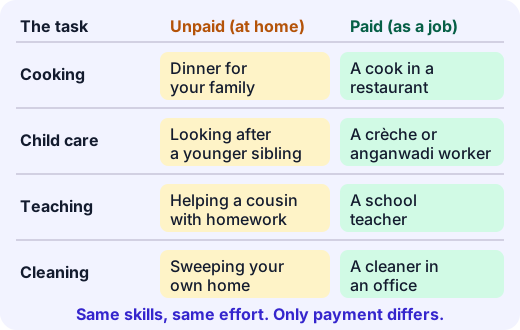
Look at the grid. The task and the skill are the same. What differs is whether someone pays for it. That is the first big idea: whether work is paid says nothing about whether it is useful.
Who does the unpaid work?
Surveys of how people use their time show a pattern in almost every country. In India's national Time Use Survey of 2019, among people who did unpaid household work for their own families, women spent about 299 minutes a day (nearly 5 hours) on it, while men spent about 97 minutes. (Far more women than men did such work at all, so the full gap is even larger.)
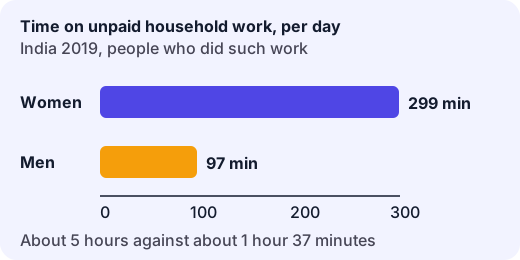
Why the gap? Partly because of old norms about "women's work", and partly because paid jobs outside the home were long closed to women. Many women do both: a paid job and a "second shift" at home. Unpaid work also falls on children, especially girls who are taken out of school to care for siblings.
Is unpaid work really worth something?
One way to see its value is the replacement cost method: if you had to hire someone to do it, what would it cost?
Example. Meera's mother works at home: cooking 2 hours, cleaning 1 hour, fetching water 1 hour, caring for Meera's grandfather 1 hour. A cook, cleaner and attendant might each be paid about Rs 80 an hour.
Hours: hours a day. Cost per day: rupees. Cost per month (30 days): rupees.
If hired, her work would cost the family about Rs 12,000 a month. That is only a rough estimate. It leaves out love, patience and being on call at night. But it shows that unpaid work has real value, even if no bill is sent.
There is a related point. When countries add up their output (GDP), most household services done for your own family are not counted, because there is no price to count. So the statistics miss a large amount of useful work. Many economists have asked for such work to be measured separately.
Why are some jobs paid more than others?
If every worker is useful, why does a software engineer usually earn more than a school cook, and a film star far more than a nurse? Pay depends on many things, and a few of them have little to do with how important the work is:
Factor How it raises or lowers pay Example Scarce skills and long training Fewer people can do it, so employers pay more Surgeon, pilot Demand for the product If buyers pay a lot, the worker can earn more A popular film actor Who pays, and how much they have Rich employers and customers can pay more Bank vs a village shop Bargaining power Organised workers can ask for more Workers' unions, cooperatives Risk and hardship Danger can raise pay, though often it does not Mining, sewer cleaning Social attitudes Jobs linked to certain groups (or to "women's work") are often paid less Care work, domestic work Rules Minimum wage and equal-pay laws set a floor and say men and women must be paid equally for the same work Daily-wage workers Notice the last three. A sewer cleaner does dangerous work that protects everyone's health, yet is often paid very little and treated without respect. Attitudes, history and weak bargaining power can keep pay low even for essential work. So pay measures partly what the market values and partly who has power. It is not a measure of a person's worth.
Common misconceptions
- "Unpaid work is not real work." It is real, and without it paid work could not happen: workers need meals, clean clothes and rested bodies.
- "Higher pay means the work is more useful." A pop star may earn more than a teacher, but a society cannot do without teachers. Pay reflects scarcity, demand and power as well as usefulness.
- "Everybody who is not paid is jobless." A homemaker or a volunteer is working. The word unemployed means looking for paid work and not finding it.
- "All paid work is secure and fair." Many workers, such as domestic workers and daily-wage labourers, have no contract, no leave and low pay.
Dignity of work
Whatever its pay, work should be done and treated with dignity. Many societies have valued some work (priest, doctor, warrior) above manual work (farming, cleaning, craft). A modern, fair society tries to give all workers decent conditions and respect, to share unpaid work more equally at home, and to recognise carers. The next time you thank the person who sweeps your street or cooks your school meal, you are making a small change in how work is valued.
Lab
The household ledger
Look inside one family's day. Sort paid and unpaid work, put a price on the unpaid chores, then share them out fairly.
Your goals
- Sort eight activities into paid and unpaid work.
- Work out what the unpaid chores would cost if the family hired help.
- Share the chores so that no one is overloaded.
The interactive lab opens once you register. Register to do this.
Quick check
The value of work check
Eight questions on paid and unpaid work, and why pay differs.
1.Which of these is unpaid work?
- A nurse caring for patients in a clinic
- Cooking dinner for your own family
- A carpenter making a cupboard for a customer
Choose one
2.Which of these are paid work?
- A shopkeeper selling groceries to earn a living
- A volunteer serving free meals
- A bus conductor employed by a transport company
- A daughter helping her grandmother bathe
Choose all that apply
3.A family would hire help for 3 hours of unpaid chores every day at Rs 90 an hour. What is the replacement cost for 30 days, in rupees?
Answer with a number
4.Why do countries' official output figures (GDP) usually leave out most housework done for your own family?
- Because housework is useless
- Because no price or payment is recorded for it
- Because only men are counted
Choose one
5.Match each reason for differences in pay to an example.
- Scarce skill
- Bargaining power
- Social attitudes
- Rules
Match each to: A union of workers negotiates a raise together · A minimum wage sets the lowest pay allowed · A heart surgeon trains for many years and few people can do the work · Care work is often paid low because it is seen as women's work
6.Someone says, "A film star earns far more than a school teacher, so the film star's work must be more useful to society." What is the best reply?
- Right: pay always matches usefulness
- Pay depends on things like demand, scarcity and power, not only on how useful the work is
- Teachers should be paid nothing
Choose one
7.In India's 2019 Time Use Survey, women spent about 299 minutes and men about 97 minutes a day on unpaid household work. How many more minutes a day did women spend?
Answer with a number
8.A woman cooks, cleans and cares for her children every day, but has no paid job. Which description fits best?
- She is not working
- She is doing unpaid work
- She is unemployed, meaning she is looking for paid work
Choose one
Answering and checking are for registered learners. Register to do this.
Quick check
New puzzles
Use the ideas about paid and unpaid work in new situations.
1.Salma spends 4 hours a day caring for her elderly father. A paid attendant would cost Rs 125 an hour. What is the replacement cost for a 30-day month, in rupees?
Answer with a number
2.Delivery riders for an app are paid per delivery, with no fixed contract, no leave and no way to bargain together. What is the best explanation for their low and uncertain earnings?
- Delivery is not real work
- Weak bargaining power and no contract can keep pay and conditions low even for useful work
- Risky jobs are always paid the most
Choose one
3.If a town's sanitation workers stopped for a week, disease would spread quickly, yet they are often paid less than office clerks. What does this show?
- Pay does not simply reflect how important work is to society
- Sanitation work is not useful
- Clerks work harder
Choose one
4.Which of these would help share and recognise unpaid care work more fairly?
- Everyone in the family doing a share of the home chores
- Measuring and talking about how much unpaid work is done
- Good crèches and public services for children and the elderly
- Telling children that housework is only for women
Choose all that apply
Answering and checking are for registered learners. Register to do this.
Your turn
What is work worth?
Keep a note of one day in your home (or interview a family member), then write your answers.
- List the paid and unpaid work done in your household in one day. Who does each task, and about how long does it take?
- Pick one unpaid task and estimate what it would cost to hire someone to do it for a month. Show your working.
- Choose two jobs in your area (for example a nurse, a farm worker, a driver, a teacher, a cleaner). Explain why one may be paid more than the other, using at least two reasons from the unit. Say whether you think the difference is fair.
- Suggest one change that would make the sharing or the respect for work fairer in your home or town.
How it's judged
- Sorting and observing work
- Valuing unpaid work
- Explaining differences in pay
- Proposing a change
Writing and submitting your answer is for registered learners. Register to do this.
Like what you see?
Register for free to answer the quick checks, do the activities and save your work. Your work is saved on your device and syncs to your account.