Unit 13
Festivals and cultures
Meet Diwali, Eid, Christmas and Pongal, and find out how many cultures live side by side.
Read
Many festivals, one street
On Ananya's street, four families live side by side. In autumn, Ananya's house is full of little clay lamps. A few weeks or months later, the house next door is glowing with fairy lights, and the family across the road invites everyone for sweet vermicelli. All year round, someone on the street is getting ready for something.
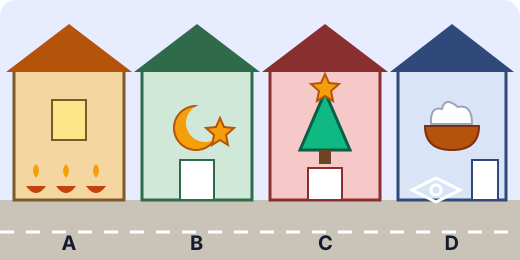
A festival is a special time when a community comes together to celebrate something important: a story, a belief, the harvest or a season. A tradition is something a family or community does again and again, and passes down. A culture is the whole way of life of a group of people: their food, clothes, music, stories, languages and festivals.
India has many cultures, and so does the world. They live side by side, and they often share and learn from each other.
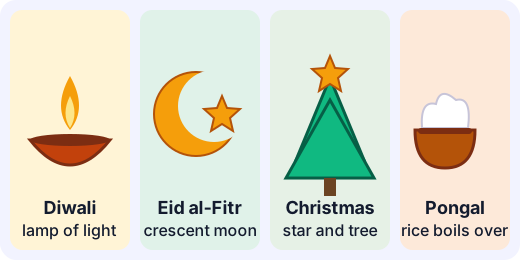
Four festivals
Diwali is celebrated by Hindus, and also by Jains and Sikhs, who each have their own reasons for it. It lasts five days. Many families light clay lamps (diyas), draw rangoli patterns, wear new clothes and share sweets. For many Hindus it celebrates the victory of light over darkness and the return of Rama to Ayodhya. People greet each other with "Happy Diwali" or "Shubh Deepavali".
Eid al-Fitr is celebrated by Muslims. It comes at the end of Ramadan, a month when many Muslims fast from dawn to sunset. On Eid, people go to special morning prayers, wear their best clothes, give gifts of money or food to people in need, and visit friends and family. A treat many families make is sewaiyan (sweet vermicelli). People greet each other with "Eid Mubarak".
Christmas is celebrated by Christians on 25 December. It remembers the birth of Jesus. Families go to church, sing carols, put up a star or a crib and a decorated tree, and share food and cake. People say "Merry Christmas".
Pongal is a harvest festival of Tamil Nadu, in mid-January. People thank the Sun, the farmers and the cattle for the harvest. The best-known tradition is to boil new rice and milk in a pot in the open air. When it boils over, everyone shouts "Pongalo Pongal!"
Try it: Pick one festival you do not celebrate. Ask a friend or neighbour who does: "What do you do? What does it mean?" Listen and ask politely.
What they have in common
Festival Tradition What it celebrates Diwali Hindu (also Jain, Sikh) Light winning over darkness Eid al-Fitr Muslim The end of the month of fasting, Ramadan Christmas Christian The birth of Jesus Pongal Tamil harvest festival Thanks for the harvest These festivals are very different. Yet in each one, people gather with family and friends, share food, wear special clothes and think about something that matters to them. There are many more: Guru Nanak Jayanti (Sikh), Buddha Purnima (Buddhist), Onam in Kerala, Navroz (Parsi New Year), the Lunar New Year in China, and so on.
Example. Imran's family celebrates Eid. His friend Joseph, who celebrates Christmas, visits with a plate of cake. Imran offers sewaiyan. Each family keeps its own tradition, and each shares in the other's joy. That's what "many cultures live side by side" looks like.
Common mix-ups
- "Every festival is the same." They have different stories, foods and dates. Some follow the Sun calendar (Christmas is always 25 December). Others follow the Moon, so their dates move from year to year (Eid and Diwali).
- "A festival belongs only to one group." Each festival has its own tradition, but many neighbours join in as guests.
- "My way is the only right way." Families can hold different beliefs and still be good neighbours. We can respect what we do not share.
For the grown-up helping
Your child may name only the festivals they know. Gently add others and ask "What does this festival celebrate?" It is fine not to be sure of every detail: look it up together, or better, ask a neighbour. Teach children to say each festival's greeting.
Activity
Ask and make a festival card
Your child learns about three festivals from three different traditions by asking people, and makes a festival card for each. About 40 minutes, over a few days.
You'll need
- Three cards or sheets of paper
- Pencils, crayons or paint
- Scissors and glue (optional)
Steps
- Choose three festivals from three different traditions. Include at least one your family does not celebrate.
- For each festival, help your child ask someone who celebrates it (a family member, neighbour, friend or teacher) what the festival is, what they do, what it celebrates and what they eat. You can also look in a library book.
- On a card for each festival, your child writes the festival name and its tradition, draws one symbol or scene, and writes one sentence on what it celebrates.
- On the back of each card, your child writes what people do (for example, lighting lamps, praying, sharing food) and the festival greeting.
- Place the cards on a table. Ask "What is the same in all three? What is different?"
Safety
- If the festival includes lamps, candles or fire, an adult handles them. Keep paper decorations far from flames.
- Do not taste a food from another home without checking with the grown-up first. Ask about nuts, milk and other allergies.
- Be polite and ask first before taking photos of people.
Keeping a log of the activity is for registered learners. Register to do this.
Quick check
Festivals and cultures check
Six questions about festivals and the cultures that celebrate them.
1.Match each festival to what it celebrates.
- Diwali
- Eid al-Fitr
- Christmas
- Pongal
Match each to: Thanks for the harvest · Light winning over darkness · The end of the month of fasting, Ramadan · The birth of Jesus
2.Which house is getting ready for Diwali?
- House A
- House B
- House C
- House D
Choose one
3.Which house is getting ready for Pongal?
- House A
- House B
- House C
- House D
Choose one
4.What is a tradition?
- Something a family or community does again and again and passes down
- Something that happened only once, long ago
- A kind of game played at school
Choose one
5.Which of these are things people do at Christmas?
- Sing carols
- Put up a star or a decorated tree
- Fast from dawn to sunset for a month
- Boil rice and milk in a pot until it overflows
Choose all that apply
6.Which greeting do people use at Eid?
- Eid Mubarak
- Merry Christmas
- Shubh Deepavali
Choose one
Answering and checking are for registered learners. Register to do this.
Quick check
New puzzles
Think about how festivals and cultures meet in everyday life.
1.What do Diwali, Eid and Christmas have in common?
- People gather with family and friends, and share food
- They all fall on the same date every year
- They are all harvest festivals
Choose one
2.It is Eid morning. Joseph, whose family celebrates Christmas, visits his friend Hamid. What is the best thing for Joseph to say?
- Eid Mubarak!
- Merry Christmas!
- Nothing, because it is not his festival
Choose one
3.Rani's class has children who celebrate Diwali, Eid, Christmas and Pongal. Which sentence describes her class best?
- Many cultures live side by side in her class, each with its own festivals
- Only one of the festivals is the real one
- The children cannot be friends because their festivals differ
Choose one
4.A neighbour invites Zoya to a festival Zoya has never seen. Which is the kindest way to take part?
- Say thank you, ask what to do and what it means, and join in respectfully
- Laugh at the parts that seem strange
- Say no, because it is not her festival
Choose one
Answering and checking are for registered learners. Register to do this.
Activity
Tell it back
Your child describes festivals from at least three traditions and explains what "many cultures live side by side" means. About five minutes.
Steps
- Ask your child to tell you about three festivals from different traditions. For each, ask "What does it celebrate? What do people do?"
- Ask "What is a tradition? What is a culture?"
- Ask "Many cultures live side by side in our country. What does that mean? What is a kind way to behave when a neighbour is celebrating a festival you do not celebrate?"
- Write down what your child said, in their words.
Keeping a log of the activity is for registered learners. Register to do this.
Like what you see?
Register for free to answer the quick checks, do the activities and save your work. Your work is saved on your device and syncs to your account.