Unit 12
Homes and food around the world
Compare homes, food and clothing in a hot, a cold and a wet place, and see why each suits where people live.
Read
A home that suits its place
Imagine three children writing letters to each other.
Meera lives in the Thar Desert in Rajasthan, where summer days can be over 45 degrees Celsius. Tashi lives in Ladakh, high in the mountains, where winter nights can fall far below freezing. Bina lives in Assam, where it rains hard for months and the rivers rise.
Their homes, their meals and their clothes are very different. Why? Because each family is living in a way that suits where they are.
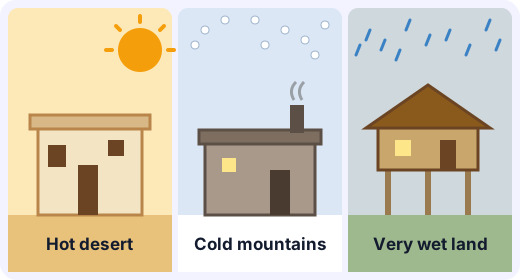
A hot, dry place: Meera in the Thar Desert
- Home. Thick walls of mud or stone, painted pale, keep the sun's heat out. Windows are small, and many houses have a shady courtyard. Thick walls heat up slowly, so rooms stay cooler.
- Food. Little grows in dry land, so people use foods that last: millet (bajra) rotis, dried desert beans and berries, curd and buttermilk. Many families also keep goats and camels for milk.
- Clothing. Loose, light clothes and a turban or scarf shade the head and keep off dust and sun.
A cold place: Tashi in Ladakh
- Home. Thick walls of stone and mud-brick hold in heat. Windows are small and face the sun. Inside, a stove keeps the family warm, and flat roofs are used to dry food for winter.
- Food. Warm, filling meals: barley flour (tsampa), thukpa (noodle soup) and hot butter tea. Barley is one of the few crops that grows in the cold.
- Clothing. Thick woollen coats, warm hats and boots, with layers underneath.
A wet place: Bina in Assam
- Home. Houses of bamboo and wood stand on stilts, a little above the ground, so floods, wet soil and animals stay out. The roof slopes steeply so rain runs off fast.
- Food. Rice grows well in wet fields. Meals are rice with fish, vegetables and greens, and Assam is famous for its tea.
- Clothing. Light cotton clothes that dry quickly, an umbrella or raincoat, and a wide hat called a japi.
Compare them
Hot, dry Cold Wet Home Thick pale walls, small windows Stone walls, stove inside Stilts, steep roof Food Dried foods, millet, curd Barley, warm soups, butter tea Rice, fish, vegetables Clothing Loose, light, head covered Thick wool, hats, boots Light cotton, umbrella 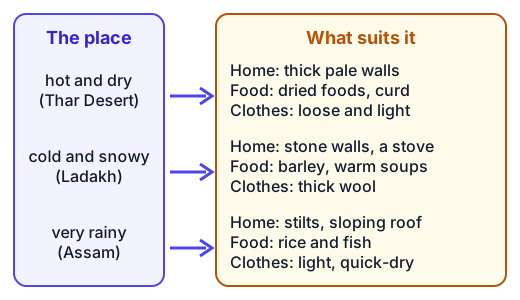
Example. Why does Tashi's family dry vegetables on the roof in autumn? Winter is long and little can grow, so they store food for the cold months. The same idea, storing food that lasts, is also why the Thar families eat dried beans. Different places, same clever thinking: use what the land gives and plan for the weather.
Common mix-ups
- "People in cold places live in igloos." Almost no one lives in an igloo. Some Inuit hunters of the far north built snow shelters for short trips. Most people in cold places, like Tashi, live in solid houses.
- "Everyone in a hot place lives the same way." Materials differ. One village may build with stone and another with mud or bamboo.
- "These ways are old-fashioned." They were worked out over hundreds of years. They still work, and many modern builders copy them.
For the grown-up helping
Show your child pictures of homes from different places and ask "What is the weather here? How can you tell?" It is normal to say "they are poor" or "they are strange". Gently turn that into "How does this suit where they live?" so children see these ways as clever choices.
Lab
Pack for the place
Visit three places, one hot and dry, one cold and one very wet. For each one, choose the home, the food and the clothing that suit it, and read why.
Your goals
- Choose the home, food and clothing that suit the hot desert, the cold mountains and the very wet land.
- Read the reason for each right choice.
The interactive lab opens once you register. Register to do this.
Activity
Plate, closet and roof hunt
Your child finds out how the food, clothes and home where you live suit your weather, and compares them with one of the three places in the reading. About 30 minutes.
You'll need
- Paper and pencil
- Your home, kitchen and wardrobe
Steps
- Ask your child to describe your weather in each season. Is it hot, cold, wet, dry?
- Look at your home together. Check the roof, the walls, the windows, the doors. Ask "How do these help with our weather?"
- Open the kitchen. Choose three foods the family eats often. Ask "Does this food grow near us? Does it keep well? Is it good to eat when it is hot or cold?"
- Open the wardrobe. Find one piece of clothing for each season. Ask "What does it protect you from?"
- Draw a two-column chart. In one column, write what suits your place. In the other, pick one place from the reading (the desert, Ladakh or Assam) and write how it is different and why.
Safety
- An adult handles anything hot, sharp or from the stove.
- Do not taste unfamiliar foods without a grown-up. Check for allergies first.
- Stay off roofs and balconies; look from the ground.
Keeping a log of the activity is for registered learners. Register to do this.
Quick check
Homes and food check
Six questions about homes, food and clothing in a hot, a cold and a wet place.
1.Why is the house in the third picture, the very wet land, built on stilts?
- To keep it above floods and wet ground
- To see far away over the fields and rivers
- To keep out the heat of the desert sun
Choose one
2.Why do houses in a hot desert often have thick, pale walls and small windows?
- To keep the sun's heat out
- To hold up heavy snow
- To let the rain run off
Choose one
3.Match each piece of clothing to the place where it makes the most sense.
- Loose, light cotton and a turban
- A thick woollen coat and warm boots
- Quick-drying cotton and an umbrella
Match each to: A very rainy land · A hot, dry desert · A cold mountain place
4.Which of these help a house in a very rainy place?
- Standing on stilts
- A steep, sloping roof
- A flat roof where water can collect
- Tiny windows to keep out the cold
Choose all that apply
5.Why do many families in a dry desert eat dried foods like beans and berries?
- Little grows fresh in dry land, and dried foods keep for a long time
- They do not like fresh food and prefer dry food to eat
- Because it rains a lot there, so food must be kept dry
Choose one
6.Which sentence is true?
- People everywhere live in the same kind of home
- People build homes and choose food and clothes that suit where they live
- People in all cold places live in igloos
Choose one
Answering and checking are for registered learners. Register to do this.
Quick check
New puzzles
Use what you know about places to solve new problems.
1.A new village is built where the winters are long and very snowy, with strong cold winds. Which home would suit it best?
- Thick walls, small windows and a stove inside
- A house with thin walls and big open windows
- A house on tall stilts with a steep roof for heavy rain
Choose one
2.Sana moves from a snowy mountain village to a hot, rainy town by the sea. Which of her things will she need least?
- Her thick woollen coat
- Light cotton clothes
- An umbrella
Choose one
3.Two hot places have different homes. One village builds with stone because stone is nearby. Another builds with bamboo because bamboo grows nearby. What does this show?
- People often build with what the land around them gives
- One village does not know how to build well
- Homes in hot places must always be built of stone
Choose one
4.Aarav says, "People in the desert are silly to wear long, loose clothes in the heat." What is the best reply?
- Loose clothes shade the skin from the sun and let air move
- You are right, shorts and a vest would be better in the heat
- They wear them only because they like the way the clothes look
Choose one
Answering and checking are for registered learners. Register to do this.
Activity
Tell it back
Your child explains why people in a hot, a cold and a wet place live differently. About five minutes.
Steps
- Ask "Why do houses in a very rainy place stand on stilts? Why are houses in a hot desert made with thick walls and small windows?"
- Ask "What would go wrong if Tashi from Ladakh wore Meera's clothes in winter?"
- Ask "What is the big idea? Why do people in different places live in different ways?"
- Write down what your child said, in their words.
Keeping a log of the activity is for registered learners. Register to do this.
Like what you see?
Register for free to answer the quick checks, do the activities and save your work. Your work is saved on your device and syncs to your account.