Unit 1
Habitats
Find out why a frog lives in a pond and a camel in a desert, and draw who eats whom in a food chain.
Read
A home with everything you need
After the rains, Tara and her cousin Imran sit beside the village pond. A frog plops into the water. A dragonfly zips past. A duck paddles between the reeds.
"Why are there so many animals here?" asks Tara. "And why don't we ever find frogs in the middle of the dry road?"
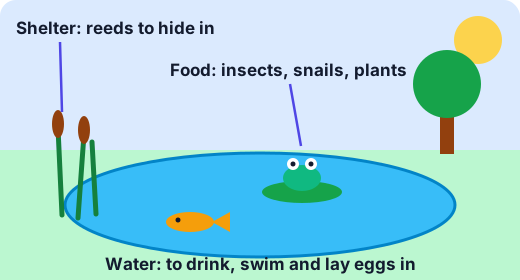
A habitat is a home
A habitat is the place where a plant or an animal lives. A pond is a habitat. So is a forest, a desert, the sea, a patch of grass, or the space under a stone.
Living things live where their needs are met. A good habitat gives them:
- Food to eat,
- Water to drink,
- Shelter: a safe place to rest, hide and raise their young.
The pond gives a frog all three. There are insects to eat, water to keep its skin damp and to lay eggs in, and reeds to hide from birds. The dry road gives a frog none of these, so no frog lives there.
Different habitats, different animals
Habitat Who lives there How it meets their needs Pond frog, duck water, water plants and insects to eat, reeds to hide in Forest monkey, elephant fruit, leaves and shade; trees to climb and sleep in Desert (like the Thar in Rajasthan) camel, scorpion a camel's body can cope with heat and little water; a scorpion hides under rocks by day Sea dolphin, octopus water all around, fish and crabs to eat Try it: Pick any animal you know. Where does it find food? Where does it drink? Where does it hide or sleep? If you can answer all three, you have described its habitat.
Who eats whom: food chains
Every animal needs food, and food comes from other living things. A food chain shows who eats what, using arrows.
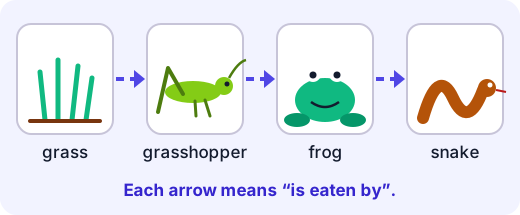
Read it like this: the grasshopper eats the grass. The frog eats the grasshopper. The snake eats the frog. The arrow means "is eaten by", so it points towards the eater.
Every food chain starts with a plant, because plants make their own food using sunlight.
Example. In a rice field the chain is: rice plant → rat → snake → eagle.
- The rat eats the rice.
- The snake eats the rat.
- The eagle eats the snake.
This chain has one plant and three animals.
Watch out for these mix-ups
- The arrow does not point at the food. In "frog → snake" the snake is the eater. The frog is the food.
- A camel's hump holds fat, not water. The fat is stored energy. A camel survives the desert because its whole body copes with heat and little water.
- Animals do not simply pick a home they like. They live where their body and their needs match. A frog's skin needs to stay damp, so it lives near water.
When a habitat loses its water, food or shelter, the animals there must move away or they cannot live. That is why we keep ponds, forests and grasslands clean and safe.
For the grown-up helping
Take your child to any small habitat: a garden, a pond edge, a tree. Ask the same three questions each time: What does it eat? Where does it drink? Where does it hide? Drawing food chains with arrows is hard at first; most children point the arrow the wrong way. Try acting it out: the child is the snake and "takes" a toy frog, then the toy frog "takes" a toy grasshopper. Say "the arrow shows where the food goes".
Lab
Habitat match-up and food chains
First, move each animal to the habitat where it can find food, water and shelter. Then build two food chains by tapping the living things in order.
Your goals
- Place all eight animals in the habitat that meets their needs, and read why each one fits.
- Build a grass food chain and a rice field food chain, starting with the plant and following who eats whom.
The interactive lab opens once you register. Register to do this.
Activity
Habitat hunt
Visit a small habitat near home (a garden, park, tree, pond edge or a patch of grass) and look at who lives there and what they need. About 30 minutes.
You'll need
- Paper and a pencil or crayons
- A clipboard or something hard to lean on
- A magnifying glass, if you have one
Steps
- Choose one small habitat, such as one tree, a corner of the garden or the edge of a pond. Sit or stand quietly for two minutes and just look.
- Draw the habitat. Add every living thing you see (plants, insects, birds, worms, snails) and label what you can.
- For two living things, ask your child where it gets food, where it gets water, and where it hides or rests. Write the answers beside the drawing.
- The adult gently lifts a stone or a pile of leaves. Look, then put it back exactly as it was so the animals keep their home.
- Draw one food chain from what you saw, for example leaf → caterpillar → bird. Use arrows that mean "is eaten by".
- Ask your child, "What would happen to these animals if the water or the plants disappeared?"
Safety
- An adult goes along and lifts stones or logs, because snakes, scorpions and stinging insects can hide there.
- Look but do not touch animals with bare hands. Do not pick up bees, wasps, caterpillars with hairs, or anything unknown.
- Stay well back from the water's edge of a pond, river or well, and never go alone near water.
- Do not taste any plants, berries or mushrooms.
- Wash hands with soap after the hunt.
Keeping a log of the activity is for registered learners. Register to do this.
Quick check
Habitats check
Seven questions about habitats and food chains.
1.Look at the food chain. Which could fill the empty box?
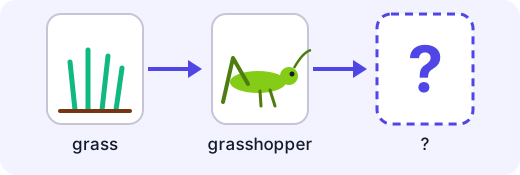
- A frog
- More grass
- A rock
Choose one
2.Which three things must a habitat give an animal?
- Food, water and shelter
- Food, sunshine and sand
- Water, shelter and company
Choose one
3.Match each animal to its habitat.
- Frog
- Camel
- Monkey
- Dolphin
Match each to: Desert · Forest · Sea · Pond
4.Put this food chain in order, starting with the plant.
- Grass
- Frog
- Snake
- Grasshopper
Put these in order
5.A food chain says frog → snake. What does that tell you?
- The snake eats the frog
- The frog eats the snake
- The frog and snake live together as friends
Choose one
6.How many animals are in this food chain? grass → deer → tiger
Answer with a number
7.Why can a camel live in the desert?
- Its hump is a tank full of water
- Its body copes with heat and little water, and its hump stores fat for energy
- The desert has a lot of water for it to drink every day
Choose one
Answering and checking are for registered learners. Register to do this.
Quick check
New puzzles
Use what you know about habitats in some new places.
1.In a very hot summer a pond dries up completely. What is the problem for the fish that lived in it?
- Their habitat no longer gives them water or shelter, so they cannot stay
- They now have too much food
- There is no problem; fish can live on dry ground
Choose one
2.A rabbit needs grass to eat, water to drink and bushes to hide in. Which place gives it all three?
- A dry stretch of sand with no plants
- A meadow with grass, bushes and a stream
- A bare rock in the middle of the sea
Choose one
3.In a rice field the food chain is rice → rat → snake. If all the rats left the field, what would the snake lose?
- Its food
- Its sunlight
- Nothing at all
Choose one
4.A food chain has 5 living things. The first is a plant and all the others are animals. How many animals are in it?
Answer with a number
Answering and checking are for registered learners. Register to do this.
Activity
Tell it back
Your child explains, in their own words, why an animal lives where it does and how a food chain works. About five minutes.
Steps
- Ask your child to pick any animal and say where it lives. Then ask, "Why does it live there? What does that place give it?" Listen for food, water and shelter.
- Ask, "Could that animal live in a different habitat, such as a desert or the middle of a town? Why or why not?"
- Ask your child to draw a food chain with three or four things, or to make one with toys, and to say what the arrows mean. Don't correct yet; ask "Who eats whom here?"
- Write down what your child said, in their words.
Keeping a log of the activity is for registered learners. Register to do this.
Like what you see?
Register for free to answer the quick checks, do the activities and save your work. Your work is saved on your device and syncs to your account.