Unit 2
Testing what plants need
Grow plants with and without light or water, and learn why a fair test changes only one thing.
Read
Ravi's bean test
Ravi planted two bean seeds in two cups. He put one cup on the sunny windowsill. He hid the other in a dark cupboard, as a surprise for his sister.
A week later he opened the cupboard. The bean there was thin, floppy and pale yellow. The bean on the windowsill was strong and green.
"The dark did that!" said Ravi. "Or maybe it was the cupboard air. Or maybe I forgot to water it." How can he find out?
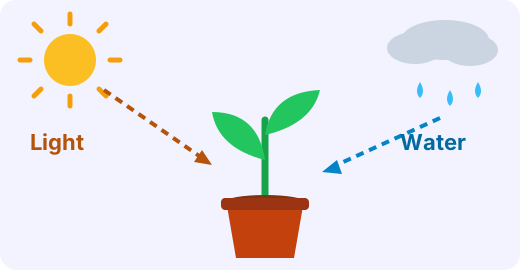
What a plant needs
A growing plant needs light and water. It uses light to make its own food in its leaves. Its roots drink water from the soil. Without light the plant turns pale and weak. Without water it dries up and droops.
Plants do not eat soil. They make their food from light, water and air. The soil holds the roots and carries water.
A seed is a little different. It has a store of food packed inside, like a lunch box. With a bit of water and warmth it can start to sprout even in the dark, using that store. But when the lunch box is empty, the young plant must have light to keep growing.
A fair test
To find out what a plant needs, we do a test. A test needs one plant that is treated differently. A fair test changes only one thing and keeps everything else the same.
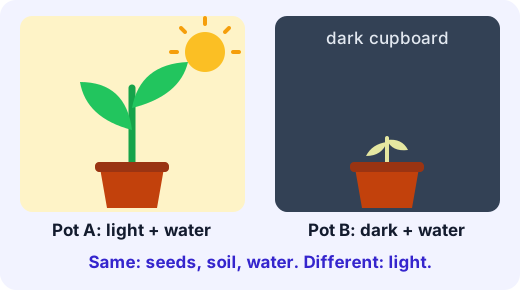
Suppose we want to know if plants need light. Pot A and Pot B get:
- the same kind of seed,
- the same soil and the same pot,
- the same amount of water,
- different light: A is in the sun, B is in a dark cupboard.
If B does worse, the only difference is light, so light must be the reason.
Example. Ravi sets up four pots and checks them after 10 days.
Pot Light Water After 10 days 1 sun watered tall and green 2 dark watered small and pale 3 sun not watered dry and drooping 4 dark not watered small, dry and brown - Compare pot 1 and pot 2. Only light is different, so this tests light. Plants need light.
- Compare pot 1 and pot 3. Only water is different, so this tests water. Plants need water.
- Compare pot 2 and pot 3? Both light and water are different. We could not tell which one caused the change. That is an unfair comparison.
Steps of a good test
- Ask a question: "Do plants need light?"
- Guess what will happen.
- Set up the pots, changing one thing only.
- Wait, look every day, and measure.
- Say what you found, using what you saw.
Common mix-ups
- Changing two things at once. A plant in a dark cupboard and not watered tells us nothing about either.
- Giving the test plants too little of everything. If both pots are dry, you cannot see what light does. Give both plants what they need, except the one thing you test.
- Saying more than you saw. One pot is a hint. Use two or three seeds in each pot if you can.
For the grown-up helping
Let your child do the test, even if you already know what will happen. Ask "What are you changing?" and "What must stay the same?" before they begin. Check that your child keeps the pots the same: same seeds, same cups, same amount of water at the start. Children often want to give the "special" plant extra of everything. Gently say, "Is that fair?" Measure with a ruler or with paper strips so the answer is a number, not a feeling.
Lab
The plant test
Set up two pots and grow them for 10 days. Test whether plants need light, then whether plants need water. Only change one thing each time.
Your goals
- Set up a fair test for light, where only the light is different, and say what it shows.
- Set up a fair test for water, where only the water is different, and say what it shows.
The interactive lab opens once you register. Register to do this.
Activity
Grow a bean test
Grow bean seeds in three cups to test what plants need, then compare them. You need about 10 minutes to start, five minutes a day for a week, and a few minutes at the end.
You'll need
- Three matching clear cups or jars
- Cotton wool, or soil from the garden
- Nine dried green gram (moong) or chickpea seeds, soaked in water overnight
- A jug of water and a spoon
- Labels or sticky notes and a pen
- A ruler
- A sunny windowsill and a dark cupboard
Steps
- Label the cups A, B and C. Put the same amount of cotton wool or soil in each cup, and wet each one with the same spoonfuls of water.
- Push three soaked seeds into each cup, just touching the glass so you can see them.
- Cup A goes on the sunny windowsill and gets one spoon of water every day. Cup B goes in the dark cupboard and gets one spoon of water every day. Cup C goes on the windowsill but gets no water after the first day.
- Write down your guess for each cup before you start.
- Each day, look at the cups. Measure the tallest shoot with the ruler, and draw or note how the plants look (colour, firmness).
- After seven days, compare. A and B differ only in light. A and C differ only in water. Say what each pair shows.
Safety
- Dried beans and seeds are a choking risk for children under three. Keep them out of reach.
- Do not eat the beans or the water they were soaked in.
- If you see fuzzy mould, an adult takes the cup away without sniffing it and everyone washes their hands.
- Wash hands after touching soil.
- Put the cups where they will not be knocked off the windowsill.
Keeping a log of the activity is for registered learners. Register to do this.
Quick check
Plant test check
Six questions about testing what plants need.
1.You want to find out if plants need light. What should be different between the two pots?
- Only the light
- The light and the amount of water
- The kind of seed and the soil
Choose one
2.Look at the three pots. Which two pots make a fair test of water?
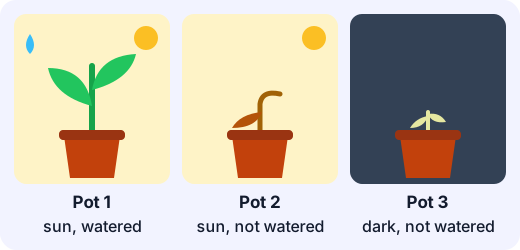
- Pot 1 and Pot 2
- Pot 1 and Pot 3
- Pot 2 and Pot 3
Choose one
3.Which things should you keep the same when you test whether plants need light?
- The kind of seed
- The amount of water
- The amount of light
- The kind of soil
Choose all that apply
4.Plant A grew on a sunny windowsill and plant B grew in a dark cupboard. Both were watered the same. Plant B was pale and weak. What does this show?
- Plants need light to grow well
- Plants do not need water
- Plants grow best in cupboards
Choose one
5.Put the steps of a plant test in order.
- Set up the pots, changing one thing
- Ask a question
- Say what you found
- Look at the plants every day
Put these in order
6.After 10 days, the watered plant is 8 cm tall and the unwatered plant is 3 cm tall. How many centimetres taller is the watered plant?
Answer with a number
Answering and checking are for registered learners. Register to do this.
Quick check
New puzzles
Use fair testing in some new situations.
1.Kiran wants to know if plants need water. Plant 1 is on the windowsill and watered. Plant 2 is in a cupboard and not watered. Plant 2 died. Kiran says "Plants need water." Is his test fair?
- Yes, it is fair
- No, because both light and water are different
- No, because the plants should be different kinds
Choose one
2.How could Kiran fix the test?
- Put both plants on the windowsill, water one and do not water the other
- Water both plants the same
- Use a bigger pot for the dry plant
Choose one
3.Meera wants to test light and also test water. She wants to use as few pots as possible, and each fair comparison needs two pots. One pot is in the sun and watered. How many pots does she need in all?
Answer with a number
4.Lina sprouts a seed on wet cotton wool in a dark drawer. It starts to sprout. She says plants never need light. What is the best thing to say?
- A seed has food stored inside, so it can sprout in the dark, but a young plant needs light to keep growing well
- Lina is right; plants never need light
- Seeds cannot sprout without light
Choose one
Answering and checking are for registered learners. Register to do this.
Activity
Tell it back
Your child explains what makes a test fair, using a plant example. About five minutes.
Steps
- Say, "Tara tested whether plants need water. She put one plant in the sun and watered it. She put another in a dark cupboard and did not water it. The dry plant died. Is that a fair test?"
- Let your child think and answer. Ask "What did Tara change? What should she have kept the same?"
- Ask your child how they would fix Tara's test. Write down what they say in their own words.
Keeping a log of the activity is for registered learners. Register to do this.
Like what you see?
Register for free to answer the quick checks, do the activities and save your work. Your work is saved on your device and syncs to your account.