Unit 1
Giving reasons
Say what you think and add "because", then find out why a reason is more than saying it twice.
Read
The hare, the tortoise and "because"
You may know the old Aesop story. A hare laughs at a slow tortoise. "I'm much faster than you!" The tortoise says, "Let's race and see." The hare zooms ahead. He is so far in front that he lies down under a tree for a little nap. The tortoise keeps walking, slowly, slowly, without stopping. When the hare wakes up, the tortoise is nearly at the finish line!
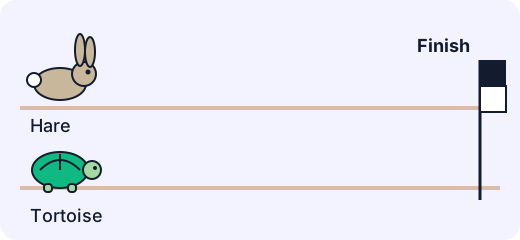
Now here is a question to think about. Is the hare or the tortoise the better runner?
Two friends, Asha and Joseph, are talking about it.
- Asha says: "The hare is the better runner."
- Joseph says: "Why do you think so?"
- Asha says: "Because the hare is the better runner."
Hmm. That did not help Joseph at all. Asha just said the same thing twice.
Try again.
- Asha says: "The hare is the better runner because he can run much faster. He was far ahead before he napped."
Now Joseph knows why Asha thinks it. He can look at her reason and decide: "Yes, running fast does make a runner good," or "But the hare lost the race!"
What is a reason?
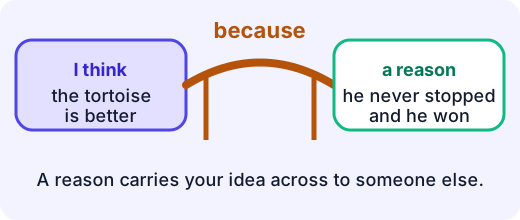
A reason is something that helps another person see why you think what you think. It is something new, not the same words again.
We can say it like this:
I think … because …
What Asha says Is it a reason? "The hare is better because he is the hare." No. It says the same thing again. "The hare is better because he runs fast." Yes! It tells us something new. "The hare is better. Really, he is." No. It only sounds stronger. "The hare is better because I like him." Not really. It tells us about Asha, not about running. Try it: Say "I think the tortoise is the better runner because …" and finish the sentence with a reason Joseph could use. Did your reason say something new?
A reason lets someone agree
Joseph might say, "I think the tortoise is the better runner because he did not give up, and he won." That is a reason too!
Now both friends have reasons. Do they have to agree? No. But now they can talk. Joseph can say, "I see why you think that." Reasons are like a bridge: they let your idea walk across to another person.
For the grown-up helping
Read the story aloud, then let your child answer the question in their own words. If they say "because it is", gently ask, "What is something that is true about the hare (or the tortoise) that makes you think so?" Do not tell them which answer is right: there is more than one good answer, as long as there is a reason. Repeating the same words is very normal at this age. Praise any real reason, even a small one.
Quick check
New puzzles
Reasons are everywhere. Can you spot them in new places?
1.Mina wants to go to the park. Which sentence gives a reason?
- We should go to the park. We should go!
- We should go to the park because the swings are there and it is sunny.
- I just want to go.
Choose one
2.Ravi says, "Mangoes are the best fruit because mangoes are the best." Did Ravi give a reason?
- Yes, he said "because"
- No, he only said the same thing again
Choose one
3.We should take an umbrella. Which of these are reasons? Pick all that apply.
- The sky is full of dark clouds
- We should take one, really we should
- The radio said it will rain today
- I am saying it very loudly
Choose all that apply
4.Fill in the missing word: I think the cat is hungry ___ she keeps looking at her bowl.
Answer with a word or phrase
5.Tara says, "Dogs are better pets than fish because dogs can play fetch with you." Sam says, "Fish are better pets than dogs because fish are better." Who gave the better reason?
- Tara
- Sam
Choose one
Answering and checking are for registered learners. Register to do this.
Your turn
Shastrartha - hare or tortoise?
The question: Is the hare or the tortoise the better runner?
Talk it through, or write it with a grown-up's help. A grown-up may write down your words.
- Say what you think: "I think the ___ is the better runner."
- Give a reason: "I think this because ___."
- Give an example from the story, or from your own life, that shows your reason.
- Say what a friend who thinks the other way might say, and why they might think it.
How it's judged
- A clear position (pratijna)
- A real reason (hetu)
- An example (udaharana)
- Fair to the other side (purvapaksha)
Writing and submitting your answer is for registered learners. Register to do this.
Activity
Because game
A talking game where your child gives a reason for each choice, then tells you what a reason is. About 10 minutes.
Steps
- Ask three "which do you like better?" questions, such as roti or rice, rain or sun, cat or dog.
- After each answer, ask "Why?" and wait. Accept any reason, even a small one.
- If your child says the same thing twice ("because I like it"), ask "Can you tell me something about it that makes you like it?"
- Now swap. Give a reason that is the same thing twice, then a real reason. Ask your child which one helped you more, and why.
- Finally ask "What is a reason?" and write down your child's words.
Keeping a log of the activity is for registered learners. Register to do this.
Like what you see?
Register for free to answer the quick checks, do the activities and save your work. Your work is saved on your device and syncs to your account.