Unit 2
Listening to other views
Say a friend's idea back in your own words before you answer it, and see why that makes talking easier.
Read
The monkey, the crocodile and "You think..."
Here is a story from the Panchatantra, a very old book of animal tales from India.
A clever monkey lived in a jamun tree beside a river. One day a crocodile swam up, tired and hungry. The kind monkey threw down some sweet purple jamuns. The crocodile loved them! He came back every day, and the two became friends.
Later, the crocodile's wife heard about the sweet fruit. "If the monkey eats such fruit every day, his heart must be very sweet," she said. "Bring me his heart!" So the crocodile invited the monkey for a ride across the river. But halfway across, he told the monkey the truth. The quick monkey thought fast. "My heart? I left it up in the tree! Take me back and I'll fetch it." The crocodile took him back, and the monkey leapt up into the branches and never came down.
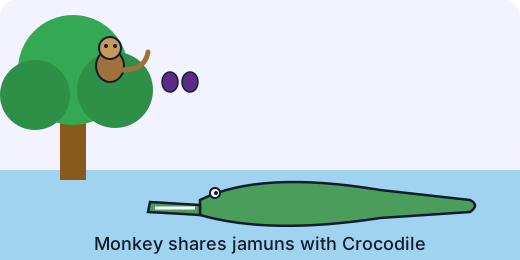
Here is the question: Should the monkey have shared the fruit with the crocodile?
Two friends, two ideas
Dev says: "Yes, the monkey should share, because sharing makes friends."
Priya says: "No. The crocodile was a stranger, and he might not be safe."
It is easy to shout, "No, you are wrong!" But that does not help. Dev does not learn why Priya thinks so, and Priya does not know if Dev understood her.
Say it back first
Here is a better way. Before you answer, say your friend's idea back in your own words.
"You think the crocodile might not be safe, because he was a stranger."
Now Priya can say, "Yes, that's it!" Or she can say, "Not quite. I meant …" Either way, Dev understands her better.
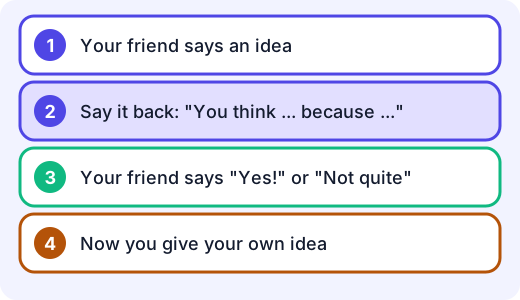
Here are the steps:
- Your friend says an idea.
- You say it back: "You think … because …"
- Your friend says "Yes!" or "Not quite."
- Now you give your own idea, with your own reason.
Dev might say: "I think the monkey should still share, because sharing is kind, and he could not know what the crocodile would do. But I see why you want to be careful."
Try it: Ask a grown-up what their favourite food is and why. Say it back: "You like … because …" Did you get it right?
Why does this matter?
You cannot truly disagree with an idea you have not understood. If you answer too fast, you might argue against something your friend never said! Saying it back checks that you heard. It is also a kind thing to do: it shows your friend that their idea mattered to you.
You do not have to agree. You only have to understand first.
For the grown-up helping
Read the story, then ask your child what they think. Practise "You think … because …" with small things (food, games, colours) before the big question. At this age, children often repeat their own idea instead of their friend's. That is normal. Model the sentence yourself, and thank them when they get close. Leave the question open: both "share" and "be careful" have good reasons.
Quick check
New puzzles
Practise listening in new situations.
1.Tara says, "The monkey should share, because sharing makes friends." Which sentence says her idea back?
- You think the monkey should share, because sharing makes friends.
- No, sharing is silly.
- You think the crocodile is bad.
Choose one
2.Your friend says an idea you do not agree with. What is the best thing to do first?
- Say your idea more loudly
- Say your friend's idea back in your own words
- Walk away
Choose one
3.Put the steps in the right order.
- Your friend says an idea
- Your friend says yes or not quite
- You give your own idea and reason
- You say it back: You think ... because ...
Put these in order
4.Dev says, "The monkey was clever because he thought fast." Which says his idea back?
- You think the monkey was clever because he thought fast.
- You think the monkey was lucky.
- You think the crocodile was clever.
Choose one
5.Why do we say a friend's idea back before we answer?
- So we know we understood it before we disagree
- So that we win
- So our friend stops talking
Choose one
Answering and checking are for registered learners. Register to do this.
Your turn
Shastrartha - should the monkey share?
The question: Should the monkey have shared the fruit with the crocodile?
Talk it through, or write it with a grown-up's help. A grown-up may write down your words.
- Say what you think: "I think the monkey ___ have shared."
- Give a reason: "I think this because ___."
- Give an example from the story or from your own life.
- Pretend a friend thinks the other way. Say their idea back to them: "You think ___ because ___." Say it so well that they would answer "Yes, that's it!"
How it's judged
- A clear position (pratijna)
- A real reason (hetu)
- An example (udaharana)
- Says the other view back fairly (purvapaksha)
Writing and submitting your answer is for registered learners. Register to do this.
Activity
Say it back
Your child practises saying your idea back before answering, then explains why it helps. About 10 minutes.
Steps
- Tell your child an opinion with a reason, such as "I think evening is the best time of day, because the weather is cool."
- Ask your child to say it back, starting "You think ... because ...". Say "Yes!" or "Not quite, I meant ...".
- Swap. Your child shares an opinion with a reason, and you say it back, sometimes a little wrong on purpose. Let your child tell you "not quite".
- Do one more round about a different thing, such as a favourite game or festival.
- Ask "Why is it good to say it back before we answer?" and write down your child's words.
Keeping a log of the activity is for registered learners. Register to do this.
Like what you see?
Register for free to answer the quick checks, do the activities and save your work. Your work is saved on your device and syncs to your account.