Unit 6
How do I know?
Learn the difference between seeing something, being told it and guessing it, and which ways are surer.
Read
The hare who heard a big noise
A little hare was lying under a palm tree, thinking about what would happen if the world ended. Just then, BOOM! A heavy fruit fell from the tree onto the ground nearby.
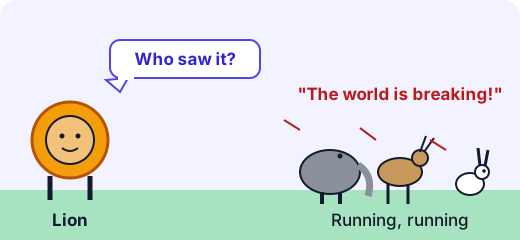
"The world is breaking!" cried the hare. He jumped up and ran as fast as he could. He did not look back.
Another hare saw him running. "Why are you running?" she asked. "The world is breaking!" he said. So she ran too. Then a deer joined in, and then an elephant, and soon a hundred animals were running, all shouting, "The world is breaking!"
A wise lion saw them racing past. He stood in their path and roared, "Stop! Why are you running?" They said, "The world is breaking!" The lion asked, "Who saw it?" The elephant said, "The deer told me." The deer said, "The hare told me." The lion turned to the little hare. "Did you see the world breaking?"
"No," said the hare, in a small voice. "I only heard a big noise."
So the lion took the hare back to the palm tree. There on the ground lay a big fruit that had fallen. The world was not breaking at all.
This old story is from the Jataka tales. It asks a very good question: how do I know?
Three ways of knowing
When we think we know something, there is a way we came to know it. There are three common ways.
Way of knowing What it means Example I saw it (or heard it, touched it) myself My own eyes, ears or hands told me I see rain falling from the window I was told Someone else said it My teacher says tomorrow is a holiday I guessed I worked it out from a clue, but I have not checked The sky is full of dark clouds, so I think it will rain 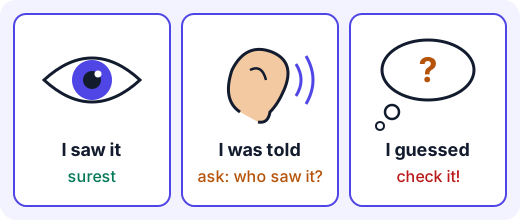
Thinkers in India long ago also asked how we come to know things. They talked about seeing for ourselves, being told by someone we can trust, and working something out from clues. You are doing the same thing!
Some ways are surer than others
Seeing for yourself is usually the surest way. But even our eyes can be fooled sometimes. A straw looks bent when it is in a glass of water, but when you take it out, it is straight.
Being told is as good as the person telling you. Ask: Did they see it themselves? Do they usually tell the truth? Do they know about this? In the story, the hare was told by nobody. He only heard a noise. The other animals were told by someone who was told by someone who was told by the hare. By the time it reached the elephant, nobody had seen anything.
Guessing is useful, because it gives us an idea to check. But a guess is not the same as knowing. The hare guessed that the noise meant the world was breaking. His guess was wrong.
Try it: Think of something you know. Did you see it, were you told it, or did you guess? How could you check?
Does everyone saying it make it true?
The animals thought, "So many of us are running, so it must be true!" But a hundred animals who all heard the same thing from one hare are really only one guess, repeated. When many people say something, it may be true, but it may not be. It is better to ask, "How do they know? Did anyone see it?"
The big question
If everyone says it, does that make it true?
Some people say, "If so many people say it, it is probably true. They can't all be wrong." Others say, "Many people can be wrong together, like the animals. The only way to know is to check." You can think either way. Give your reason, and say what someone who thinks the other way might say.
For the grown-up helping
Use the sentence "How do you know?" often, in a friendly voice, and not just when your child is wrong. Children this age can usually say "I saw it" or "Mum told me", and learn to say "I guessed" more slowly. Praise it when they say "I'm not sure, I only heard it." The big question has more than one good answer, so ask for a reason and an example. The idea of checking will come back in science, history and later courses.
Quick check
New puzzles
Think about how you know things.
1.Match each sentence to the way the person knows it.
- Omar watches the bus drive away.
- Priya's brother says the match was cancelled.
- Lena has not opened the box, but thinks it holds a ball because it is round.
Match each to: He saw it · She guessed · She was told
2.All the children say there is a tiger behind the school. Nobody has seen it. Do you know there is a tiger?
- Yes, because everyone says so
- Not yet. I should ask who saw it
- There is a tiger, and I know because I am sure
Choose one
3.You want to know if there is a bird in the tree outside. Which way is surest?
- Look up at the tree yourself
- Guess, because trees often have birds
- Ask a friend who has not looked
Choose one
4.You want to know if the shop at the corner is open. Which are good ways to find out? Pick all that apply.
- Walk to the corner with a grown-up and look
- Ask a neighbour who has just come back from the shop
- Decide it is open because it is a nice day
- Toss a coin
Choose all that apply
5.Everyone in the village says the well is empty. Meera goes to the well, looks in and sees water. What does Meera know?
- The well has water, because she saw it herself
- The well is empty, because everyone says so
- She cannot know anything at all
Choose one
Answering and checking are for registered learners. Register to do this.
Your turn
Shastrartha - if everyone says it, is it true?
The question: If everyone says it, does that make it true?
Talk it through, or write it with a grown-up's help. A grown-up may write down your words.
- Say what you think: "I think that if everyone says it, it ___ true."
- Give a reason: "I think this because ___."
- Give an example, such as the hare and the falling fruit, or one from your own life.
- Say what a friend who thinks the other way might say, starting "You think ... because ...".
How it's judged
- A clear position (pratijna)
- A real reason (hetu)
- An example (udaharana)
- Fair to the other side (purvapaksha)
Writing and submitting your answer is for registered learners. Register to do this.
Activity
Saw it, told it, guessed it
Your child plays a short game of sorting what they know into "I saw it", "I was told" and "I guessed", then checks one guess. About 15 minutes.
You'll need
- Three pieces of paper, labelled "I saw it", "I was told" and "I guessed" (draw an eye, an ear and a thought bubble)
- An opaque bag or box with a small safe object inside (such as a spoon or a toy)
Steps
- Say a few things your child knows, such as "It is daytime", "Grandma lives in another city", "There is a spoon in the bag". For each, ask "How do you know?" and place it on the right paper.
- Ask your child to shake or feel the bag from the outside and guess what is inside. Put the guess on the "I guessed" paper.
- Ask "Is a guess the same as knowing? How can you check?" Let your child open the bag and look. Move the idea to the "I saw it" paper.
- Say "Someone told me there is a big fruit on the moon." Ask "Do you know that is true? What would you ask?" (Who saw it? How do they know?)
- Ask the big question "If everyone says it, does that make it true?" and write down your child's words. Both answers are welcome, if there is a reason.
Safety
- Choose an object with no sharp edges or small parts.
- Do not use a sealed box that could contain anything unknown.
Keeping a log of the activity is for registered learners. Register to do this.
Like what you see?
Register for free to answer the quick checks, do the activities and save your work. Your work is saved on your device and syncs to your account.