Unit 5
Kindness to living things
Find out what animals and plants need, and think about how our actions can help or hurt them.
Read
The king of the deer
Long ago, a king loved to hunt deer in the forest. He had so many hunts that the deer were afraid. Two herds of deer, each with its own deer-king, went to the king and made a deal. "Please stop hunting us all over the forest," they said. "Each day one deer will come to you. That way you will have meat, and the others will be safe." The king agreed.
Each day, one deer walked to the king, and each day one deer died. One day it was the turn of a mother deer who was going to have a baby. She begged her king, "Please, let someone else go first. My baby has not even been born."
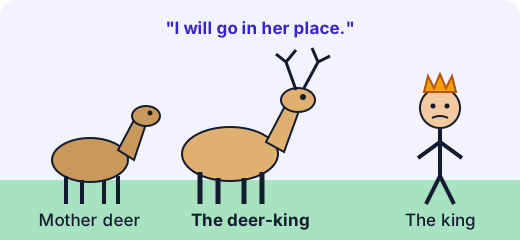
The deer-king looked at her and thought about the baby and its mother. Then he did something very brave. "I will go in your place," he said. He walked to the king and laid his head down.
The king was amazed. "I have heard of animals begging to live," he said, "but I have never seen one give his own life for another." He felt ashamed. He said, "I will not hunt your herd any more." And from that day he let the deer live in peace.
This story comes from the Jataka tales, which are old stories from India about the Buddha's earlier lives. The story asks us to see that the deer had needs, and feelings, like us.
What living things need
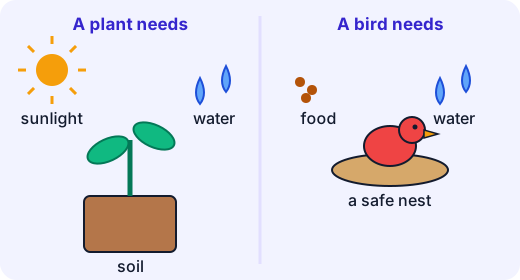
Every living thing needs some things to stay alive and well. These are called needs.
Living thing What it needs Animals (like deer, dogs, birds) food, water, a safe place to live, and a way to stay warm or cool Plants (like a tulsi or a mango tree) water, sunlight, air, and soil to grow in When we know what a living thing needs, we can think about how our actions affect it. If we pour water on a plant every few days, it grows. If we forget it in a dark cupboard, it droops.
Thinking about our actions
Here are some examples.
Example. A boy sees a bird's nest in a tree near his house. He wants to see the eggs, so he thinks about climbing up. What might happen? The bird mother may be frightened and fly away. The eggs could get cold, or fall. A kind action: watch from the ground, quietly, and let the nest be.
Example. A girl's puppy is left outside in the hot sun with no water. What does the puppy need? Water and shade. A kind action: move the puppy to a cool place and give it a bowl of water.
Try it: Look at a plant or an animal near you. What does it need? Is anything missing? What kind action could you do?
The big question
Do animals have feelings like ours?
Think about a dog that wags its tail when you come home, or a cow that cries out when her calf is taken away. Many people say animals feel happy, scared and sad, just as we do. Scientists agree that many animals feel pain and fear. But we cannot ask an animal, "How do you feel?", so some people say we cannot be sure animals feel exactly as we do. And a plant has no face or voice, so we watch for what it needs, not for how it feels. You can think either way. Give your reason, and say what someone who thinks the other way might say.
For the grown-up helping
Read the story aloud and ask "Why did the king change his mind?" Children this age can name what a pet or a plant needs and can usually say what is kind. Gently ask "How do you know?" to help children notice what the animal's body and sounds tell us. The big question has more than one good answer. We know animals feel pain and fear; how like ours their feelings are is less certain. Accept either position when your child gives a reason. Always supervise your child around real animals, and teach them to wash their hands afterwards.
Quick check
New puzzles
Think about what living things need and what a kind action would be.
1.Match each living thing to something it needs.
- A plant
- A fish
- A puppy
Match each to: Food and a safe, warm place · Clean water to swim in · Sunlight and water
2.Asha put a small plant in a dark cupboard and forgot it for two weeks. What will probably happen to the plant?
- It will droop and turn pale because it has no light or water
- It will grow big and strong
- Nothing, plants do not need anything
Choose one
3.A small stray puppy is shivering in the rain. Which is a kind action?
- Take it to a dry place and give it water, then ask a grown-up what to do next
- Chase it away because it is wet
- Walk by and think about something else
Choose one
4.Which of these do animals need to stay well? Pick all that apply.
- Food
- Water
- A safe place to live
- A television
Choose all that apply
5.Dev finds a nest with eggs in a low bush. He wants a better look. What is the kindest thing to do?
- Look from far away and leave the nest alone
- Take an egg home to look at it
- Shake the bush to see what happens
Choose one
Answering and checking are for registered learners. Register to do this.
Your turn
Shastrartha - do animals have feelings like ours?
The question: Do animals have feelings like ours?
Talk it through, or write it with a grown-up's help. A grown-up may write down your words.
- Say what you think: "I think animals ___ have feelings like ours."
- Give a reason: "I think this because ___."
- Give an example, such as the deer-king, a pet, or an animal you have watched.
- Say what a friend who thinks the other way might say, starting "You think ... because ...".
How it's judged
- A clear position (pratijna)
- A real reason (hetu)
- An example (udaharana)
- Fair to the other side (purvapaksha)
Writing and submitting your answer is for registered learners. Register to do this.
Activity
What does it need?
Your child looks closely at a real plant or animal, says what it needs and how our actions could help or hurt it, and suggests one kind action. About 15 minutes.
You'll need
- A plant in a pot or in the garden, or a safe place to watch birds, ants or a family pet
- Paper and a pencil (optional, to draw what you see)
Steps
- Choose one living thing to look at together. Look quietly for a minute.
- Ask "What does it need to stay alive and well?" For a plant, think of water, light, air and soil. For an animal, think of food, water and a safe place.
- Ask "Is it getting what it needs? How can you tell?" Look at its leaves, its movements or its sounds.
- Ask "What could someone do that would hurt it? What could someone do to help it?" Ask your child to choose one kind action they can really do, such as watering the plant or putting out a bowl of water for birds in the shade.
- Ask the big question "Do animals have feelings like ours?" and write down your child's words. Both answers are welcome, if there is a reason.
Safety
- Watch animals from a distance. Do not touch wild animals, nests or insects.
- Pets can scratch or bite if scared. A grown-up stays close.
- Wash hands after touching plants, soil or animals.
- Do not eat any leaf, flower or berry.
Keeping a log of the activity is for registered learners. Register to do this.
Like what you see?
Register for free to answer the quick checks, do the activities and save your work. Your work is saved on your device and syncs to your account.