Unit 6
Noticing my learning
Look back at something hard you learned, say what helped, and decide whether learning from mistakes beats getting it right first time.
Read
Zara and the shoelaces
Zara's brother Imran could tie his shoelaces in a flash. Zara could not. Every morning at the door she tried, and every morning the laces came undone, or ended up in a knot like a bowl of noodles.
"I can't do it," she said. "Imran got it right the first time."
Her grandmother, Nani, sat beside her. "Did he? I remember him trying for weeks. You just did not see it." Then she asked something strange. "Zara, what happened this time? Tell me what you did, and what you noticed."
Zara looked at her shoes. "I made the loop, and then the loop fell out."
"Good noticing!" said Nani. "What do you think would help?"
Learning how you learn
When you learn something hard, there are two things going on. One is the new thing itself (the knot). The other is how you learn: what helps you, what gets in the way, and what to try next. You can notice this part too, and that is a skill.
You can learn how you learn.
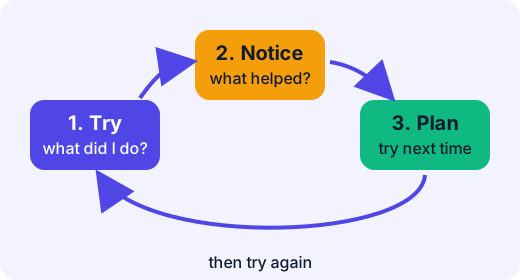
After each try, Nani asks three questions:
- What did I do? (Say it step by step.)
- What helped, and what did not?
- What will I try next time?
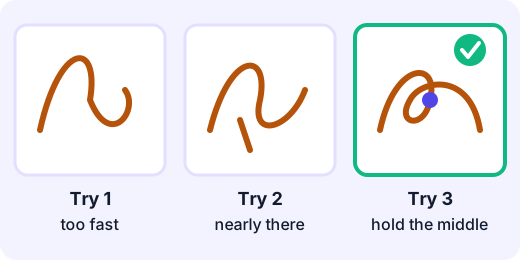
Zara tried again, and this time she said her ideas aloud. "The first time, I pulled too fast. The second time, Nani showed me the bunny-ears way, and that helped. But I forgot to hold the middle. Next time I will hold the middle with my thumb."
Things that can help you learn
People learn in different ways. Here are some things that often help:
What helps Example Watching someone Seeing Nani tie the laces slowly Doing it yourself Trying again with your own fingers Breaking it into small steps First the loop, then the wrap, then the pull Saying it out loud Zara explaining her steps Asking for help Asking Nani to show the hard bit Taking a break Stopping when you feel cross and coming back later Notice which of these helped you. Maybe Zara learns best by watching, and her friend Omar learns best by drawing. Both are fine.
Example. Omar was learning the three times table. He said, "I learned it by singing it with a tune, not by reading it. For the next table I will try a tune again." That is noticing his learning. He now has a tool for the next hard thing.
Mistakes are information
A mistake tells you something. When the knot fell out, Zara learned that the loop was not held. That is useful. If she had never made a mistake, she would not have found out what to change.
A common thought is "If I need many tries, I am not clever." That is not true. Needing many tries is normal for anything new, even for grown-ups. What matters is what you do after a mistake: look at it, be curious, and try again with one change.
But getting it right first time is not bad, either! Sometimes it matters a lot to be careful. A pilot must check the plane before flying, and a baker should measure the sugar before baking. So the question is a real one. Is it better to get it right the first time, or to learn from getting it wrong? Think about when each one matters, and give your reasons.
The third try
On her third try, Zara tied her laces, and they held. She grinned. "I did it!" Nani asked, "What helped most?" Zara said, "Holding the middle with my thumb. And you not telling me to hurry." She drew a thumb in her notebook, to remember.
For the grown-up helping
Read the story, then choose something your child found hard recently, such as a skill, a game or a word. Ask the three questions: "What did you do? What helped? What will you try next?" Accept any answer they give; the point is that they get used to looking at their own learning. Praise the noticing and the effort ("You tried three ways!") more than the result. If your child says "I'm bad at this", answer "not yet" and ask what they could change.
Quick check
New puzzles
Notice learning in new situations.
1.What does 'noticing my learning' mean?
- Looking at what helped me learn and what to try next
- Counting how many answers I got right
- Comparing myself with the quickest child in class
Choose one
2.Ravi's drawing of a horse looks wrong. He says, 'I'm just bad at drawing.' Which is the best way to look at it?
- He should give up, because he is not good at it
- He can look at what looks wrong, try one change, and see if it helps
- He should copy someone else's drawing and say it is his
Choose one
3.Put the three learning questions in the order you ask them after a try.
- What helped, and what did not?
- What will I try next time?
- What did I do?
Put these in order
4.Meena learned to ride a bike. Pick all the things that are examples of what helped her learn.
- Watching her cousin ride slowly
- Never trying, so she would not fall
- Practising one step at a time: balance first, pedals later
Choose all that apply
5.Which of these is a time when it is especially important to get it right the first time?
- A pilot checking the plane before it flies with passengers
- A child trying out a new pattern with paint on scrap paper at home
- A child practising how to say a new word in a word game
Choose one
Answering and checking are for registered learners. Register to do this.
Your turn
Shastrartha - right first time, or learn from mistakes?
The question: Is it better to get it right first time or to learn from getting it wrong?
Talk it through, or write it with a grown-up's help. A grown-up may write down your words.
- Say what you think: "I think it is better to ___."
- Give a reason: "I think this because ___."
- Give an example from Zara's story or from something you learned.
- Say what someone who thinks the other way might say, and why they might think so.
How it's judged
- A clear position (pratijna)
- A real reason (hetu)
- An example (udaharana)
- Fair to the other side (purvapaksha)
Writing and submitting your answer is for registered learners. Register to do this.
Activity
My learning story
Your child picks something they found hard and then learned, and tells the story of how they learned it. About 15 minutes.
You'll need
- Paper and a pen or crayons
- Optional, something they learned to do (a toy, a book, a game)
Steps
- Ask your child to pick something that was hard and is now easier, such as tying shoes, reading a word, riding a bike, a game or a song. If they cannot think of one, help them remember.
- Ask the three questions and write down the answers. What did you do? What helped, and what did not? What will you try next time (or for the next hard thing)?
- Ask your child to draw three pictures, in order, of the try, the thing that helped, and the next try. They can tell you what to write under each.
- Ask "Did you get it right the first time? What did a mistake teach you?" Share a time you learned from a mistake too.
- Ask the big question "Is it better to get it right first time or to learn from getting it wrong?" and write down your child's words. Both answers are welcome, if there is a reason.
Safety
- Choose something safe to talk about. Do not ask your child to try something risky to make a story.
Keeping a log of the activity is for registered learners. Register to do this.
Like what you see?
Register for free to answer the quick checks, do the activities and save your work. Your work is saved on your device and syncs to your account.