Unit 5
Belonging and being different
Talk about how it feels to be left out, how groups can include people, and whether it is okay to be different.
Read
The Ugly Duckling
This is an old story, first written down by Hans Christian Andersen long ago in Denmark. Here is our own way of telling it.
One spring, a mother duck sat on her nest. One by one the eggs cracked, and out came fluffy yellow ducklings, all cheeping. The last egg was bigger than the rest. It cracked, and out tumbled a chick who was grey and gangly, with a long neck.
"You look different!" said the ducklings. "Go away!" quacked the hens in the farmyard. The grey bird tried to join the games, but the others pecked and pushed. He felt small and lonely, and one night he ran away.
All through the autumn and the cold winter he wandered alone. Some animals laughed at him. A kind old woman gave him shelter for a while, but she could not keep him. He hid among the reeds as ice formed on the lake.
When spring came, he saw three beautiful white birds swimming. He thought, "They will chase me away too." He bent his head, and in the water he saw his own reflection. He was not an ugly duckling. He was a swan! The swans came near and welcomed him. He belonged after all.
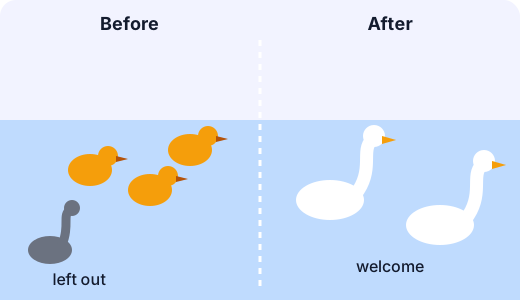
What does it mean to belong?
To belong is to feel that you are part of a group and that you are welcome. Your family, your class, your team and your neighbourhood are groups where people can belong.
Everyone wants to belong.
Everyone: shy people and loud people, fast runners and slow ones, people who speak different languages or eat different food. The duckling wanted what we all want. He wanted somebody to say "Come and play".
How it feels to be left out
Think about a time when you were left out of a game. Maybe your tummy felt heavy, or your face felt hot, or you felt like hiding. Those feelings are real, and everyone feels them sometimes. When we know how bad it feels, we can try to stop others feeling it.
What does include mean?
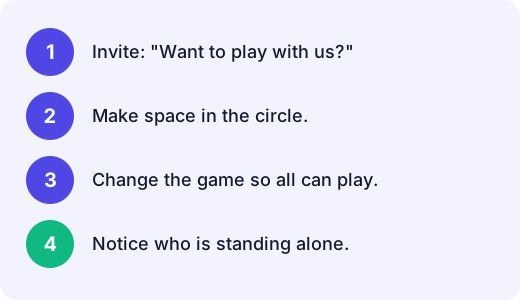
To include someone is to make room for them. A group can include people in many easy ways:
- Say "Do you want to play with us?"
- Make a space in the circle.
- Change the game so that more people can play, for example, one where you do not have to run fast.
- Notice who is standing alone.
Example. At Aisha's school, a new boy named Tomás speaks mostly Spanish. At break he stands by the wall. Aisha holds up a ball and smiles, and he smiles back. Soon they teach each other words: ball and pelota. Tomás belongs, and Aisha learned a new word. Including someone can make the group better, too.
Different, but still one of us
The duckling looked different from the others, but that was not a fault. Being different does not mean being worse. Some differences are about how we look, how we talk, what we like, or what we can do. A group of people who are all the same would be pretty boring, and would not be able to do very many things. Different people notice different things and have different good ideas.
But careful: belonging does not mean you must become exactly like everyone else. Sometimes people feel they have to hide who they are to be let in. That is not real belonging. Real belonging means being welcome as you are.
There is one more thing to think about. Some behaviour, like hitting others, is something a group may say "no" to, and it is fair to ask someone to stop that. That is very different from leaving someone out because of how they look, speak or what they like.
So what do you think?
In the story, the duckling was miserable until he found out he was a swan. Some people say the lesson is "be patient, you will find your own kind". Others say the real problem was the farmyard animals, who should have welcomed him even if he was not a swan. Is it okay to be different from everyone else? What reasons would you give?
For the grown-up helping
Read the story aloud. Stop at the point where the duckling runs away and ask "How does he feel? Has anything like that ever happened to you?" Listen to what comes up; some children will share painful memories of being left out. Do not rush to fix it. Then ask "What could the other ducklings have done?" Praise ideas about including, and gently point out that the duckling deserved kindness even before he turned out to be a swan. If your child tells you they are being left out or bullied regularly, talk to their teacher.
Quick check
New puzzles
Think about belonging in new places.
1.Which sentence best says what it means to belong?
- To look and act exactly like everyone else in the group
- To feel you are part of a group and welcome in it
- To be the leader of the group
Choose one
2.Priya uses a wheelchair, and her class is planning a running race at sports day. What would be a good way for the class to include her?
- Ask her to watch and cheer while everybody else races, so she is not in the way
- Plan a game that everyone can take part in, and ask Priya what she would enjoy
- Cancel sports day this year so nobody has to feel left out
Choose one
3.Pick all the ways of including someone.
- Asking 'Would you like to play?'
- Whispering and laughing when they walk by
- Making a space for them in the circle
Choose all that apply
4.Sam loves bird-watching. Other children in his class like football and tease him about his hobby. A friend says, 'Just pretend you love football so they let you in.' What is a good thought about this?
- Real belonging is being welcome as you are, so the group should make room for Sam's hobby too
- Sam should give up bird-watching for good so the others will like him
- Sam should stay away from groups, because groups never welcome different people
Choose one
5.A new girl in class often pushes other children in line. Her classmates ask her to stop pushing. Is that the same as leaving her out because she is different?
- Yes, any rule at all is the same as leaving someone out
- No: asking her to stop pushing is about keeping everyone safe, and she can still be welcome in the group
- Yes, because she is new and new children should not be given rules
Choose one
Answering and checking are for registered learners. Register to do this.
Your turn
Shastrartha - is it okay to be different from everyone else?
The question: Is it okay to be different from everyone else? (Think about the Ugly Duckling.)
Talk it through, or write it with a grown-up's help. A grown-up may write down your words.
- Say what you think: "I think it is (or is not) okay to be different from everyone else."
- Give a reason: "I think this because ___."
- Give an example from the Ugly Duckling story or from your own life.
- Say what someone who thinks the other way might say, and why they might think so.
How it's judged
- A clear position (pratijna)
- A real reason (hetu)
- An example (udaharana)
- Fair to the other side (purvapaksha)
Writing and submitting your answer is for registered learners. Register to do this.
Activity
Make room in the circle
Your child uses toys or paper figures to act out being left out and being included, then talks about how it feels. About 15 minutes.
You'll need
- Five or six small toys, or paper figures with faces drawn on
- A sheet of paper with a big circle drawn on it
Steps
- Put four figures inside the circle and one outside, and say "This is the new one. The others are playing."
- Ask your child to speak for the figure outside. What does it feel like? What does it want? Write down what they say.
- Ask your child to speak for the figures inside. What could they say or do? Let your child try each idea by moving the figures (invite, make space, change the game, notice who is alone).
- Ask "Has it ever felt like that for you? What helped?" Listen without fixing. Share a time you felt left out too, if you wish.
- Ask the big question "Is it okay to be different from everyone else?" and write down your child's words. Both answers are welcome, if there is a reason.
Safety
- This is a gentle talking activity. If your child shows strong feelings, pause and comfort them first.
Keeping a log of the activity is for registered learners. Register to do this.
Like what you see?
Register for free to answer the quick checks, do the activities and save your work. Your work is saved on your device and syncs to your account.