Unit 1
Questions worth asking
Learn to tell a question with one answer from a question people can think about together, and ask one of your own.
Read
Kabir's day of "why"
On Saturday, Kabir woke up with a head full of questions. On the way to the market with his grandmother, they came out one after another.
"How many steps are there to the bus stop?" Kabir counted. There were twenty-two.
"What is the name of this tree?" Grandmother said, "A neem tree." That was easy too.
"Why do we have to buy rice every week?" Grandmother thought for a moment. "Because we eat it. But that is a good question. Is it better to buy a little each week, or a lot at once?" Kabir frowned. He had never thought of that. Buying a lot is cheaper, he said. But a little keeps it fresh, said Grandmother. They talked about it all the way home, and they did not agree. It was the best part of the day.
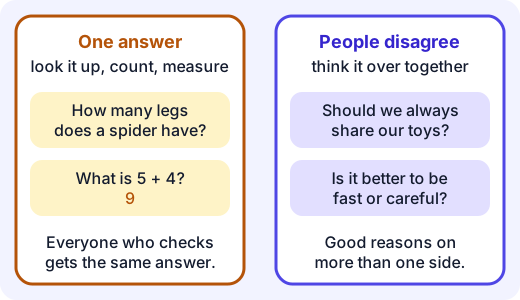
Two kinds of question
Kabir asked two kinds of question.
Questions with one answer. You can count, measure, look up or ask someone who knows. How many steps? What tree? What is 5 + 4? Everyone who checks gets the same answer. These questions are useful! But once you have the answer, the thinking is over.
Questions people disagree about. Is it better to buy a little or a lot? Should we always share? Is it fair that the youngest goes last? Nobody can look these up. Kind, clever people may give different answers, and each one can have a reason. These are questions worth thinking about together.
Question Which kind? How many days are in a week? One answer (7) Is it better to read or to play outside? People can disagree What colour do you get from mixing blue and yellow? One answer (green) Should we keep a promise even when it is hard? People can disagree Try it: Think of three questions you asked this week. Which kind was each one?
Making a question grow
Here is a trick. You can often turn a one-answer question into a thinking question. Ask about what is good, fair or better, and about what we should do.
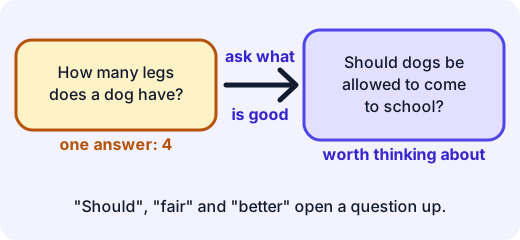
"How many legs does a dog have?" has one answer: four. But "Should dogs be allowed to come to school?" has reasons on both sides. Dogs might make us calm and happy. Some children are afraid of dogs, or are allergic to them.
So why do people ask "why"?
Sometimes "why" wants a fact: Why do leaves fall? We can find that out in a book. Sometimes "why" wants a reason to think about: Why should we take turns? People ask "why" to understand, and to see whether an idea holds up. That is the beginning of thinking together.
For the grown-up helping
Read the story aloud and pause at each of Kabir's questions: "Could we find that out by counting or looking it up, or could people disagree?" Do not worry if the sorting is not perfect; it is a hard idea. A question like "Why is the sky blue?" has an answer to find out, though it may take a book. Praise your child's own questions, and ask "What do you think?" before you answer one. Let some questions stay open.
Quick check
New puzzles
Sort and make questions in places Kabir never went.
1.Which question can be settled by measuring?
- Is the table taller than the chair?
- Which is prettier, the table or the chair?
- Is it good to be tall?
Choose one
2.Pick all the questions that people can reasonably disagree about.
- What is 6 + 3?
- Is it fair that the youngest child always goes last?
- Is it better to read a book or play outside on a rainy day?
- How many days are in a week?
Choose all that apply
3.Which of these is a question of the second kind (one people can disagree about)?
- How many legs does a dog have?
- Should dogs be allowed in school?
- What sound does a dog make?
Choose one
4.Meena asks, "Why do leaves turn brown in autumn?" What is a good way to find out?
- Look in a book or ask someone who knows
- Have a class vote
- Guess as loudly as you can
Choose one
5.Rani asks, "Should we always share our best toy?" Why is this a good question to think about together?
- Because one person in the class already knows the right answer and can tell everyone
- Because friends may have different good reasons, and we can learn from them
- Because the teacher will tell us at the end who is right and who is wrong
Choose one
Answering and checking are for registered learners. Register to do this.
Your turn
Shastrartha - why do people ask "why"?
The question: Why do people ask "why"?
Talk it through, or write it with a grown-up's help. A grown-up may write down your words.
- Say what you think: "I think people ask why because ___."
- Give a reason: "I think this because ___."
- Give an example: a time you or someone you know asked "why", from Kabir's story or from your life.
- Say what someone who thinks something different might say (for example, that people only ask "why" to get a fact), and why they might think so. Then say whether it changes your mind.
How it's judged
- A clear position (pratijna)
- A real reason (hetu)
- An example (udaharana)
- Fair to the other side (purvapaksha)
Writing and submitting your answer is for registered learners. Register to do this.
Activity
Two baskets of questions
Your child sorts questions into two baskets and then asks a thinking question of their own. About 15 minutes.
You'll need
- Six small pieces of paper or card
- A pen
- Two bowls, boxes or sheets of paper to be the "baskets"
Steps
- Write one question on each card. Use these, or your own: How many windows are in our home? What is the capital of India? Is it better to have one best friend or many friends? Should we always tell the truth? How tall is the door? Is it fair for the oldest to choose first?
- Label one basket "One answer" and the other "People can disagree". Read each card aloud and ask your child to put it in a basket and say why.
- For the "One answer" cards, ask "How could we find out?" For the other cards, ask "What would two people say, and what is each person's reason?"
- Now ask your child to make up one new question of the second kind, about school, family or animals. Write it down exactly as they say it.
- Ask "Why do you think people ask why?" and write down your child's words.
Safety
- An adult does any cutting of paper with scissors.
Keeping a log of the activity is for registered learners. Register to do this.
Like what you see?
Register for free to answer the quick checks, do the activities and save your work. Your work is saved on your device and syncs to your account.