Unit 2
Agreeing and disagreeing well
Learn the words "I agree with ... because" and "I disagree with ... because", and how to disagree with an idea and still be kind.
Read
Noor and Dev and the plan for break
Noor and Dev are best friends. At school break one rainy-looking morning, they had to choose a game for their group.
"Let's play on the swings," said Noor.
"No! That's a silly idea!" said Dev. Noor went quiet. Dev crossed his arms. Neither of them played anything.
What went wrong? Dev did not like the idea, and that is fine. But he said "silly", and it sounded like he meant Noor. He also gave no reason, so there was nothing for Noor to think about.
Now they try again.
"Let's play on the swings," says Noor.
"I disagree with you, Noor, because the clouds are dark and the swings get wet when it rains. But I like that you thought of the swings. What about a game in the corridor?"
"Hmm," says Noor. "The corridor is too narrow for running. But I agree with you that we shouldn't sit on wet swings. What about hopscotch?"
"I agree with you, Noor, because it only needs chalk, and we can play it under the roof."
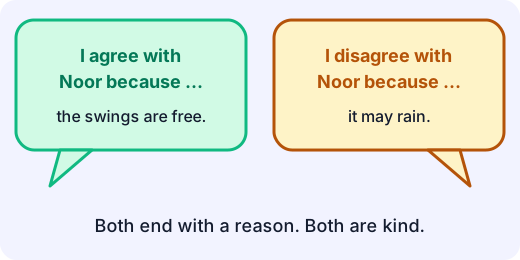
Two sentences to practise
I agree with … because …
I disagree with … because …
Both sentences have the same shape: they say who you are answering, whether you agree, and a reason. The reason is the important part. "I disagree because it's silly" is not a reason. "I disagree because the swings get wet" is a reason, and Noor can think about it.
Not so good Better "That's a silly idea." "I disagree with that idea because ..." "No." "I disagree with you because ..." "Yeah, OK." "I agree with you because ..." "You're wrong." "I see it differently, because ..." An idea is not a person
Here is the secret of disagreeing well. You can disagree with an idea and still be kind to the person. Dev's second try works because he says nice things about Noor ("I like that you thought of the swings") and pushes only on the idea ("the swings get wet").
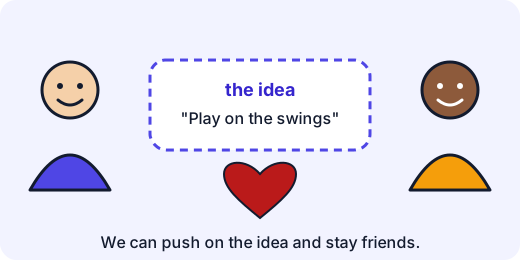
Some things that help:
- Listen to the end before you answer.
- Say what you heard: "You said we should play on the swings."
- Use a kind voice and a calm face.
- Give a reason, then ask "What do you think?"
So, is it rude to disagree?
Some people think so. They say disagreeing makes friends cross. Other people say it is helpful, because if nobody ever disagreed, we would never find a better idea. Dev and Noor found hopscotch because they disagreed. It is not rude to disagree. It can be rude to be unkind, or to say nothing useful. What do you think, and why?
For the grown-up helping
Read the story, then try the sentence frames in a real choice at home, such as what to cook or which game to play. Children at this age often hear "I disagree" as "I don't like you", so model the difference: disagree with something you say in front of them, kindly and with a reason. If your child says "no" with no reason, ask "Can you tell me why?" and help them finish the sentence. Do not push for agreement; the goal is a reason and a kind voice.
Quick check
New puzzles
Spot kind, clear agreeing and disagreeing in new places.
1.Noor says, "Let's paint the fence green." Which answer disagrees well?
- That's a silly idea, Noor, and I don't want to hear any more about it.
- I disagree with Noor because green paint would hide the flowers behind the fence.
- No, I don't like green, so we won't do it.
Choose one
2.Dev says, "Let's play hopscotch because it only needs chalk." Which answer agrees well?
- Yeah, okay, whatever you want to do is fine with me.
- I agree with Dev because chalk is easy to find and we can play under the roof.
- Dev always picks the best games, so I will say yes to anything.
Choose one
3.Pick all the things that help you disagree kindly.
- Listen to the end before you answer
- Call the person names
- Give a reason and ask "What do you think?"
- Roll your eyes and walk away
Choose all that apply
4.Ali says, "Let's have the picnic outside tomorrow." The weather report says heavy rain. Fill in the word: "I ___ with Ali because the weather report says heavy rain."
Answer with a word or phrase
5.Mira says, "Cats are better pets than dogs." You think dogs are better. What are you disagreeing with?
- Mira, as a person
- Mira's idea that cats are better pets
Choose one
Answering and checking are for registered learners. Register to do this.
Your turn
Shastrartha - is it rude to disagree?
The question: Is it rude to disagree?
Talk it through, or write it with a grown-up's help. A grown-up may write down your words.
- Say what you think: "I think it is (or is not) rude to disagree."
- Give a reason: "I think this because ___." Try using "I agree with ... because" or "I disagree with ... because" somewhere in your answer.
- Give an example from Noor and Dev's story or from your own life.
- Say what someone who thinks the other way might say, and why they might think so.
How it's judged
- A clear position (pratijna)
- A real reason (hetu)
- An example (udaharana)
- Fair to the other side (purvapaksha)
Writing and submitting your answer is for registered learners. Register to do this.
Activity
The two-sentence game
Your child practises "I agree with ... because" and "I disagree with ... because" in a make-believe choice, then explains the difference between an idea and a person. About 15 minutes.
You'll need
- Two sheets of paper and a pen
- Two soft toys or puppets (optional)
Steps
- Write "I agree with ... because ..." on one sheet and "I disagree with ... because ..." on the other. Put them where your child can see them.
- Let two toys, or you and your child, choose a snack for a picnic. One says an idea, for example "Let's bring only sweets." The other answers using one of the two sentences.
- Switch roles. Make sure you say one unkind answer on purpose, and say that it is pretend ("That's a silly idea!"). Ask your child, "What was not kind about that? Can you say it again, kindly, with a reason?"
- Ask "Can you disagree with an idea and still be kind to the person?" and write down your child's words.
- Finish with the big question "Is it rude to disagree?" and write down your child's words. Both answers are welcome, if there is a reason.
Safety
- No special safety needs. If a disagreement feels real and upsetting, stop the game and take a break.
Keeping a log of the activity is for registered learners. Register to do this.
Like what you see?
Register for free to answer the quick checks, do the activities and save your work. Your work is saved on your device and syncs to your account.