Unit 1
Good and bad reasons
Learn to tell a reason that really supports a claim from one that only sounds convincing, like "because everyone does it".
Read
The hare and the thud
An old Jataka tale tells of a hare who lay asleep under a palm tree. Suddenly there was a loud THUD behind him. A ripe fruit had dropped from the tree and landed on the ground.
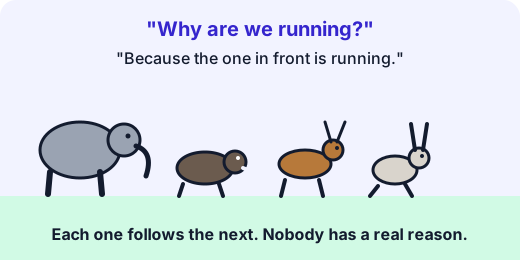
The hare did not look. He sprang up and shouted, "The earth is breaking! Run!" He raced away. A deer saw him running and ran too. Then a boar ran, and then a herd of elephants. Soon thousands of animals were stampeding through the forest, and not one of them knew why.
Then a lion stood in their path and roared for them to stop. "Who saw the earth break?" he asked. The elephants said, "The boar ran, so we ran." The boar said, "The deer ran." The deer said, "The hare ran." At last the lion asked the hare, who whispered, "I heard a thud." The lion took the hare back to the tree, and there lay the fruit.
The animals had a reason for running: "everybody else is running." It felt like a strong reason. It was a bad one.
Claim and reason
When we say what we think is true or right, that is a claim. "The earth is breaking" was a claim. A reason is what we give to show the claim is true or right.
Here is a test you can use on any reason. Imagine the reason is true. Then ask:
Does that make the claim more likely to be true (or right)?
The elephants' reason was true: the boar really was running. But a running boar tells us nothing about whether the earth is breaking. It only tells us the boar was frightened. The thud was a real clue, but a weak one, and the hare needed to look behind the tree before he decided.
Bad reasons that sound good
The animals fell for the bandwagon: "everyone does it, so it must be right." It is one of the most common bad reasons because it sounds so sensible. If many people do something, surely they know something?
Sometimes they do, but the crowd is not what makes them right. Think of these two reasons for the same claim:
Claim Reason Good or bad? "You should wash your hands before eating." "Because lots of people do." Weak: the crowd is not the point. "You should wash your hands before eating." "Because washing removes germs that can make you ill." Good: it tells us why it works. Many people wash their hands, and they are right to. But what makes it right is the germs, not the number of people. If a million people stopped washing, the germs would still be there.
Remember: a lot of people can be wrong. Long ago, almost everybody believed that the Sun moves around the Earth. They saw it rise and set, and it seemed obvious. Careful observers, over many years, showed that the Earth goes around the Sun.
Here are other reasons that sound convincing but do not support a claim:
- "Because I said so." (or "because the big boy said so"). The person may be right, but saying so is not a reason. Ask: how do they know?
- "Because I want it." Wanting something does not make it good, or true.
- "Or you'll be sorry!" A threat may make you obey, but it does not show the claim is right.
- "You're just a child." That is about the person, not the claim. A child can be right.
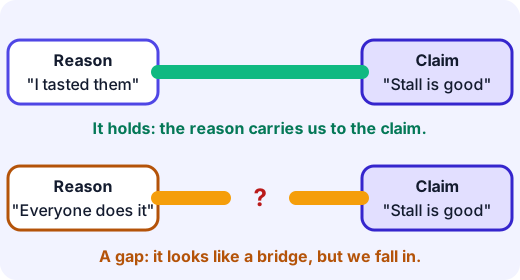
Example. Tara says, "The new mango stall is good." Three friends give reasons.
- Ishaan: "Because everyone in my building buys from it." Bandwagon. It may be popular for other reasons, such as being close by.
- Leela: "Because the owner is my uncle." That tells us who he is, not whether the mangoes are good.
- Kabir: "Because I bought two last week and both were sweet and not bruised." Good. He saw it himself, and anyone could check it.
How to check a reason
- Find the claim: what is being said is true or right?
- Find the reason: what is given to support it?
- Imagine the reason is true. Does it make the claim more likely?
- Ask what a good reason would look like: something you can see, measure, test, or explain.
A bad reason is not always a lie. It is a reason that does not do its job. And the claim may still be true: maybe the stall does have good mangoes. We only learn that when we find a better reason.
The big question
Is something right because lots of people do it? Some people say yes: a custom that lasted many generations must have worked well for something. Others say no: crowds have been wrong, and even a rule that everybody follows can be unkind. Can you find a good reason either way? Take your time, and look for the because that does real work.
Quick check
New puzzles
Test reasons in new places. Ask each time, "If this reason is true, does it help show the claim is true or right?"
1.Which of these reasons lean on "everybody does it"?
- "You should buy this bag, because every girl in Class 3 has one."
- "You should wear a helmet on a cycle, because it protects your head if you fall."
- "It's fine to leave your plate on the floor, because all the boys do."
- "Plants need water, because without it their leaves droop and dry out."
Choose all that apply
2.Three of us felt ill after eating cut fruit from a cart, but the children who did not eat it were fine. Mina says, "The fruit was dirty." Which is the best reason for her claim?
- Most people in town buy from that cart.
- The ones who ate the fruit got ill, and the ones who did not eat it stayed well.
- Mina is older than the rest of us, so she must know.
Choose one
3.Many people look both ways before they cross a road. Which is the good reason for you to do it?
- Because so many people do it.
- Because a vehicle you have not noticed could hit you.
- Because the teacher might shout if you don't.
Choose one
4.For a long time, many people believed that maggots grow out of rotting meat all by themselves. Later, careful experiments showed that flies lay eggs on the meat. What does this show?
- If almost everybody believes something, it must be true.
- A great many people can believe something that is false.
- Nobody can ever know what is true.
Choose one
5.Put the steps for checking a reason in a sensible order.
- Imagine the reason is true and ask: does the claim become more likely?
- Decide if it is a good reason, and look for a better one if not
- Find the reason given for it
- Find the claim
Put these in order
Answering and checking are for registered learners. Register to do this.
Your turn
Shastrartha - is something right because lots of people do it?
The question: Is something right because lots of people do it?
Write 8 to 12 sentences (or talk it through and have a grown-up write it down). Use these parts:
- Your position (pratijna). Say what you think, in one sentence.
- A reason (hetu). Give a reason that really supports your position. Check it with the test: if this reason is true, does it make my position more likely?
- An example (udaharana). Use a real example: the hare in the Jataka tale, the hand-washing example, or something from your own school or street.
- A bad reason to avoid (hetvabhasa). Name one bad reason that people might use here (for example, "everybody does it", "because I said so" or "because I want it"), and say why it fails.
- The other side (purvapaksha). Say what someone who thinks differently might say, and why they might think so, fairly.
- An objection (tarka). Someone says to you: "But if a custom has lasted for hundreds of years, surely lots of people can't have been wrong for all that time?" Answer it directly.
How it's judged
- A clear position (pratijna)
- A real reason (hetu)
- An example (udaharana)
- Sound reasoning (hetvabhasa)
- Fair to the other side (purvapaksha)
- Answers the objection (tarka)
Writing and submitting your answer is for registered learners. Register to do this.
Your turn
Explain it - a bad reason that sounds good
Imagine a younger cousin says, "I should have a phone, because everybody in my class has one."
Write what you would say to them (5 to 8 sentences):
- Say what the claim is and what the reason is.
- Explain, in your own words, why the reason does not really support the claim even though it sounds convincing.
- Give your cousin the test for a reason that you learned in this unit.
- Suggest one better reason your cousin could give, if they really want a phone.
Be kind: you are helping, not winning.
How it's judged
- Names the claim and the reason correctly
- Explains why the reason fails
- Teaches the test and offers a better reason
Writing and submitting your answer is for registered learners. Register to do this.
Like what you see?
Register for free to answer the quick checks, do the activities and save your work. Your work is saved on your device and syncs to your account.