Unit 2
Answering objections
When someone challenges your view, answer the challenge instead of repeating yourself, and see why an objection helps you.
Read
Meera and the bedtime debate
Meera was eight, and she had made up her mind. "Children should choose their own bedtime," she told her dad at dinner. "It's my body and my night."
"But you'll be tired at school," said Dad.
"I should choose my bedtime," said Meera.
"Won't you be too sleepy to learn?"
"I should choose my own bedtime!" said Meera, louder.
Dad put down his spoon. "You've said that three times. I asked a question, and you didn't answer it."
Meera frowned. Dad was right. She had been saying her claim over and over, like turning up the volume on a radio. Dad had pointed at something real, and she had ignored it.
What is an objection?
A claim is what you say you think. An objection is a challenge to it: a reason why the claim might be wrong, or a problem it leaves out. A reply is your answer to the objection.
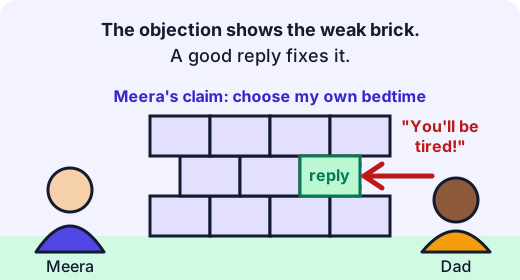
Dad's objection was: "If you stay up late you'll be tired at school." Notice what he did not say. He did not say "you are silly", and he did not just say "no". He pointed at a specific weak spot.
An objection is a gift. It shows you where your idea is weakest, and it is free. A friend who agrees with everything you say cannot help you improve it.
Think of building a wall. A person who points at a loose brick is not attacking the wall. They are telling you where it will fall.
Three kinds of reply
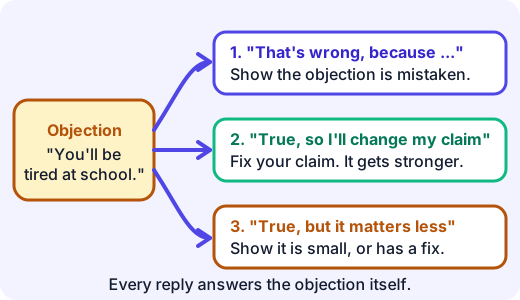
When you hear an objection, first say it back in your own words ("You think I'd be too tired for school"). Then decide which of these is true, and reply:
- "That's wrong, because ..." The objection is mistaken. Give your reason.
- "That's true, so I'll change my claim." The objection is right, so you fix your idea.
- "That's true, but it matters less, because ..." The problem is real but small, or it has a simple fix.
What does not count as a reply:
- Repeating yourself louder (what Meera did).
- Changing the subject: "You never let me do anything!"
- Attacking the person: "You just want to boss me."
- Giving in without thinking: "OK, fine, whatever."
Worked example. Here is how Meera's second try went.
"Dad, you said I'd be tired at school. That's a good point. Doctors say children my age need about nine to twelve hours of sleep, so staying up very late really could make me tired. I'll change my claim: children should choose their own bedtime inside a limit. If I'm still awake at ten, that's too late. If I'm tired at school two days in a row, you can choose my bedtime for a week."
Dad raised his eyebrows. "That's a better idea than the first one."
Look at what Meera did. She heard the objection, agreed with the true part, changed her claim to make it stronger, and gave a reason (the sleep that children need). She also made her idea testable: if she's tired two days running, the plan changes. Her claim now has fewer weak bricks.
Replying is not losing
Many people hate objections because they feel like losing. But think: if you change your claim to fix a weak spot, is your idea worse or better? Better! The only way to "lose" is to stay with an idea that has a hole in it and never learn.
It also works the other way. If you disagree with someone, try to say your objection as a clear, polite point about the idea. "I disagree because ..." works better than "That's silly".
A quick plan for the next time
- Listen to the whole objection.
- Say it back to check you understood.
- Decide: is it wrong, true, or partly true?
- Reply to it directly with a reason.
- Check: does my reply answer that point?
The big question
Should children choose their own bedtime? Meera has one view, and Dad has another. Each has good points. What would you say, and what is the best objection to your view? Answer it as you would want someone to answer yours.
Quick check
New puzzles
Spot replies that really answer an objection, and use them yourself.
1.Ravi says, "Our class should have a pet rabbit." Sana objects: "Who will feed it during the holidays?" Which is a direct reply?
- "A rabbit is soft and sweet, so we should have one."
- "We can make a holiday list so that a different family takes the rabbit home each week."
- "You just don't like animals, Sana."
Choose one
2.Same rabbit idea. A new objection: "Some children might sneeze near animals." Which replies actually answer it?
- "Good point. We could ask every family first, and keep the cage out of the room if anyone is allergic."
- "A rabbit is really cute, so it will be fine."
- "Anyone who sneezes is just being silly."
- "That's true. Then we could choose a class pet that doesn't cause allergies, like fish in a tank."
Choose all that apply
3.Why can an objection be called "a gift"?
- It shows you where your idea is weak, so you can make it stronger.
- It proves that the other person has won.
- It makes the other person stop talking.
Choose one
4.Zara says, "We should have no homework." Her teacher objects: "Then children would stop practising reading." Zara says, "Fair point. Perhaps we should have no written homework, but keep twenty minutes of reading." What did Zara do?
- She repeated her claim.
- She changed her claim to fix the weak spot the objection found.
- She changed the subject.
Choose one
5.Put these steps for answering an objection in a sensible order.
- Listen to the whole objection
- Decide if it is wrong, true or partly true
- Give a reply that answers that exact point
- Say it back in your own words
Put these in order
Answering and checking are for registered learners. Register to do this.
Your turn
Shastrartha - should children choose their own bedtime?
The question: Should children choose their own bedtime?
Write 8 to 12 sentences (or talk it through and have a grown-up write it down). Use these parts:
- Your position (pratijna). Say what you think, in one sentence. You may say "yes", "no" or "yes, inside a limit".
- A reason (hetu). Give a reason that really supports your position.
- An example (udaharana). Give a real example: your own evenings, Meera's story, or something you know.
- A bad reason to avoid (hetvabhasa). Name a weak reason people might use on this question (for example "because everyone in my class stays up late") and say why it is weak.
- The other side (purvapaksha). Say what a person who thinks differently would say, and why, fairly.
- Answer an objection (tarka). Here is an objection to your position, whatever it is: "Children don't always know what is good for them, so a grown-up should decide." If you said grown-ups should decide, the objection is "Children are the ones who feel tired or awake, so they know best." Answer it directly: say it back, say whether it is wrong, true or partly true, and reply.
How it's judged
- A clear position (pratijna)
- A real reason (hetu)
- An example (udaharana)
- Sound reasoning (hetvabhasa)
- Fair to the other side (purvapaksha)
- Answers the objection (tarka)
Writing and submitting your answer is for registered learners. Register to do this.
Your turn
Explain it - the loose brick
A friend is upset: "Whenever someone says something against my idea, I feel like I've lost, so I just say my idea again."
Write what you would tell them (5 to 8 sentences). Say:
- Why repeating your idea does not answer an objection.
- Why an objection can be "a gift". Use the wall with the loose brick, or an example of your own.
- The steps they can follow the next time someone disagrees.
How it's judged
- Explains why repeating does not work
- Explains why an objection is a gift
- Gives usable steps
Writing and submitting your answer is for registered learners. Register to do this.
Like what you see?
Register for free to answer the quick checks, do the activities and save your work. Your work is saved on your device and syncs to your account.