Unit 3
Unfair rules
Decide whether a rule is fair, and learn better and worse ways to change a rule that is not.
Read
The first-come book rule
In Class 3 there is a reading corner with one shelf of picture books. The class made a rule at the start of term:
Rule: The first child to arrive each morning chooses the book for reading time.
At first everyone thought it was fair. It sounded simple. But after a few weeks, Hamid noticed something. The same four children chose the book every day, and Hamid was never one of them.
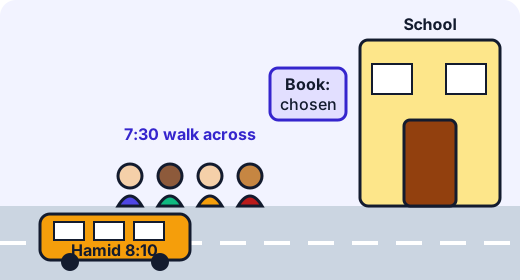
Hamid comes to school by a bus that arrives at ten past eight. The four children live across the road and are there at half past seven. Hamid cannot arrive earlier. The bus does not run earlier.
"This rule is unfair," said Hamid. "I can never be first."
"But a rule is a rule," said Kabir, who was always first. "Everyone follows it."
What makes a rule fair?
A rule says what people must or must not do. A rule is fair when it treats people properly. Here are four questions to test any rule:
- Does it treat everyone equally? Not "the same", but "equally": the same chance and the same respect.
- Does it depend on something people can't help? Hamid cannot choose when the bus arrives. A rule that rewards luck, age, or where you live may be unfair.
- Does it do its job? What is the rule for? This one was meant to choose a book without arguments. It does that, but it also gives the same four children all the turns.
- Was everyone heard? Were the people who live with the rule asked?
Careful: "It's the rule" is not a reason a rule is fair. Kabir said everyone follows it, but that tells us nothing about whether it is right. And "unfair" does not mean "I don't like it". Hamid's complaint is that the rule gives him no chance at all, no matter what he does.
Fair does not always mean the same for everyone. Suppose a rule says "Class 1 children go down the stairs five minutes before everyone else". It treats Class 1 differently. Is it fair? Yes, if there is a good reason: the smallest children could be knocked over in a crowd. A different treatment is fair when there is a good reason that is relevant. The age of a child is relevant for the stairs and not relevant for choosing a book.
Rules can be changed
Here is the most important idea. Rules are made by people, so people can change them. A rule is not like gravity. If a rule is unfair, it can be fixed, but how we fix it matters.
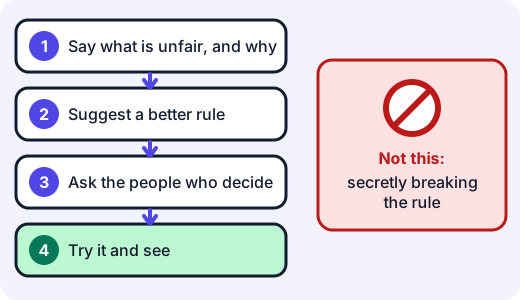
Better ways:
- Say what is unfair, and why. "This rule means I can never choose, because of my bus."
- Suggest a better rule. "What about taking turns, with a list in alphabetical order?"
- Ask the people who make the rule: the teacher, or the class in a vote or class meeting.
- Try it and see. "Let's use the new rule for two weeks."
Worse ways:
- Secretly breaking the rule. It makes you look dishonest, and nothing changes.
- Complaining behind someone's back without ever telling the people who can change it.
- Making fun of the person who made the rule.
- Taking over: just doing what you want and forcing others to follow.
Hamid chose the better way. He raised his hand at class meeting and said what he had noticed. The class agreed to a new rule: the book is chosen by a different child each day, in the order of the register.
But what about until it's changed?
Sometimes you cannot change a rule quickly, or the people in charge say no. Then you have a hard choice. Most of the time the wise path is to keep following the rule while you keep asking for it to change, as long as nobody is badly hurt by following it. If a rule asks you to hurt someone, that is different: you should tell a trusted adult at once.
History has a few brave examples of people who refused an unjust law openly, and accepted what happened to them. In 1930, Mahatma Gandhi and many others walked to the sea at Dandi and made salt, breaking a law that taxed salt and stopped people making their own, which they believed was deeply unfair. They did it in public, peacefully, and gave their reasons. That is very different from quietly cheating.
The big question
Should we follow a rule we think is unfair? Some people say yes, because without rules there is chaos, and you can ask to change them. Others say no, because following something unfair makes you part of the unfairness. Is there a middle path? Think about what the unfairness is, who is hurt, and what you can do first.
Quick check
New puzzles
Test rules for fairness, and choose good ways to change them.
1.Which rule is unfair because it depends on something a child cannot help?
- "Only children who arrive before 8:00 may join the first game", when some children live far away and come by a late bus.
- "Everyone must wash their hands before lunch."
- "Each child gets five minutes on the swing, then the next child has a turn."
Choose one
2.The library rule says: "Return a borrowed book in two weeks." Which is the best reason this rule is fair?
- Because a rule is a rule.
- Because the librarian made it.
- Because it applies to every child in the same way and lets other children borrow the book too.
Choose one
3.Your class thinks a playground rule is unfair. Which are good ways to try to change it?
- Bring a better idea to the teacher, with your reasons
- Break the rule in secret so nobody notices
- Ask the class to vote on trying a new rule for two weeks
- Tease the child who proposed the rule
Choose all that apply
4.Which statement is true about rules?
- An old rule can never be changed.
- Rules are made by people, so people can change them.
- A rule that is unfair must never be followed.
Choose one
5.Put these steps for changing an unfair rule in a sensible order.
- Ask the people who decide, such as the teacher or the class
- Try the new rule for a while and see if it works
- Say what is unfair about the rule, and why
- Suggest a better rule
Put these in order
Answering and checking are for registered learners. Register to do this.
Your turn
Shastrartha - should we follow a rule we think is unfair?
The question: Should we follow a rule we think is unfair?
Write 8 to 12 sentences (or talk it through and have a grown-up write it down). Use these parts:
- Your position (pratijna). Say what you think. You may say "yes", "no", or "it depends", but say on what.
- A reason (hetu). Give a reason that really supports your position.
- An example (udaharana). Use the first-come book rule, or a real rule from school, home or a game, and say what is unfair about it (or why it is fair).
- A bad reason to avoid (hetvabhasa). Name a weak reason people use about rules (for example "a rule is a rule", "everyone follows it" or "I don't like it") and say why it fails.
- The other side (purvapaksha). Say what someone who thinks differently would say, and why, fairly.
- An objection (tarka). Someone says: "If everyone broke the rules they thought were unfair, nobody would know what to expect and things would fall apart." (If you said "keep following", the objection is "But then an unfair rule would never be changed.") Answer it directly. Say what you would do first, and what you would do if it did not work.
How it's judged
- A clear position (pratijna)
- A real reason (hetu)
- An example (udaharana)
- Sound reasoning (hetvabhasa)
- Fair to the other side (purvapaksha)
- Answers the objection (tarka)
Writing and submitting your answer is for registered learners. Register to do this.
Your turn
Explain it - is this rule fair?
Pick a real rule you know (from school, home, a sport or a game). Write 6 to 8 sentences:
- Say what the rule is and what it is for.
- Use the four fairness questions (equal? depends on something people can't help? does its job? everyone heard?) to say whether it is fair. You do not have to use all four.
- If it is unfair in some way, say how you would try to change it. If it is fair, say what might make someone think it is unfair, and why they would be mistaken.
How it's judged
- Describes the rule and its purpose
- Tests the rule for fairness
- Says what to do
Writing and submitting your answer is for registered learners. Register to do this.
Like what you see?
Register for free to answer the quick checks, do the activities and save your work. Your work is saved on your device and syncs to your account.