Unit 12
Community helpers and rules
Meet the people who help your community and find out why rules help everyone live and work together.
Read
People who help and rules that help
When Noor wakes up, the street is already clean. The milk is at the door. The bus comes on time. Her tooth has stopped hurting because the dentist fixed it last week.
Who did all this? Lots of people, and Noor did not even meet most of them!
A community
A community is a group of people who live, work or play in the same place, and who share it. A village, a town, a street, a school, and a block of flats are all communities. In a community, people need each other, because nobody can do every job alone.
Community helpers
Community helpers are people whose work helps everyone.
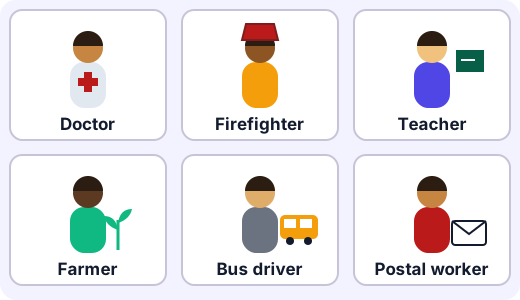
Helper What they do Doctor and nurse Help us get better when we are ill or hurt Firefighter Put out fires and rescue people Police officer Keep people safe and help when someone is lost or in trouble Teacher Help us learn Farmer Grows the food we eat Bus driver Takes people from place to place Postal worker Brings letters and parcels Sweeper and sanitation worker Keep our streets and water clean Shopkeeper Sells us the things we need Electrician Fixes the wires that bring us light Helpers can be women or men, young or old. Anyone can do any of these jobs. We say thank you to our helpers, because their work matters.
If you are ever lost or in danger, find a helper you can trust, like a police officer, a teacher or a shopkeeper, and tell them. In India you can call 112 in an emergency. Other countries have other numbers, so ask your grown-up to teach you yours.
Rules
A rule is something everyone agrees to do, or not to do, so that people can live and work well together. There are rules at home, at school and on the road.
- At home: "Wash your hands before eating." (This keeps us healthy.)
- In class: "Put up your hand to speak." (This lets everyone be heard, one at a time.)
- On the road: "Wait for the signal before you cross." (This keeps us safe.)
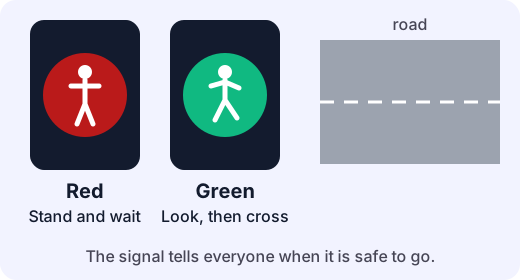
Example. Imagine a road with no rules. Some cars go left, others go right, nobody waits, and children cannot cross. People would get hurt. The rule "stop at red" means everyone knows what to do. It keeps all of us safe.
Why do we have rules?
Rules usually have one of these reasons:
- To keep people safe, like "wear a helmet when you ride a bike".
- To be fair, like "wait for your turn on the swing".
- To help people work together, like "use a quiet voice in the library so others can read".
Rules are not just there to say "no". They help everybody. If a rule seems unfair, you can talk about it with your teacher or your grown-up. Rules can be changed when people talk and agree.
Mistakes to avoid
- "Rules are only for children." Grown-ups have rules too, like traffic rules and the law.
- "Rules are to stop me having fun." Most rules help everyone, including you, to play, learn and be safe.
- "Only people in uniform are helpers." Many helpers wear no uniform, like farmers and the people who clean our streets. Every helper matters.
For the grown-up helping
Take a short walk and spot helpers and rules together: the bus driver, the shop sign that says "queue here", the crossing signal. Ask "What would happen if there was no rule?" and let your child answer. Teach your child their full name, your phone number and what to do if lost (find a helper such as a shopkeeper or a police officer, and stay put). Answer honestly if your child asks about a rule that seems unfair; explaining your own reasons is more helpful than "because I said so".
Lab
Who helps? Why a rule?
Ten cards. Some ask which helper can help. Others show a rule and ask why we have it. Choose the best answer for each.
Your goals
- Choose the right community helper for six jobs.
- Choose the reason behind each of four rules.
The interactive lab opens once you register. Register to do this.
Activity
Helper and rule hunt
Your child spots community helpers and rules around you, says thank you to one helper, and explains one rule. About 30 minutes.
You'll need
- Paper, pencil and crayons
- A clipboard or a book to lean on
Steps
- Go for a short walk near home or school, or sit at a window that looks onto the street. Your child looks for helpers (a bus driver, a sweeper, a shopkeeper, a delivery worker, a police officer) and for rules (a stop sign, a queue, a no-entry board, a crossing signal).
- For each helper your child spots, ask: What do they do? How does that help us? Draw or write each one.
- For each rule, ask: What would happen if there was no rule? Who does it help? Draw or write it.
- Choose one helper who is happy to be spoken to, such as a shopkeeper or a neighbour. With your child, say thank you and ask one question, for example "What do you like about your job?".
- At home, make a page with two columns, Helpers and Rules. Add what you found. Ask your child to pick one rule and tell you why it exists.
- Talk about a rule in your own home or class. Ask "Is it fair? Does it help everyone?" Listen, and explain your reasons.
Safety
- An adult stays with the child at all times and holds hands near roads.
- Cross only where it is safe. Stay on the pavement and away from traffic.
- Only talk to a helper with your grown-up beside you. Never go anywhere with someone you do not know.
Keeping a log of the activity is for registered learners. Register to do this.
Quick check
Helpers and rules check
Six questions about community helpers and rules.
1.A child stands at the kerb. The signal shows a red standing person and a car is coming. What should the child do?
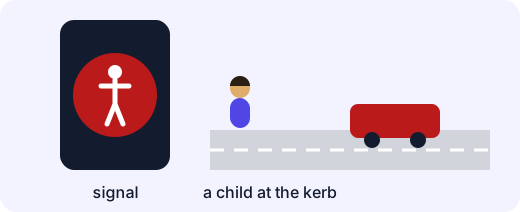
- Stand and wait until the signal turns green.
- Run across quickly.
- Walk across slowly.
Choose one
2.Who helps when a house is on fire?
- A firefighter
- A farmer
- A postal worker
Choose one
3.Match each helper to their job.
- Farmer
- Teacher
- Bus driver
- Postal worker
Match each to: Helps us learn · Takes people from place to place · Brings letters and parcels · Grows our food
4.Why do children take turns on the slide?
- It is fair, and nobody gets pushed or hurt.
- So the strongest child can always go first.
- Because grown-ups like it.
Choose one
5.Which are good reasons to have a rule?
- It keeps people safe.
- It is fair to everybody.
- It helps people work together.
- So one person can be the boss of everyone.
Choose all that apply
6.What is a community?
- A group of people who live, work or play in the same place and share it
- One very big building
- A person who lives alone
Choose one
Answering and checking are for registered learners. Register to do this.
Quick check
New puzzles
Helpers and rules show up in new places. Can you use what you know?
1.The street is clean when you wake up in the morning. Who worked while you were asleep?
- A street sweeper
- A teacher
- Nobody. Streets clean themselves.
Choose one
2.The lights are out all along your street because a wire is broken. Who can mend it?
- A librarian
- An electrician
- A baker
Choose one
3.A swimming pool has a rule: no running on the wet floor. Why?
- The floor is slippery and people could fall and get hurt.
- Running would wear out the floor.
- There is no reason.
Choose one
4.What would happen on a road if there were no rules?
- More crashes, and people would get hurt.
- Everyone would get there faster and safely.
- Nothing would change.
Choose one
Answering and checking are for registered learners. Register to do this.
Activity
Tell it back
Your child explains, in their own words, why we have rules and how helpers help. Three minutes.
Steps
- Ask "Why do we have rules? Tell me one rule and why it is there."
- Ask "Who helps in our community? What does one of them do?"
- Ask "What would happen if there were no rules on the road?" Write down what your child says.
Keeping a log of the activity is for registered learners. Register to do this.
Like what you see?
Register for free to answer the quick checks, do the activities and save your work. Your work is saved on your device and syncs to your account.