Unit 11
Maps of my world
Draw a map of your room and of the way to a nearby place, using symbols and words like near, far, left and right.
Read
A bird's-eye picture
Kavya wants to find her lost toy ball. "Is it under the bed? Behind the shelf?" She cannot see the whole room at once.
Her brother has an idea. "Let's draw a map of the room. Then we can see where everything is."
A map is a picture from above
Imagine you are a bird flying right above your room. You look down. You cannot see the sides of the bed or the table. You see their tops. A map is a picture of a place seen from above.
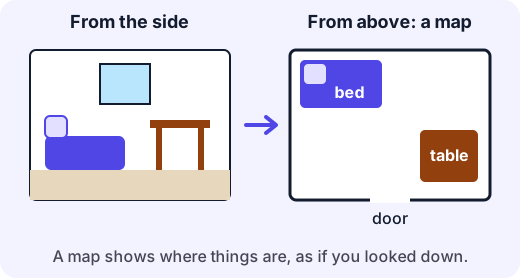
On the map, the bed is a rectangle, the table is another rectangle, and the door is a gap in the wall. We do not draw every little detail. We draw just enough to find our way.
Symbols and a key
A map uses symbols. A symbol is a small, simple drawing that stands for something real. A square can stand for a house. A green circle can stand for a tree. A wavy blue line can stand for a river.
Many maps have a key. A key is a little list that tells you what each symbol means.
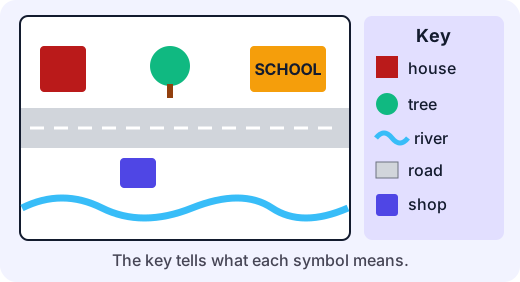
You can make up your own symbols for your own map. Just put them in your key so that everyone can read it.
Near, far, left and right
Maps help us say where things are.
- Near (or close) means a short way away. Far means a long way away.
- Left is the side of your left hand. Right is the side of your right hand.
- Next to means right beside. Between means in the middle of two things.
Words change when you turn! If the shop is on your left and you turn around to face the other way, the shop is now on your right.
Example. On the map above, the school is at the top, next to the road. The river runs along the bottom. The house is at the top-left, far from the school. The tree is in the middle of the top, near the road. So we can say: "The tree is between the house and the school."
Draw a map
Here is how to draw a map of your room:
- Draw the walls as a big box. Mark the door.
- Draw the biggest things first: the bed, the cupboard.
- Add smaller things: the table, the shelf, the toy box.
- Use symbols and add a key.
- Check: is each thing in the right place compared with the others?
To draw the way to school or a shop, draw your start and your goal. Then draw the places you pass, in order, with the road in between.
Try it: Walk to the nearest corner of your street with a grown-up. Notice three things you pass. Draw them in order on a strip of paper.
Mistakes to avoid
- "A map should look like a photo." It does not. A map is simple on purpose.
- "A map shows the sides of things." It shows the tops, as a bird would see them from above.
- "Left and right stay the same when I turn." They change as you turn. That is why a map helps: it does not change when you turn.
For the grown-up helping
Use real things: let your child stand in the doorway of a room, then look at the floor and find where the door would be on a drawing. Practise left and right with "Simon says" using hands and feet. Children this age often draw the sides of objects instead of the tops; put a toy brick on the table and look straight down on it together. Encourage words such as "next to", "near" and "far", and let your child invent symbols as long as they add them to a key.
Lab
Map maker
First, build a map of a room from four clues. Then read a map of a village and answer three questions with words like right, across and nearer.
Your goals
- Place the bed, table, plant and shelf so that all four clues are true.
- Answer three questions about a village map using right, across and nearer.
The interactive lab opens once you register. Register to do this.
Activity
Map of my room
Your child draws a map of a room, as if looking down from above, with symbols and a key. About 25 minutes.
You'll need
- Paper, pencil and crayons
- A ruler (optional)
- Small objects such as blocks (optional, for trying the layout)
Steps
- Choose a room, such as your child's bedroom or the kitchen. Stand in the doorway together and look at it.
- Ask your child to imagine floating near the ceiling and looking down. Use blocks on the floor if it helps, then look at them from above.
- Draw the walls as a big box on the paper. Mark the door with a gap.
- Draw the biggest things first (bed, cupboard, table), then smaller ones. Use simple shapes and, where it helps, a symbol.
- Add a key in a corner. Draw each symbol and write what it is.
- Ask three questions, for example: What is next to the bed? What is far from the door? What is on your left when you stand at the door? Your child answers by pointing on the map.
- Check the map by walking around the room and comparing.
Safety
- Move furniture only if an adult does it.
- Keep walkways clear and do not climb on furniture to look down.
Keeping a log of the activity is for registered learners. Register to do this.
Activity
Map of the way
Your child walks a short, familiar way (to school, a shop, a park) with you and draws it as a map. About 30 minutes.
You'll need
- Paper, pencil and crayons
- A clipboard or a book to lean on
Steps
- Choose a short, safe walk of ten minutes or less to a place nearby, such as a shop, a park or the school gate. Walk it together first.
- On the way, stop at three or four things you pass and say them out loud in order, for example: house, tree, temple, shop. Say where each one is, using left, right, near and far.
- Back home, draw your start (home) at one side of the paper and the goal at the other. Draw the road or path between them.
- Draw the things you passed, in the right order, as symbols along the way. Add a key.
- Add a small arrow where you turned. Write left or right beside it.
- Hand the map to someone else and ask them to use it to say how to get there.
Safety
- An adult stays with the child on every walk and holds hands near roads.
- Cross only where it is safe, and look both ways. Stay on the pavement.
- The child does not go out alone. Leave your full home address off the map if you plan to share it.
Keeping a log of the activity is for registered learners. Register to do this.
Quick check
Maps check
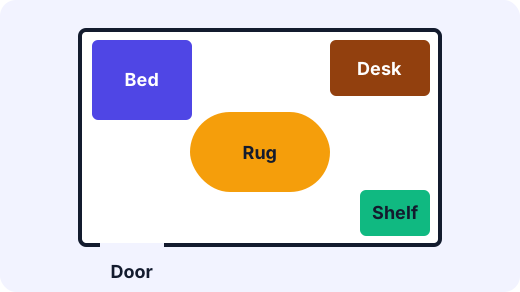
Six questions about maps. Look at the room map for questions 2 to 4.
1.What is a map?
- A picture of a place as if you look down on it from above
- A photo of a place taken from the side
- A story about a place
Choose one
2.Look at the map of the room. What is in the top-left corner?
- The bed
- The desk
- The shelf
Choose one
3.Is the desk on the left side or the right side of the room?
- The left side
- The right side
Choose one
4.Which of these three things is nearest to the door?
- The bed
- The desk
- The shelf
Choose one
5.Match each map word to what it means.
- Map
- Symbol
- Key
Match each to: A picture of a place from above · A list that tells what the symbols mean · A small drawing that stands for something real
6.The key of a map says a wavy blue line is a river. On the map you see a wavy blue line. What is it?
- A river
- A road
- A tree
Choose one
Answering and checking are for registered learners. Register to do this.
Quick check
New puzzles
Maps show up in new places. Can you use what you know?
1.Mina has a school map with a tree symbol and a swing symbol. She wants to add the water tap. What should she do?
- Draw a small symbol for the tap and add it to the key.
- Leave it out.
- Stick a photo of the tap on the map.
Choose one
2.Dev stands at the school gate with the shop on his left. He turns around to face the other way. Where is the shop now?
- On his right
- Still on his left
- In front of him
Choose one
3.Raju flies a kite high over his village and looks down. Why does what he sees look like a map?
- A map is a picture from above, and that is what he sees.
- Because it is coloured.
- Because the village is far away.
Choose one
4.Anika walks from her house to school. She passes the bakery, then the park. Where should the bakery be drawn on her map?
- Between her house and the park
- After the school
- Before her house
Choose one
Answering and checking are for registered learners. Register to do this.
Activity
Tell it back
Your child explains, in their own words, what a map is and how it helps. Three minutes.
Steps
- Ask "What is a map?" Let your child answer in their own words.
- Ask "Why do we draw a map from above and not from the side?" Write down what your child says.
- Ask "What is a key, and why do we need it?"
Keeping a log of the activity is for registered learners. Register to do this.
Like what you see?
Register for free to answer the quick checks, do the activities and save your work. Your work is saved on your device and syncs to your account.