Unit 1
Observing with your senses
Be a science detective. Use your eyes, ears, nose, hands and tongue to find out what a thing is like.
Read
Be a science detective
Kabir's aunt gives him a small cloth bag. "Something is inside," she says. "Find out what it is. But no peeking!"
Kabir squeezes the bag. It feels round and firm. He lifts it to his nose. It smells fresh and sharp. He gives it a gentle shake. It makes no sound at all.
"I think it's a lemon!" he says. He opens the bag. He was right.
Kabir did what scientists do first. He observed. To observe means to look and notice carefully. You use your senses to do it.
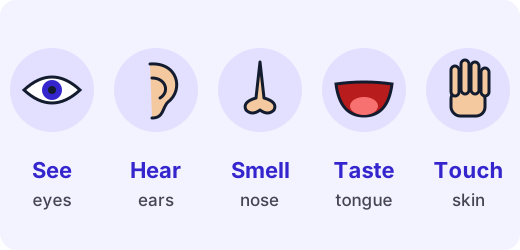
Your five senses
Sense Which part of you What it tells you Sight eyes colour, shape, size Hearing ears loud, soft, ringing, buzzing Smell nose sweet, sharp, fresh, smoky Taste tongue sweet, sour, salty, bitter Touch skin, mostly your hands rough, smooth, hot, cold, soft, hard Each sense finds out something different. The more senses you use, the more you know.
Use more than one
Look at a lemon with only your eyes. You see something yellow. Now pick it up. It is bumpy! Now sniff it. It smells sharp and fresh. Three senses told you three different things.
Example. Priya observes a bell.
- She looks: it is round, shiny and made of metal.
- She touches: it is cold and hard.
- She shakes it and listens: ring-ring!
Now Priya has three good clues. A bell is easy to tell from a sponge.
Try it: Close your eyes. Ask a grown-up to put a spoon in your hand. What do you feel? What do you hear when you tap it on the table? Then open your eyes. Did you guess it?
Write it down
Scientists do not trust their memory. They record what they observe. You can do this with a drawing and a word.
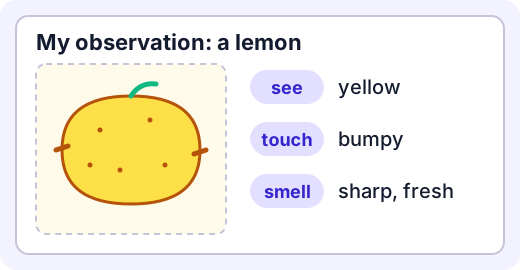
A good word tells what you noticed: yellow, bumpy, loud. Words like "nice" or "good" do not help, because they do not say what the thing is like.
Stay safe
Eyes, ears, nose and hands are your tools, but use them with care.
- Never taste something unless a grown-up says it is food.
- Do not touch things that are hot, sharp or that you do not know.
- Do not sniff strong things close up. Wave the smell towards your nose.
For the grown-up helping
Let your child lead. Ask "What do you notice?" and "How do you know?" instead of naming things yourself. Young children often say "pretty" or "good"; gently ask "What makes it pretty?" to nudge them towards a describing word. Mixing up a sense and its body part (for example, "I hear with my nose") is normal at this age. Have them point to the part as they say the sense.
Lab
Sense detective
Three mystery things are hidden in a bag. Use your senses to collect clues, then work out what each one is.
Your goals
- Collect at least three clues, from three different senses, for each mystery thing.
- Use your clues to work out all three things.
The interactive lab opens once you register. Register to do this.
Activity
Nature walk log
Your child takes a short walk (in the garden, on the street or in a park) and records three things they observe with a drawing and a word each. About 25 minutes.
You'll need
- Paper and a pencil or crayons
- A clipboard or a book to lean on
Steps
- Before you go, name the five senses together. Say "Today we use eyes, ears, nose and hands. Tongue stays at home."
- Walk slowly. Stop at three things your child picks (a leaf, a stone, a bird sound, a wall, a flower).
- At each one, ask "What do you see? What do you hear? What do you feel or smell?" Aim for at least three senses each time.
- Your child draws the thing and says one describing word. Write the word beside the drawing.
- Back home, they point to one drawing and tell you how they found out. For example, "I felt it, it was rough."
Safety
- Stay with your child. Keep to safe, familiar places and away from roads.
- Do not taste anything. Do not touch plants you do not know, animals, insects, broken glass or sharp edges.
- Wash hands when you come in.
Keeping a log of the activity is for registered learners. Register to do this.
Quick check
Senses check
Six questions about observing. Take your time.
1.How many senses do we use to observe the world?
Answer with a number
2.Which part of your body tells you a lemon tastes sour?
- Your tongue
- Your ears
- Your hands
Choose one
3.You can hear the bell ring. Which sense tells you this?
- Sight
- Hearing
- Smell
Choose one
4.Look at the observation card. Which sense told Kabir the lemon is bumpy?
- Sight
- Touch
- Smell
Choose one
5.Which senses could you safely use to find out about a rose? Pick all that help.
- Look at its colour
- Smell it
- Gently feel its petals
- Taste it
Choose all that apply
6.Match each describing word to the sense you use to find it out.
- red
- loud
- rough
- sour
Match each to: I hear it · I see it · I taste it · I touch it
Answering and checking are for registered learners. Register to do this.
Quick check
New puzzles
Detectives use their senses in new places. Can you?
1.Asha puts her hand in a closed box with a hole just big enough for her hand. Which sense can she NOT use to find out what is inside?
- Sight
- Touch
- Hearing (she can shake the thing)
Choose one
2.Which sentence is an observation, something you noticed with your senses?
- The stone is grey and rough.
- The stone is the best stone.
- The stone must have come from far away.
Choose one
3.Nani wants to know if a mango is ripe. Which senses can help her? Pick all that help.
- Looking at the colour of its skin
- Gently pressing it to feel if it is soft
- Smelling it near the stem
- Listening to its colour
Choose all that apply
4.You smell smoke coming from the kitchen. Which sense warned you? Write one word.
Answer with a word or phrase
Answering and checking are for registered learners. Register to do this.
Activity
Tell it back
Your child describes an everyday object using more than one sense, and says how they found out. Five minutes.
You'll need
- A piece of fruit, a spoon, a sock or any safe household thing
Steps
- Give your child the object. Ask "Tell me three things about it. How do you know each one?"
- If they only say what it is or whether they like it, ask "What do you see? What do you feel? What do you hear if you tap it?"
- Write down what they say in their own words, with the sense they used for each.
Safety
- Do not taste. Choose an object that is not sharp or hot.
Keeping a log of the activity is for registered learners. Register to do this.
Like what you see?
Register for free to answer the quick checks, do the activities and save your work. Your work is saved on your device and syncs to your account.