Unit 2
Living and non-living
Is a stone alive? Is a tree? Find out what living things do that non-living things never do.
Read
Is it alive?
Anaya sits by the pond with her grandmother. She points. "That frog is alive. That stone is not. But how do I know?"
"Good question," says Grandmother. "Let's find out what living things do."
Three things living things do
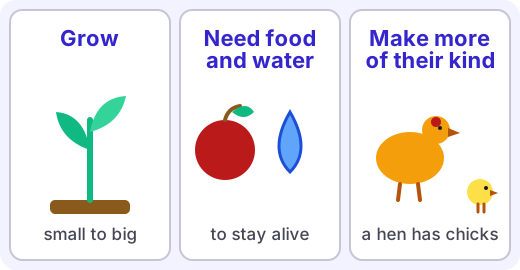
Everything that is alive does these three things:
- It grows. A baby gets bigger. A tiny seedling becomes a tree.
- It needs food and water. Without them it gets weak and cannot stay alive. Plants make their own food from sunlight, water and air. Animals eat plants or other animals.
- It makes more of its own kind. A hen lays eggs and chicks come out. A mango tree makes seeds that can grow into new mango trees.
Living things also sense the world. A flower turns towards the light. A fish swims away when you clap near the water.
A stone does none of these things. It does not grow. It does not eat or drink. It never has baby stones. So a stone is non-living.
Moving is not enough
Many children think "if it moves, it is alive". That is not quite right.
- A toy car moves. It is not alive. It does not grow, eat or make baby cars.
- A river moves. It is not alive.
- Clouds drift across the sky. They are not alive.
- A tree stands still. It is alive. It grows taller, drinks water through its roots and makes seeds.
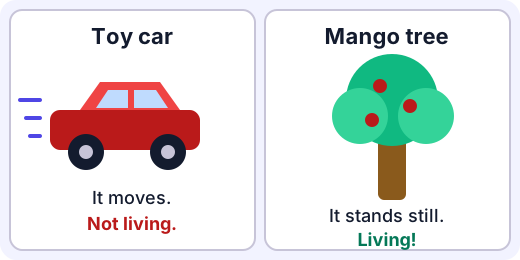
So do not ask "does it move?" Ask "does it grow, need food and water, and make more of its own kind?"
Example. Is a goldfish living?
- Does it grow? Yes, a young goldfish gets bigger.
- Does it need food and water? Yes, it eats fish food and lives in water.
- Does it make more of its own kind? Yes, goldfish lay eggs.
Yes, to all three. A goldfish is living.
Example. Is a bicycle living?
- Does it grow? No.
- Does it need food and water? No. A person pedals it.
- Does it make more bicycles? No. People in a factory make them.
No, to all three. A bicycle is non-living.
Some tricky ones
- A seed looks like a tiny stone, but it is alive. It is resting. Give it water and warmth and it grows.
- A wooden spoon is made from a tree, but the spoon itself does not grow or need water. It is non-living.
- A dry leaf that has fallen off a tree is no longer alive.
Try it: Look around the room. Pick three things. For each one, ask the three questions. Is it living or non-living? What is your reason?
For the grown-up helping
Ask "How do you know?" every time. The reason ("it grows", "it eats") matters more than the answer. Many six-year-olds think the sun, fire, wind or a moving car is alive. That is a normal idea. Do not tell them they are wrong; ask the three questions together and let them find out. Plants are the hardest part, because they do not move around. A small plant on a windowsill that you watch for a few weeks is the best teacher.
Lab
Living or non-living?
Ten things need sorting. Decide if each one is living or non-living. After each answer you find out the reason.
Your goals
- Sort all ten things correctly into living and non-living.
- Read the reason after each one.
The interactive lab opens once you register. Register to do this.
Activity
Living and non-living hunt
Your child hunts for living and non-living things at home or in a garden or park, and gives a reason for each. About 20 minutes.
You'll need
- Paper and a pencil
- Two sheets or two bowls, marked "living" and "non-living" (optional)
Steps
- Remind your child of the three questions together. Does it grow? Does it need food and water? Does it make more of its own kind?
- Find three living things (a plant, an insect, a pet, a person) and three non-living things (a stone, a cup, a toy).
- For each one, ask "Is it living? How do you know?" Write the reason in your child's words.
- Pick one hard one together, such as a seed, a dry leaf or a wooden spoon. Talk about it. There is no rush to be right.
- Draw one living and one non-living thing and write "grows" or "does not grow" below each.
Safety
- Look at insects without touching them. Some bite or sting.
- Do not touch or taste unknown plants, berries or mushrooms.
- Stay away from animals you do not know. Wash hands when you finish.
Keeping a log of the activity is for registered learners. Register to do this.
Quick check
Living and non-living check
Six questions. Think about what living things do.
1.Look at the picture of the seedling. What is it doing?
- It is growing
- It is sleeping
- It is breaking
Choose one
2.Which of these do living things do? Pick all that are true.
- They grow
- They need food and water
- They make more of their own kind
- They run fast
Choose all that apply
3.A wind-up toy mouse runs across the floor. Is it living?
- Yes, because it moves
- No, it does not grow, eat or have babies
- Yes, because it looks like a real mouse
Choose one
4.A tree stands in one place all day and never walks. Is it living?
- No, because it does not move around
- Yes, because it grows, drinks water and makes seeds
- Only when the wind blows
Choose one
5.Pick all the living things.
- A cat
- A river
- A mango tree
- A shoe
- An ant
Choose all that apply
6.Which is the best reason that a rabbit is living?
- It is soft
- It grows, eats and has baby rabbits
- It hops
Choose one
Answering and checking are for registered learners. Register to do this.
Quick check
New puzzles
Some of these are tricky. Use the three questions.
1.A dry seed sits still in a packet. When you plant it and give it water, it grows into a plant. Is the seed living?
- Yes, it is alive and resting
- No, it is just a tiny stone
- No, only the plant is living
Choose one
2.Ravi says "A river moves and has water, so it is living." Which sentence shows what is missing?
- A river does not eat food or have baby rivers
- A river is too big
- A river has no water in it
Choose one
3.Which group has only non-living things?
- pebble, spoon, cloud
- pebble, ant, spoon
- cat, spoon, cloud
Choose one
4.A wooden chair was made from a tree. Is the chair living?
- Yes, because it is made of wood from a tree
- No, a chair does not grow or need food and water
- Yes, because it stands still like a tree
Choose one
Answering and checking are for registered learners. Register to do this.
Activity
Tell it back
Your child explains, in their own words, how they can tell a living thing from a non-living thing. Three minutes.
Steps
- Ask "Is a stone alive? How do you know?" Then ask "Is a tree alive? How do you know?"
- If your child says "a tree moves" or "a stone does not move", ask "What else does a tree do that a stone cannot?"
- Ask "If you met a new thing and did not know if it was alive, what would you ask?" Write down what they say in their own words.
Keeping a log of the activity is for registered learners. Register to do this.
Like what you see?
Register for free to answer the quick checks, do the activities and save your work. Your work is saved on your device and syncs to your account.