Unit 10
Then and now
Ask an older person about their childhood and find out what has changed and what has stayed the same.
Read
When Grandma was little
Omar finds an old photo in a box. It is black and white. A girl in a plain frock stands next to a well with a bucket.
"Who is that?" he asks.
"That is me!" says his grandmother, laughing. "I was seven, just like you. We had no tap in the house. Every morning I carried water from that well."
Omar is looking at the past. His grandmother is telling him how things were then.
Past, present and future
- The past is what happened before today. Yesterday is past. So is the time when your grandmother was a child.
- The present is now, today.
- The future is what has not happened yet. Tomorrow is future.
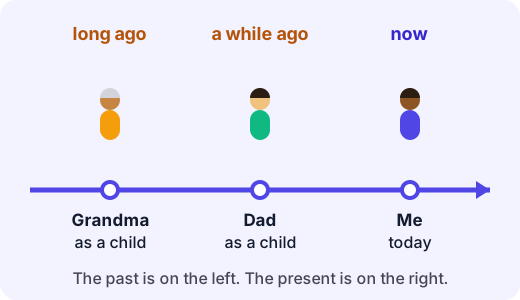
Your grandmother was a child a long time ago. Your father was a child a while ago. You are a child now. Each person lived at a different time.
Things change
Over a long time, many things change. Look at how people did the same jobs in different ways.
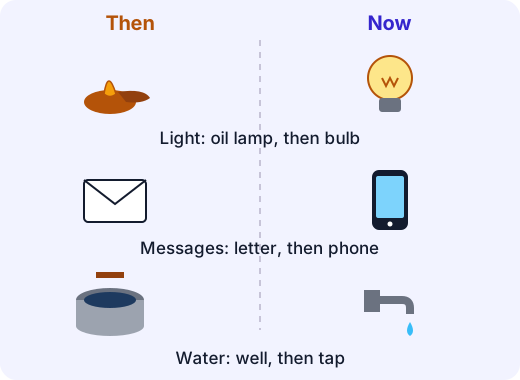
Job Long ago Now Light at night oil lamp or candle electric bulb Sending a message a letter that takes days a phone message in a second Getting water a well and a bucket a tap Notice that the job is the same. People always needed light, water and a way to talk to each other. Only the way of doing it changed.
Not everything has changed. Many people still love the same stories, festivals, games and foods that their grandparents loved. And some places today still use wells or lamps.
People remember
Nobody can go back in time. But old people remember what it was like, and they can tell us. Old photos, old toys and old letters tell us too.
Memories are special, but a person may forget some things. If you want to be sure, ask another older person or look at old photos.
Ask an older person
You can be a history detective! Ask a grandparent, a neighbour or an older friend:
- What games did you play?
- How did you get to school?
- What did your house look like?
- What did you eat on special days?
Listen well. Write down or draw what they say. Then ask yourself: What is different from now? What is the same?
Example. Omar's grandmother says, "We walked to school with a slate and chalk, and we sat on the floor." Omar uses a notebook and pencil, and sits on a bench. Different: slate and floor, notebook and bench. Same: children went to school to learn.
Mistakes to avoid
- "Things were always like they are now." Not true! Many things we use today were not there when your grandparents were small.
- "Old things were bad and new things are good." Old ways worked for the people then. Each way fits its time.
For the grown-up helping
Show an old photo and ask "What do you notice?" Use the words "then" and "now" in daily talk: "When I was little, we...". Children of this age find years and dates hard, so use "long ago", "a while ago" and "now" rather than numbers. If an older person finds some memories sad, let them choose what to share. If there is no older relative nearby, a neighbour, a teacher or a video call will do.
Lab
Which way is older?
Six jobs, each done in an old way and a new way. Tap the way that people used first. Then think about what stayed the same.
Your goals
- Tap the older way for each of the six jobs.
- Say what stays the same when the way of doing a job changes.
The interactive lab opens once you register. Register to do this.
Activity
Ask an older person
Your child interviews an older person about their childhood, then compares it with their own. About 30 minutes.
You'll need
- Paper and pencil, or crayons
- A phone or recorder, if the older person agrees (optional)
- An old photo or an old toy to look at (optional)
Steps
- Choose a grandparent, great-aunt, neighbour or older friend. Ask them first, and agree a time. A video call works if they live far away.
- Together with your child, pick three questions, for example "What games did you play?", "How did you get to school?" and "What did you eat on special days?".
- Your child asks the questions. The adult helps write down short answers, or draws what the older person says. Record the talk only if the older person says yes.
- If the older person has an old photo, toy or object, look at it together. Ask "What is it? How did you use it?"
- Afterwards, fill in two columns on a page, "Then" and "Now". Put what the older person said in "Then" and what your child does today in "Now".
- Ask your child "What is different? What is the same?" and write down the answer.
- Say thank you to the older person. Your child can show them the page.
Safety
- Ask the older person before recording or taking a photo, and do not share it beyond the family without their yes.
- Stop if the person is tired or does not want to talk about something. Memories can be sad, and that is fine.
- Look at old objects with an adult; keep sharp, hot or breakable things out of a child's hands.
Keeping a log of the activity is for registered learners. Register to do this.
Quick check
Then and now check
Six questions about the past and the present.
1.Which picture is more likely to show a time long ago?
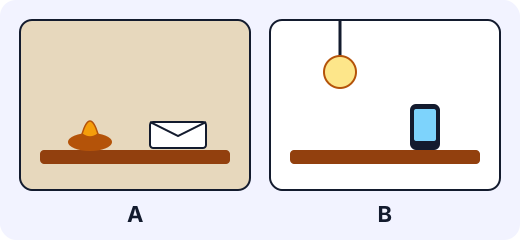
- Picture A
- Picture B
Choose one
2.Grandma tells you what school was like when she was small. Which time is she telling you about?
- The past
- The present
- The future
Choose one
3.Put these in order, from the longest ago to now.
- Today
- When Grandma was a child
- When Dad was a child
Put these in order
4.An oil lamp and an electric bulb look very different. What is the same about them?
- Both give light.
- Both need electricity.
- Both are new.
Choose one
5.Which are good questions to ask an older person about their childhood?
- What games did you play?
- How did you get to school?
- What did you eat on special days?
- How much money is in your bank account?
Choose all that apply
6.Match each old way to the newer way that does the same job.
- Oil lamp
- Paper letter
- Well and bucket
Match each to: Phone message · Electric bulb · Water tap
Answering and checking are for registered learners. Register to do this.
Quick check
New puzzles
Then and now show up in new places. Can you use what you know?
1.Grandpa says, "When I was young, there was no TV in our village." Which time is he talking about?
- The past
- The present
- The future
Choose one
2.Sita's grandmother says the bus trip to town took all day when she was small. Sita wants to check. What could she do?
- Ask another older person, or look at old photos.
- Guess.
- Nothing. It cannot be checked.
Choose one
3.Long ago a shop weighed rice with a hand scale. Now it uses a digital scale. What stayed the same?
- The shop still weighs the rice.
- The tool for weighing.
- Nothing stayed the same.
Choose one
4.Is this true or false: the phone you use today will one day be an old thing from the past.
- True
- False
Choose one
Answering and checking are for registered learners. Register to do this.
Activity
Tell it back
Your child explains what has changed and what has stayed the same between "then" and "now". Three minutes.
Steps
- Ask "What did you find out about when Grandma (or the older person) was little?"
- Ask "What is different now? What is the same?"
- Ask "How do we know what it was like long ago?" Write down what your child says.
Keeping a log of the activity is for registered learners. Register to do this.
Like what you see?
Register for free to answer the quick checks, do the activities and save your work. Your work is saved on your device and syncs to your account.