Unit 8
Weather and seasons
Keep a weather chart, learn the weather words, and see how the year repeats in seasons.
Read
Today and every year
Zara looks out of the window every morning before school. Yesterday it was sunny and hot. Today there are grey clouds and a cool wind. "What's the weather?" she asks her mother. "Cloudy and windy," says Mother. "Better take an umbrella."
Zara has started a weather chart, so she can see how the sky changes from day to day.
Weather words
Weather is what the air and sky are like right now, today, in the place where you are. Here are some weather words:
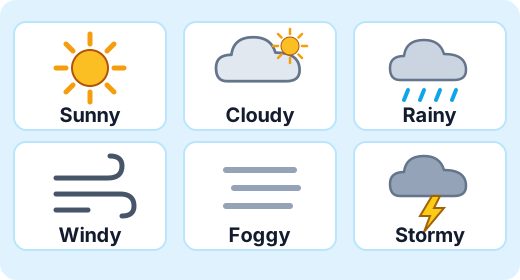
We also say how the weather feels: hot, warm, cool, cold. A thermometer measures how hot or cold the air is.
Weather can change a lot. A morning can be sunny and the afternoon can have a thunderstorm. A day can be hot and the next day can be cool.
A weather chart
A chart helps us keep track. Each day we look outside and mark the weather.
Day Mon Tue Wed Thu Fri Weather sunny rainy rainy cloudy sunny Now we can answer questions:
- How many rainy days? 2
- How many sunny days? 2
- Which day was cloudy? Thursday
Example. In the chart, there were 2 rainy days and 2 sunny days in 5 days. So there was 1 cloudy day, because .
Try it: Make your own chart for one week. Each morning, draw a sun, cloud, rain drop or wind swirl.
Seasons
If you keep the chart for a whole year, you will see a pattern. The weather changes slowly through the year, and the same changes repeat every year. We call these parts of the year seasons.
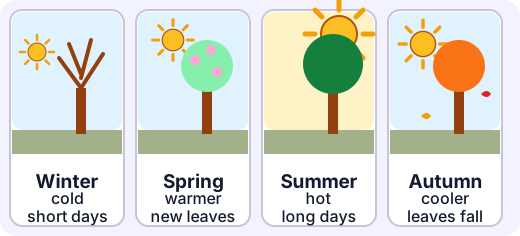
Many places have four seasons: winter, spring, summer and autumn. Some places in the world have only two or three: for example a hot season, a rainy season and a cool season.
In much of India, the monsoon is a rainy season. Winds bring heavy rain, usually from June to September, and farmers wait for it. Where you live, the seasons may have different names and times. Look at your own place and find your pattern.
Seasons change more than the rain. In many places:
- Summer days are long and hot. The sun rises early and sets late.
- Winter days are short and cool or cold. It gets dark early.
For example, in Delhi there are about 14 hours of daylight in June, but only about 10 hours in December.
Plants and animals follow the seasons. Trees may drop their leaves in autumn and grow new ones in spring. Birds travel to warmer places. People change what they wear and eat.
The seasons come in the same order every year: winter, then spring, then summer, then autumn, and then winter again.
Weather or season?
- Weather changes day to day. "It is raining today."
- A season is a long part of the year, and it repeats every year. "Winter is cold."
One rainy day does not make a rainy season. A season is the usual pattern across many weeks.
Mistakes to avoid
- "If it's hot today, it must be summer." Hot days can happen in other seasons too. We name the season by the pattern over many weeks.
- "Seasons are the same all over the world." They are not. When it is summer in India, it is winter in Australia. Some places near the equator are warm all year.
- "Summer is hot because the Earth is closer to the sun." It is not. It is because of how the Earth is tilted as it goes around the sun. You will learn more about this when you are older.
For the grown-up helping
A weather chart on the fridge, with one sticker or drawing each morning, is the best tool. Look at the sky together and use the weather words out loud. Ask "How is today different from yesterday?" To teach seasons, point out things that repeat: the same festival, the same fruit in the market, the same clothes coming out of the cupboard. Daylight changes are real but small day to day, so compare sunset times a few months apart.
Lab
Build a weather chart
Look at the sky picture for each day of a week. Choose the right weather word for each day. Then read the chart and answer two questions.
Your goals
- Choose the right weather word for all seven days.
- Use the chart to say how many days were rainy and which weather came most often.
The interactive lab opens once you register. Register to do this.
Activity
Keep a weather chart
Your child keeps a weather chart for two weeks, then compares the weather and the daylight with another time of year. Two minutes a day, plus a talk at the end.
You'll need
- A sheet of paper with a grid of 14 boxes, one for each day (or a calendar page)
- Crayons or pencils, or stickers
- Optional: a thermometer
- Photos or memories from another time of year, and the sunrise and sunset times from a weather app or newspaper
Steps
- Each morning, look out of the window together. Ask "What is the weather?" Your child draws a sun, a cloud, rain drops or wind swirls in that day's box. Write the day in the box.
- Do this for 14 days. If you miss a day, leave the box empty and carry on.
- At the end, count the days of each kind of weather. Which came most often? Which came least?
- Compare with another time of year. Look at photos of the same place in a different season. Ask "What is different? What did people wear? What fruits or festivals?"
- Look up the sunrise and sunset times for today and for the same date six months ago, or for a date from a different season. Ask "Which day was longer?"
- Ask "What do you think the weather will be like in three months? Why?"
Safety
- Stay indoors during storms. Look out of the window rather than going out when there is lightning.
- Never look at the sun directly.
- If you use a thermometer, use a plastic or digital one rather than glass or mercury.
Keeping a log of the activity is for registered learners. Register to do this.
Quick check
Weather and seasons check
Seven questions about weather and seasons. Use the chart for the first two.
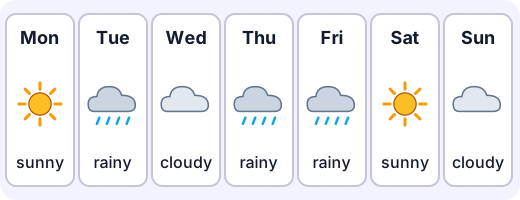
1.Look at the weather chart. How many days were rainy?
Answer with a number
2.Which weather happened on the most days in this chart?
- Rainy
- Sunny
- Cloudy
Choose one
3.What is weather?
- What the air and sky are like today
- A long part of the year that repeats
- The clothes we wear
Choose one
4.Which of these are weather words? Pick all that apply.
- Sunny
- Windy
- Summer
- Tuesday
Choose all that apply
5.Put the seasons in the order they come, starting with winter.
- Spring
- Autumn
- Winter
- Summer
Put these in order
6.In most places, which season has the longest days?
- Summer
- Winter
Choose one
7.Winter ends. What happens to the seasons?
- They come round again next year
- They never come back
- Summer stays forever
Choose one
Answering and checking are for registered learners. Register to do this.
Quick check
New puzzles
Use what you know about weather and seasons in new places.
1.In one week, 4 days were sunny and 1 day was windy. The other days were rainy. How many days were rainy?
Answer with a number
2.Ben's chart shows 5 sunny days and 2 rainy days. How many more sunny days than rainy days?
Answer with a number
3.Mina notices it gets dark at 5:30 pm at one time of year and at 7:30 pm at another. Which season is more likely to be the one with dark at 5:30 pm?
- Winter
- Summer
Choose one
4.It rained today, but it was sunny yesterday. What changed?
- The weather changed. The season is probably the same.
- The season changed.
Choose one
5.Which sentence is about a season, not today's weather?
- It is raining right now.
- Every year winter comes after autumn.
- It is cloudy this morning.
Choose one
Answering and checking are for registered learners. Register to do this.
Activity
Tell it back
Your child explains the difference between weather and seasons in their own words. Three minutes.
Steps
- Ask "What is the weather today? Was it the same yesterday?"
- Ask "What are the seasons where we live? What changes from one season to the next?"
- Ask "Will winter come again next year? How do you know?" Write down what your child says.
Keeping a log of the activity is for registered learners. Register to do this.
Like what you see?
Register for free to answer the quick checks, do the activities and save your work. Your work is saved on your device and syncs to your account.