Unit 7
The sun, moon and sky
Watch your shadow grow and shrink through the day, and follow the moon as it changes shape through the month.
Read
The sky has patterns
Dev walks to school early in the morning. His shadow is stretched out long in front of him, like a giant. At lunchtime he plays in the field, and his shadow is a short blob under his feet. On the way home it is long again, but now it stretches the other way.
His shadow changed all day. Why? And what does the moon do at night?
The sun and your shadow
A shadow forms when something blocks the light. In the daytime the light comes from the sun.
The sun seems to move across the sky each day.
- In the morning it comes up in the east. It is low in the sky.
- At noon it is high above us.
- In the evening it goes down in the west. It is low again.
(The sun is not really moving across the sky. The Earth is spinning, and that makes it look as if the sun moves.)
A shadow always falls on the side away from the sun. And its length depends on how high the sun is.
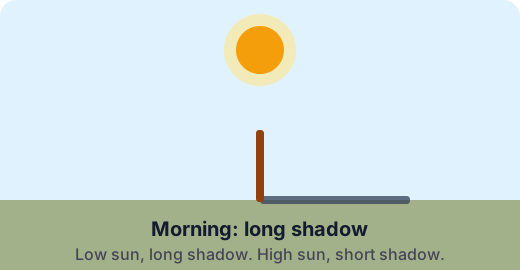
Time Where the sun is The shadow Morning low, in the east long, pointing west Noon high short Late afternoon low, in the west long, pointing east Example. At sunset, the sun is in the west. Which way does your shadow point? Away from the sun, so towards the east.
Try it: Stand a stick in the ground. Mark where the end of its shadow falls in the morning, at noon and in the afternoon. You have made a sun clock!
Safety: Never look straight at the sun. It can hurt your eyes. Look at the shadow instead.
The moon
At night we often see the moon. It looks like a glowing ball, but the moon makes no light of its own. It shines because sunlight bounces off it, just like a torch shining on a wall.
The moon looks different from night to night. Sometimes it is a thin curve, sometimes a half circle, sometimes a full round disc.
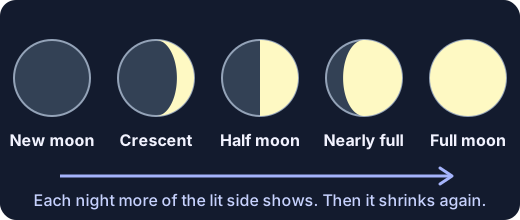
These shapes are called the phases of the moon. They follow a pattern that repeats about every 30 days, which is about one month.
- New moon (Amavasya in Hindi): we cannot see the moon at all.
- A thin crescent appears, and each night more of it shows.
- Half moon.
- Full moon (Purnima): a complete round disc.
- Then it shrinks again, back to a crescent, and then the new moon.
Why does the shape change? Half of the moon is always lit by the sun. As the moon travels around the Earth, we see more or less of its lit half. The moon is never really "eaten" or "cut".
In India the lit part grows from the right-hand side. If you live in the southern half of the world, like Australia, the moon looks flipped.
Mistakes to avoid
- "The moon only comes out at night." You can often see it in the daytime, pale in the blue sky.
- "The moon gives its own light." It does not. It shines by the sun's light.
- "The shadow of the Earth makes the moon's shapes." No. The shapes come from how much of the sunlit half we can see.
For the grown-up helping
The two best activities are the shadow stick (take photos or mark the shadow's end with a stone at three or four times of day) and a moon diary: draw the moon from the same window every few nights for a month. Don't worry about perfect drawings; the pattern appears all by itself. Keep children safe: never look at the sun directly, even briefly, and not through binoculars, a camera or sunglasses.
Lab
The shadow stick
A stick stands in the sun. Slide the time of day and record the shadow at four times, including noon. Then use your table to answer three questions.
Your goals
- Record the shadow at four or more different times, including 12 noon.
- Find out when the shadow is shortest, and which way it points.
The interactive lab opens once you register. Register to do this.
Activity
Track a shadow across a day
Your child tracks a real shadow on a sunny day. Three short visits outdoors over one day, about 5 minutes each.
You'll need
- A stick or a tall pencil, about as long as your forearm
- A flat spot in the sun (a path, a balcony or the playground)
- Chalk, or three small stones and tape
- A notebook and pencil
Steps
- In the morning (about 9 am) set the stick upright in a bucket of sand, or have your child stand still on a spot. Mark the end of the shadow with chalk or a stone and write the time next to it.
- Ask "Which way does the shadow point? Where is the sun?"
- Come back around 12 noon, with the stick in exactly the same place. Mark the end of the new shadow. Is it longer or shorter?
- Come back around 3 or 4 pm. Mark the shadow again. Which way does it point now?
- Look at the three marks together. Ask "What happened to the shadow? What did the sun do?" Draw the three marks in the notebook.
Safety
- Never look straight at the sun, not even for a moment. Look at the shadow.
- Use a hat and water in hot weather, and stay in the shade between visits.
- Do not use a pointed or sharp stick; ask an adult to set it up.
Keeping a log of the activity is for registered learners. Register to do this.
Activity
A month-long moon diary
Your child draws the moon from the same window or yard every few nights for one month, then looks for the pattern. Two minutes each time.
You'll need
- A notebook or sheets of paper stapled together
- A pencil or crayons
- A calendar
Steps
- Pick a spot to look from each time, such as a window or the porch. Choose a time after sunset, like 7 pm.
- Look at the moon. Draw its shape in a circle. Write the date next to it. If you cannot see it, because of clouds or a new moon, write that.
- Do this every 2 or 3 nights for about one month, so you have 10 or more drawings. A few missing nights are fine.
- Lay the drawings in date order. Ask "What do you notice? Is the lit part getting bigger or smaller?"
- Talk about it. Ask "Which shape do you think comes next after the last drawing?" and check on the next clear night.
Safety
- Do the sky-watching with a grown-up in a safe place, such as a window, balcony with a rail, or your own yard.
- Do not go out alone in the dark.
Keeping a log of the activity is for registered learners. Register to do this.
Quick check
Sun, moon and sky check
Seven questions about the sun, shadows and the moon.
1.In the morning Dev's shadow is long. What does his shadow look like at noon, when the sun is high?
- Shorter
- Even longer
- The same
Choose one
2.The sun is on your left. Which side is your shadow on?
- Your right
- Your left
- There is no shadow
Choose one
3.In which direction does the sun come up in the morning?
- East
- West
- North
Choose one
4.Here is the moon on four nights. What does it look like on the last night?
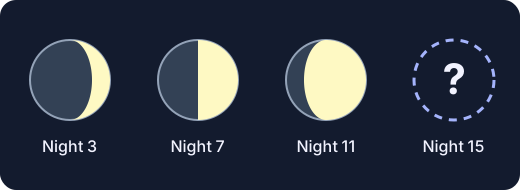
- A full round moon
- A thin crescent
- No moon at all
Choose one
5.Where does the moon's light come from?
- The sun shines on the moon
- The moon makes its own light
- Street lamps
Choose one
6.About how long is it from one full moon to the next?
- About one week
- About one month
- About one year
Choose one
7.Put the moon shapes in order, starting with the new moon.
- Half moon
- Full moon
- New moon (can't see it)
- Thin crescent
Put these in order
Answering and checking are for registered learners. Register to do this.
Quick check
New puzzles
Use what you know about the sun and moon in new places.
1.Ria measured her shadow at 8 am, 12 noon and 4 pm. At which time was it shortest?
- 8 am
- 12 noon
- 4 pm
Choose one
2.At sunset the sun is in the west. Which way does a tree's shadow point?
- East
- West
Choose one
3.A pole's long shadow points west. Is it morning or afternoon?
- Morning
- Afternoon
Choose one
4.Mohan sees a full moon tonight. About how many nights until the next full moon?
- About 1 night
- About 15 nights
- About 30 nights
Choose one
5.Why does the moon look like different shapes on different nights?
- We see more or less of its lit half
- Clouds eat parts of it
- The moon grows and shrinks
Choose one
Answering and checking are for registered learners. Register to do this.
Activity
Tell it back
Your child explains the patterns of the sun and the moon in their own words. Three minutes.
Steps
- Ask "When is your shadow long, and when is it short? Why?" Let your child show with a torch or lamp if they like.
- Ask "What does the moon look like over a month?" Your child can draw it.
- Ask "Where does the moon's light come from?" Write down what your child says.
Keeping a log of the activity is for registered learners. Register to do this.
Like what you see?
Register for free to answer the quick checks, do the activities and save your work. Your work is saved on your device and syncs to your account.