Unit 4
Dance traditions
Learn the grammar behind classical and folk dance (mudras, steps and counts) and perform a short piece of your own in one form.
Read
The grammar of dance
Two girls watch the same dancer on a stage. The first says, "She is just waving her hands about." The second, who has learned a little Bharatanatyam, whispers, "She just said a peacock came to the pond, and it is dancing for the rain." Same dancer, same minute, two completely different experiences.
What does the second girl know? She does not know a secret. She knows a vocabulary, and she knows how it is put together. This unit is about that grammar: what the pieces of a dance form are, how they fit together, and how you can use them to perform a short piece of your own.
Dance is a language of the body
A spoken language has words, sentences and rhythm. Dance has the same layers.
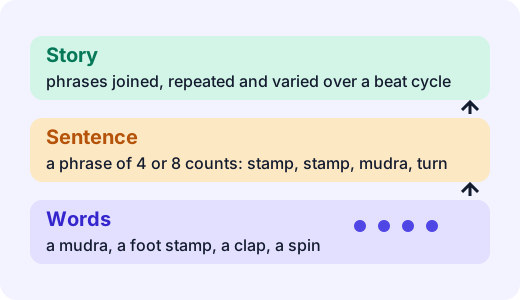
- Words are single moves: a stamp of the foot, a clap, a turn, a hand shape.
- Sentences are short phrases, usually four or eight counts long, made by joining words.
- A story is made by joining, repeating and varying phrases over a repeating beat pattern.
Notice that the rhythm is part of the grammar. In Indian traditions a repeating cycle of beats is called a tala. A common one, Adi tala, has 8 counts. Every phrase must land on the right count, just as a sentence must end where the meaning does.
Classical dance: a deep vocabulary
India's national academy for the performing arts, the Sangeet Natak Akademi, recognises eight classical dance forms: Bharatanatyam, Kathak, Kuchipudi, Odissi, Kathakali, Sattriya, Manipuri and Mohiniyattam. Each has its own costume, music, region and style, but they share ideas that go back to old Sanskrit texts on the performing arts, such as the Natya Shastra.
Three ideas are worth knowing.
Nritta is "pure" dance: patterns of steps, poses and rhythm that are beautiful but tell no story. In Bharatanatyam the basic units of nritta are called adavus, short step-patterns, often practised to spoken syllables such as ta-ka-di-mi (four syllables, one count each).
Nritya adds abhinaya, expression. The dancer uses face, eyes, body and hands to show a feeling or a story. Classical texts name nine basic moods, the navarasa: love, laughter, sorrow, anger, courage, fear, disgust, wonder and peace.
Mudras are the hand gestures. In Abhinaya Darpana, an old manual of Bharatanatyam, 28 single-hand mudras (called asamyukta hasta) and 24 double-hand mudras are described. Each is a precise shape of the fingers, and it can carry more than one meaning depending on the context.
Mudra Shape Some things it can show Pataka all four fingers straight and together, thumb bent in a flag, a river, a wave Mushti a closed fist holding, strength, gripping a rope Suchi one finger pointing up, the rest closed a needle, "one", "you" Alapadma fingers spread and curved like petals a full-bloomed lotus, a mirror 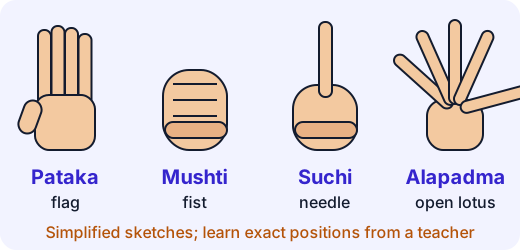
Try it: Make Pataka. Now turn the hand so the fingers point down and wiggle them. Rain? Then move it slowly side to side. A river? One shape, several meanings: the meaning comes from how you move it and what comes before and after, exactly like a word in a sentence.
Folk dance: grammar without a textbook
Folk dances are learned in the community, by joining in, and are often not written down. But they have grammar too.
- Garba (Gujarat, danced at Navratri) is done in circles around a lamp or an image. The vocabulary is a set of foot patterns, claps in a regular rhythm and turns, and the circle moves around together.
- Bhangra (Punjab) has bold jumps, shoulder movements and arm lifts, driven by the beat of the dhol, a barrel drum.
- Bihu (Assam) uses quick hip and hand movements, with flowing wrists, to celebrate the spring new year.
A beginner learns a handful of basic steps, then discovers that the dancers are combining them: the same grammar principle as classical dance, with a different vocabulary.
Misconception: "Folk dance is just free movement, and classical dance is the one with rules." Not so. Both have rules; they are just learned differently. A folk dance's rules are carried by the community and the beat. If you change a Garba clap-pattern halfway round the circle, everyone notices.
How to build a short piece
You can perform a piece in one form after only a few lessons, if you build it carefully. Here is a method.
- Choose a form and a teacher: a family member, a class teacher, a local dance school or a good video from a recognised company or teacher.
- Learn a small vocabulary: three or four moves, such as two mudras and two steps. Do each correctly before you combine them.
- Fit them to counts. Say the rhythm aloud, such as 1-2-3-4, and place each move on a count.
- Join them into a phrase of four counts, then repeat it. Try one variation: a different direction, or a pose at the end.
- Add expression. Where are your eyes looking? What is the mood?
- Rehearse, then perform for someone, and ask what they saw.
Example. A beginner puts together a 16-count piece in Bharatanatyam style:
Counts Move 1 to 4 foot stamp on each count (a simple adavu) 5 to 8 Pataka at chest height, hands opening outwards (a flower opening) 9 to 12 Alapadma held in front of the face, turning slowly 13 to 16 a held pose, eyes bright, on count 16 Four phrases of four counts make 16 counts. If the piece repeats once it lasts 32 counts. The structure is simple, but because each part is placed on its count and carries a meaning, it is a piece and not just wandering movement.
Notes on practice and respect
- Learn the shapes from a person if you can; a photograph shows only one frame of a moving hand. The sketches in this unit are simplified.
- Many dance forms are linked to temples, festivals and communities. Learn what a dance means to the people who keep it before you perform it.
- Warm up your ankles, knees and wrists, and stop if anything hurts.
Dance has a grammar. Once you can see it, you can read any performance more deeply, and you can start to write your own sentences.
Activity
Perform a 16-count piece
Learn four moves from one dance form, build them into a 16-count piece, explain each move, and perform it for an audience. Plan for three sessions of about 30 minutes, plus a short performance.
You'll need
- A teacher, family member or recognised video lesson for the form you choose (classical or folk)
- A clear floor space, about 2 m by 2 m, with a non-slip surface
- Music or a person to keep the beat by clapping or using a drum or tin
- Paper and pencil for a move chart
- A phone or camera if a grown-up is happy to record the performance
Steps
- Choose one form, such as Bharatanatyam, Kathak, Garba, Bhangra or Bihu. Ask someone who knows it, or watch a lesson, and learn four moves: for classical dance, two mudras and two steps; for folk dance, four basic steps or arm patterns.
- For each move, write its name, draw a quick sketch, and write what it means or how it is used. Practise each alone, slowly, until it is clean.
- Choose a steady beat (clap or music) and count aloud 1-2-3-4. Place one move on every four counts to make a 16-count piece, with the moves in the order you chose.
- Run the piece several times: first slowly, then at the real tempo. Fix any move that is late or early. Mark where your eyes and face will show the mood.
- Add one change: repeat the piece with a variation (a new direction, a pose at the end, or a different ordering of two moves). Check that it still lands on count 16.
- Perform for at least two people. Before you start, say the name of the form. After you finish, explain two of your moves: what the shape or step is called and what it can mean.
- Ask the audience: What did you notice? Which move was the clearest? Write down two comments.
Safety
- Warm up first with gentle ankle, knee, hip and wrist circles. Stop if anything hurts.
- Clear the floor of mats, toys and wires. Dance barefoot only on a safe surface or wear grippy socks.
- Keep a safe distance from furniture and other people when you jump or turn.
- If a form is linked to a faith or festival, ask permission and learn the meaning before performing it.
Keeping a log of the activity is for registered learners. Register to do this.
Quick check
Dance grammar check
Eight questions about the vocabulary and structure of dance.
1.In Indian classical dance, the mudra Pataka (all fingers straight and together) is most closely linked with which image?
- A flag
- A closed fist holding a rope
- A needle
- A fully open lotus
Choose one
2.Match each mudra to the shape or image it is linked with.
- Mushti
- Suchi
- Alapadma
- Pataka
Match each to: A closed fist · Spread, curved fingers like lotus petals · One finger pointing up, like a needle · Straight, joined fingers like a flag
3.A dancer performs a fast pattern of footwork and poses to a rhythm, telling no story and showing no particular mood. What is this kind of dance called?
- Nritta
- Nritya
- Navarasa
Choose one
4.Which of these are parts of a dance form's "grammar"?
- Mudras (hand shapes with meanings)
- Adavus or basic steps
- A repeating beat cycle (tala)
- The colour of the dancer's costume
Choose all that apply
5.A phrase of 8 counts is performed 3 times without a break. How many counts is the dance?
Answer with a number
6.Put the steps for building a short piece in a sensible order.
- Place each move on a count of the beat
- Add expression and rehearse
- Join them into a phrase and repeat it
- Learn three or four moves, one at a time
- Perform for an audience
Put these in order
7.A friend says, "Folk dances have no grammar because nobody wrote them in a book." Which reply is best?
- She is right. Grammar only exists in written texts.
- Folk dances have steps, claps, formations and rhythms that people learn and share, and a change would be noticed, so they do have grammar.
- Only classical dances have steps; folk dance is free movement.
Choose one
8.What is the Sanskrit-origin word for the hand gestures of Indian classical dance, such as Pataka and Mushti?
Answer with a word or phrase
Answering and checking are for registered learners. Register to do this.
Quick check
New puzzles
Use dance grammar in situations the reading did not show.
1.A dancer wants to show "she gripped the rope with all her strength". Which hand shape fits best?
- Mushti, the closed fist
- Pataka, straight open fingers
- Alapadma, spread petals
Choose one
2.A folk step pattern takes 6 counts. A section of the song lasts 48 counts. How many complete repetitions of the pattern fit in that section?
Answer with a number
3.Two dancers perform the same 8-count phrase, but one finishes two counts after the other. What grammar element has gone wrong?
- Timing, because the moves were not placed on the right counts
- Costume
- The choice of story
- Nothing, because the moves were the same
Choose one
4.A student invents her own hand sign for "rain" and uses it in a classical performance without telling anyone. Why will the audience probably not understand it?
- A gesture only works as vocabulary when the audience and dancer share its meaning
- Because inventing gestures is not allowed in any dance
- Because a gesture must be made with both hands
Choose one
Answering and checking are for registered learners. Register to do this.
Your turn
Explain the grammar of your piece
Use the piece you performed (or the one you plan to perform) to answer in your own words.
- Name the dance form you chose and describe the four moves in your piece: what each is called, what it looks like, and what it means or does.
- Describe how you fitted them to a count. Where does each move start and end? How long is your piece?
- Someone says, "Dance is just feeling; it doesn't have rules." Reply using at least two examples from your piece or from a form you have seen.
How it's judged
- Vocabulary
- Structure and counts
- Defending the grammar idea
Writing and submitting your answer is for registered learners. Register to do this.
Like what you see?
Register for free to answer the quick checks, do the activities and save your work. Your work is saved on your device and syncs to your account.