Unit 3
Music in two notations
Write down the same tune in sargam and in staff notation, and see why they are two different maps of the same music.
Read
Two maps of one tune
Anjali in Pune and Tom in Leeds each learned the same little tune from their grandmothers, by ear. When they try to share it, they hit a problem. Anjali writes: Sa Sa Pa Pa Dha Dha Pa. Tom draws dots on five horizontal lines. Each looks at the other's page and sees nothing they can read. Yet when they sing, the tune is exactly the same.
Both pages are notation: marks on paper that tell a musician what to play or sing. Notation is not the music. It is a map of the music, and just as a road map and a satellite photograph show the same city in different ways, different notations show the same tune in different ways. In this unit you will read and write a melody in two notations: sargam, used for Indian classical and many folk and film songs, and staff notation, used in Western music and across the world.
Sargam: names for the seven notes
The seven main notes of an Indian scale are called swaras. Their names are the first syllables of the system:
Sa Re Ga Ma Pa Dha Ni, then Sa again an octave higher.
They are often written in short form (S R G M P D N), in Devanagari or in any script. A sargam page for a melody is just these names in the order they are sung.
Three ideas matter:
- Sa is not one fixed pitch. A singer picks the Sa that suits her voice. The tanpura (a drone instrument) is tuned to that Sa, and every other note is found in relation to Sa. A deeper voice and a higher voice can sing the same raga starting from different Sa. Sargam is therefore a relative notation: it says "go up to the fifth note above your Sa", not "play the key called G".
- Komal and tivra. The notes above are the plain (shuddha) forms. Re, Ga, Dha and Ni can also be sung one small step lower; each is then called komal ("soft") and is written with a line under it. Ma can be sung a small step higher, tivra, written with a small vertical mark above. Sa and Pa never change, so a full octave has 7 + 4 + 1 = 12 notes.
- Octaves. A dot under a swara means the lower octave (mandra), a dot above means the upper octave (tar), and no dot means the middle octave.
Rhythm in sargam: the taal
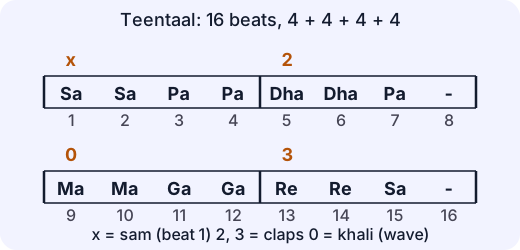
Rhythm in Indian music is organised in a repeating cycle called a taal. The commonest, Teentaal, has 16 beats in four groups (vibhag) of four: 4 + 4 + 4 + 4. Four marks help the musician find their place:
- x (sam): beat 1, the strongest beat, where the cycle begins and returns.
- 2 and 3: claps on beats 5 and 13.
- 0 (khali): "empty", a wave of the hand on beat 9.
On the page, each group of four beats sits between vertical bars, and each swara takes one beat. A dash (-) after a note means "hold it for one more beat". So Pa - is a two-beat note.
Staff notation: a fixed map
Staff notation puts notes on five horizontal lines (the staff) and the four spaces between them. Higher on the staff means higher pitch. A symbol at the start, the clef, tells you which pitches the lines mean; the treble clef places the note G on the second line from the bottom. Notes are named by the letters A B C D E F G, and each letter is a fixed pitch: a C is a C whoever plays it. Notes too high or too low for the five lines sit on short extra lines called ledger lines; the C just below the staff (middle C) sits on one.
Rhythm is shown by the shape of each note:
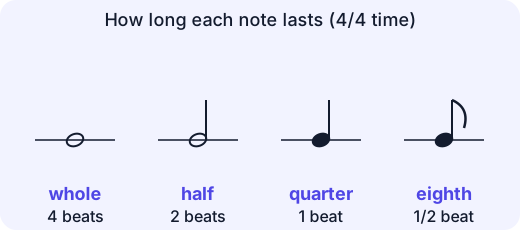
The beats are counted in groups called bars (or measures), divided by vertical lines. Two numbers at the start, the time signature, say how many beats are in each bar. In 4/4 the top number says four beats in a bar and the bottom says the beat is a quarter note. A bar in 4/4 must add up to 4 beats: for example half + quarter + quarter = 2 + 1 + 1.
Putting the two together
Here is the opening tune. If we say that Sa is the note C, the seven notes correspond like this.
Sargam Sa Re Ga Ma Pa Dha Ni Sa (higher) Staff name (Sa = C) C D E F G A B C 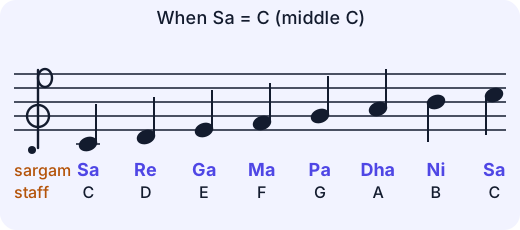
The pattern of steps in this scale is whole, whole, half, whole, whole, whole, half (a whole step is two piano keys, a half step is the very next key). This is the plain, no-flats-or-sharps scale, which is also the C major scale in Western music.
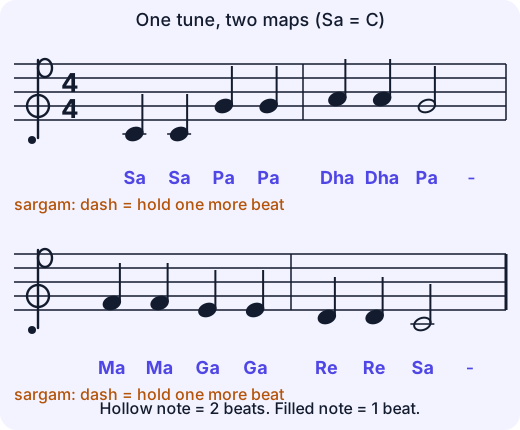
Example. The tune Anjali and Tom both know is the one many people call "Twinkle, Twinkle". In sargam it is:
Beats 1-4 Beats 5-8 Beats 9-12 Beats 13-16 Sa Sa Pa Pa Dha Dha Pa - Ma Ma Ga Ga Re Re Sa - Convert it to staff notation, with Sa = C, step by step:
- Look up each name in the table: Sa = C, Pa = G, Dha = A, Ma = F, Ga = E, Re = D.
- Bar 1 is C C G G, four quarter notes (1 beat each).
- Bar 2 is A A G and then a dash, so the G is held for two beats: a half note.
- Bars 3 and 4 follow the same way: F F E E, then D D C and a dash, with a half note at the end.
- The four bars of 4/4 give 16 beats, one Teentaal cycle.
What changes if the singer's Sa moves?
Suppose a deeper-voiced singer chooses D as Sa instead. In sargam nothing changes: Sa Sa Pa Pa ... The tune is the same relative to Sa. In staff notation every note moves up by a whole step: D D A A B B A, then G G F♯ F♯ E E D, and the staff music now needs two sharps in its key signature. Sargam says where the notes are in relation to Sa. Staff notation says which exact pitches to play. Each map is better at something: sargam is quick for a singer who adjusts to her own voice; staff notation is exact for a group of instruments tuned to the same pitches.
When Sa = C, komal and tivra notes have staff names with flats (♭, one half step lower) or sharps (♯, one half step higher): komal Re = D♭, komal Ga = E♭, tivra Ma = F♯, komal Dha = A♭, komal Ni = B♭.
Common mistakes
- "Sa always means C." No, Sa is wherever the singer places it. We chose C only to compare the maps.
- "Sargam has no rhythm." It does, through the taal marks, the bars and the dashes. Different maps show different things.
- "Hollow notes are quieter." No. Hollow note heads are longer (half or whole notes), not softer.
- "One notation is better." Each was designed for the music and the way of teaching in its culture. Many musicians learn both.
Try it: Hum a short tune you know well. Sing it using "Sa Re Ga" names for its notes if you can, and write its first four notes in sargam. Then sing it again starting from a higher note. Does your sargam change?
Activity
Write a tune in two notations
Compose a short 16-beat tune, write it in sargam in a Teentaal grid and then in staff notation, and have someone else play or sing it back from your page. About 50 minutes.
You'll need
- Paper, pencil, eraser and a ruler
- Something to make notes with, such as your voice, a keyboard, a flute, a xylophone, or 8 same-size plastic bottles with different amounts of water in them
- A phone or other recorder, if you have one
- A friend or family member to read your tune back
Steps
- Plan the tune. A Teentaal cycle has 16 beats in four groups of four. Using only the notes Sa Re Ga Ma Pa Dha Ni, make up a tune: each note takes one beat, and you may use a dash (-) to hold a note for one more beat. Try it out loud. End on Sa so it feels finished.
- Write it in sargam. Draw a grid of two rows, each with two groups of four beats between vertical bars. Write the notes in the cells, with the beat numbers underneath. Put x over beat 1, 2 over beat 5, 0 over beat 9 and 3 over beat 13.
- Make a tuning chart. Let Sa be the note C (on a keyboard, the white key just to the left of the two black keys that sit together). Then Re = D, Ga = E, Ma = F, Pa = G, Dha = A, Ni = B. If you use bottles, add water until the eight bottles sound the notes in rising order from Sa to higher Sa.
- Draw a staff. With the ruler, draw 5 parallel lines about 8 mm apart, and four vertical bars to make four bars of four beats. Write 4 over 4 at the start. Put the treble clef at the start if you can, or write the word 'treble' to remember.
- Convert each sargam note to a staff note using your chart: Sa = C goes on a ledger line below the lowest line, Re = D hanging just under the lowest line (in the gap between it and the ledger line), Ga = E on the lowest line, Ma = F in the first space, Pa = G on the second line, Dha = A in the second space, Ni = B on the middle line. Use filled note heads with stems for one beat, and hollow note heads with stems for two-beat notes.
- Check your count. Each staff bar must add to 4 beats and match the four beats of a vibhag in your grid. Fix any bar that adds up to too much or too little.
- Perform. Play or sing your tune from your sargam grid. Then give both notations to a helper (without telling them the tune) and ask them to play or sing from one of them. Record it if you can.
- Move Sa. Choose a different Sa (for example D), and write the staff notation again. Notice what changes and what stays the same.
Safety
- If using bottles, use plastic ones, not glass, and wipe up any spilled water straight away.
- Keep volume friendly for people nearby, and take breaks if you are singing for a long time.
Keeping a log of the activity is for registered learners. Register to do this.
Quick check
Sargam and staff check
Eight questions. In all of them, unless it says otherwise, Sa is the note C.
1.Sa is C. Which sargam name belongs to the note G?
- Ma
- Pa
- Dha
- Ga
Choose one
2.In a sargam page, a dot under a swara tells the singer to sing it in which octave?
- The lower octave (mandra)
- The upper octave (tar)
- Sing it komal, a half step lower
- Hold it for two beats
Choose one
3.How many beats are in one cycle of Teentaal?
Answer with a number
4.Read these four notes in order, using the treble clef. Which is the sargam?
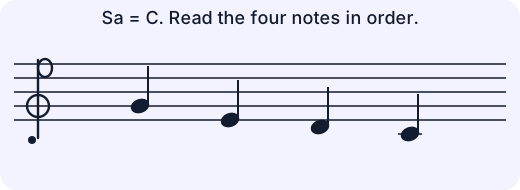
- Pa Ga Re Sa
- Pa Ma Re Sa
- Dha Ga Re Sa
- Pa Ga Sa Re
Choose one
5.This bar is in 4/4. On which beat of the bar does the note G begin?
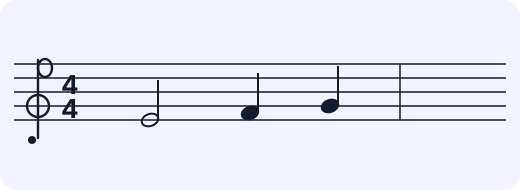
Answer with a number
6.Put these swaras in order from the lowest pitch to the highest, in the middle octave.
- Pa
- Ga
- Ma
- Re
- Sa
Put these in order
7.Match each note to how long it lasts in 4/4 time, where a quarter note is one beat.
- Whole note
- Half note
- Quarter note
- Eighth note
Match each to: 2 beats · Half a beat · 1 beat · 4 beats
8.A singer decides to move her Sa from C up to D and sings the same tune. What changes on the two pages?
- The sargam page stays the same; every note on the staff page moves up by a whole step
- Both pages stay exactly the same
- The sargam page changes to new names; the staff page stays the same
- Neither notation can show this
Choose one
Answering and checking are for registered learners. Register to do this.
Quick check
New puzzles
Use the two notations in situations the reading did not show.
1.A bar in 4/4 holds a half note and a quarter note. The rest of the bar is filled with eighth notes only. How many eighth notes are needed?
Answer with a number
2.Sa is C. Which staff note is komal Ni (Ni sung one half step lower)?
- B flat (B♭)
- B
- A flat (A♭)
- C sharp (C♯)
Choose one
3.A singer chooses D as her Sa. Which note does she sing for Pa?
- G
- A
- B
- E
Choose one
4.A sargam line has one beat per cell and reads: Ga Re Sa - - Pa. For how many beats is Sa held?
Answer with a number
5.Which of these statements about sargam and staff notation are true? Pick all that apply.
- Sargam names notes in relation to Sa, which the singer can place at different pitches
- Staff notation names fixed pitches, so a C is always the same pitch
- Staff notation shows how long each note lasts by the shape of the note
- Sargam cannot show rhythm at all
- Sargam is just a wrong version of staff notation
Choose all that apply
Answering and checking are for registered learners. Register to do this.
Your turn
Two maps of the same music
Write your answers in your own words. You may use your tune from the activity as an example.
- Write this tune in staff notation names (letters and note lengths) with Sa = C, using 4/4 time. The sargam is: Sa Re Ga Sa | Sa Re Ga Sa | Ga Ma Pa - | Ga Ma Pa - (each swara takes one beat; a dash holds the previous note one beat). For each bar say the notes and their lengths.
- Rewrite just the first bar with Sa = D (use the letters of notes only, in order). What stays the same and what changes between the two versions?
- Complete the idea: "Sargam and staff notation are different maps of the same music because ..." Give one thing sargam shows well and one thing staff notation shows well.
How it's judged
- Converting a tune
- Moving Sa
- Explaining the two maps
Writing and submitting your answer is for registered learners. Register to do this.
Like what you see?
Register for free to answer the quick checks, do the activities and save your work. Your work is saved on your device and syncs to your account.